
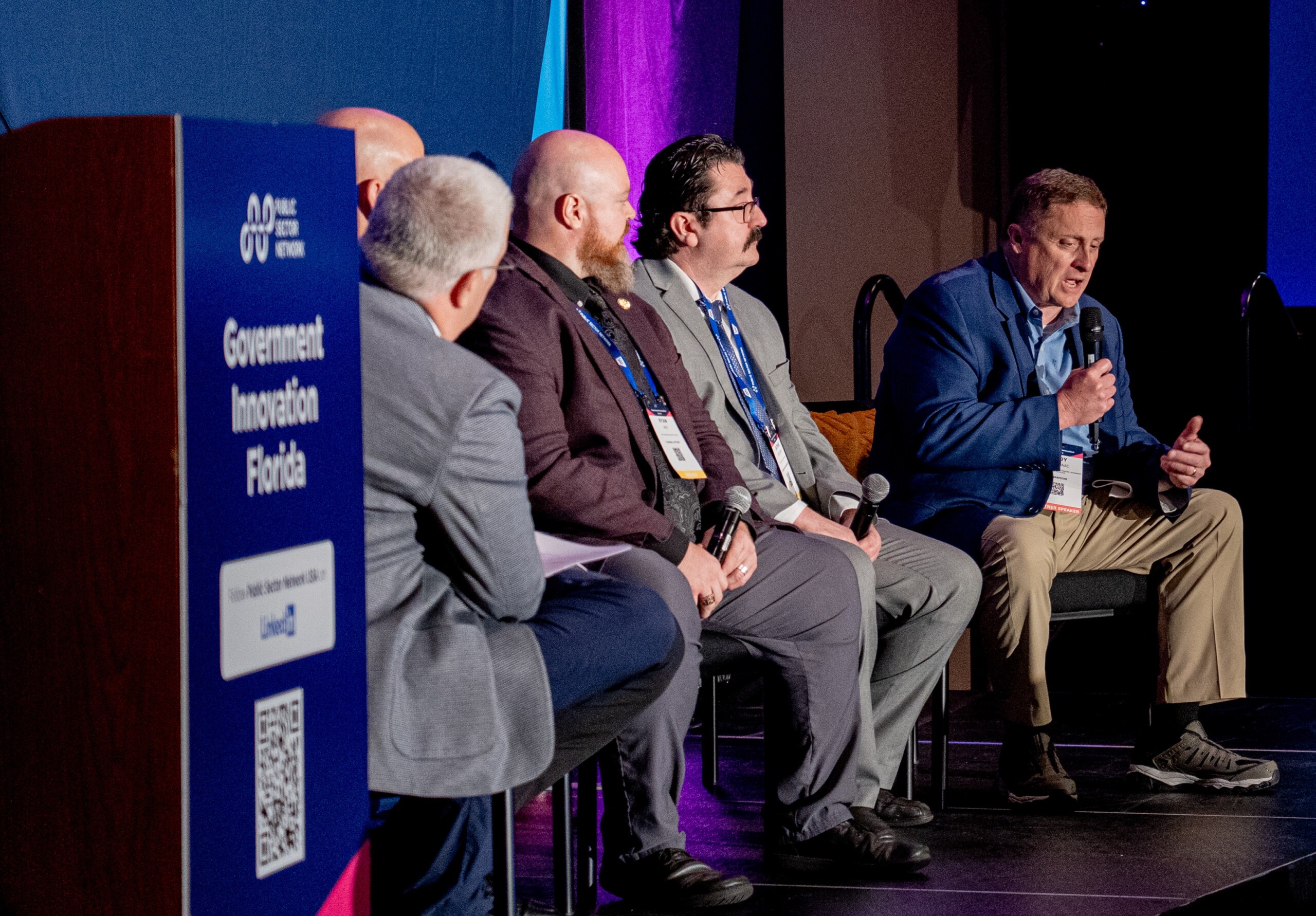
At the Government Innovation Showcase in Florida, state leaders gathered to discuss modernizing services, advancing digital transformation and the importance of cross-agency collaboration. With the theme “From Intent to Impact: Building Florida’s Next Decade of Digital Government”, the event facilitated networking opportunities and provided agency leaders time to hear real-world examples of strategic AI initiatives.
Eric Graham, State Chief Data Officer of Florida Digital Service, delivered the keynote “Preparing Florida for the Next Decade of Digital Government” with a statement relevant for all government leaders:
“AI readiness isn’t actually an AI problem. It’s a data problem.”
That observation gets to the heart of a challenge facing state and local governments today.
For the last decade, government modernization has largely focused on digital transformation. Agencies digitized records, automated forms, moved applications to the cloud and made services available online. Now, as agencies accelerate towards intelligent automation, the role of a secure and trusted data environment becomes foundational. Government agencies must evolve to operate effectively in an AI-enabled world. Florida is evolving its data approach to support enterprise-wide alignment as we enter the era of intelligent government.
Graham offered important insight for AI-driven government leaders: If information is fragmented, AI operates on that fragmentation. If definitions differ between agencies, AI doesn’t scale. If information can’t be trusted, neither can any decisions based on that data.
Small Digital Changes, Big Public Impact
We continued the discussion of AI’s impact on information readiness in a panel called ”Small Digital Changes, Big Public Impact.” Joined by Ryan May, CISO of the Florida Lottery; Arthur Bialowas, CISO of Florida A&M University; and Chris Welch, the Assistant Director/Lieutenant Colonel, Department of Financial Services / Criminal Investigations Division in Florida, we discussed the need to start with impactful use cases in order to find the measurable impact of AI initiatives.
In complex public sector environments, targeted digital workflows can strengthen service delivery and system performance without large-scale disruption. Often, incremental modernization reduces operational and cybersecurity risk while accelerating digital maturity—without disrupting critical services. Florida’s CIO also recently participated in The 2026 NASCIO State CIO Survey | The State CIO in Motion: Priorities, Pressures and Progress, which confirms Florida is on the right path. NASCIO’s survey explores how state CIOs navigate digital services, technology investment governance, AI, IT accessibility and technology. The results confirm Florida’s strategy: 78% of state CIOs reported they adopted an AI governance framework and 77% are using AI in inventory and documenting uses in agencies and applications, an increase from 2025.
Florida, Graham and our panelists are all in agreement: AI investment includes data governance and information readiness.
Any government agency evaluating their own readiness for the era of intelligent government should review their documents and content and ask the following questions:
- Is information accurate and discoverable?
- Is it governed throughout its lifecycle?
- Can employees securely access the right information when they need it?
- Can information move between processes and systems without losing its context?
- Can an agency demonstrate who or what system accessed sensitive information and what they did with it?
- Are audit reviews and cyber protocols integral parts of data governance?
- Those questions become increasingly important as AI moves from experimentation into operational government.
Secure, Holistic, Interoperable, Networked, Ethically Managed and Discoverable
As part of Florida’s emerging data strategy, they’ve also defined the ideal state for data as secure, holistic, interoperable, networked, ethically managed and discoverable—their SHINED principles. This federated approach is built around collaboration, interoperability and shared capabilities.
For years, modernization has largely optimized what happens inside agencies, but intelligent government requires improving what happens between them. Citizens don’t experience a permitting database, document repository, ERP system and workflow application; they experience their interaction. The technology architecture may be fragmented, but the citizen experience cannot be.
Modernize the Information Layer
This is also why modernization doesn’t always have to begin with replacing core systems.
Most Florida agencies have made substantial investments in mission-critical applications such as ERP, financial, permitting and GIS. Those systems contain important data and support essential functions. Now, there are opportunities to make the information surrounding those systems work more intelligently.
Platforms such as Laserfiche can provide an information and process layer across existing environments—connecting content with automated workflows in a governed environment.
Florida’s Justice Administrative Commission offered a practical example at the event. Long before today’s AI conversation, the agency moved away from paper-intensive processes with Laserfiche. When COVID suddenly forced employees to work from home, that digital foundation helped the agency continue to support Florida’s justice system. What looked like document modernization became operational resilience. The same principle applies to AI today.
Keep Pace or Drive Innovation? Build the Foundation Before the Next Technology Arrives
One of the most interesting things I heard in Florida was that the next decade of government won’t be defined by the technologies agencies adopt, but by the institutional capabilities they build. I think that’s exactly right.
AI will change. Models will change. Applications will change. The next breakthrough technology will eventually arrive. Through all the changes, government agencies will still need to take responsibility for protecting constituents’ information and maintaining public trust.
The agencies that lead in the AI era won’t be those that deploy AI first but the ones that can connect information across organizational boundaries, govern it throughout its lifecycle, protect it without limiting its use and turn it into public value.
That’s the foundation of intelligent government.
When a government leader considers the next AI initiative, they shouldn’t ask themselves, “Which AI should be deploy?”
The question should be much simpler:
“Is our information ready?”
If you’re ready to hear the best practices of information readiness and learn how to confidently modernize mission-critical operations with a secure, cloud-based content management platform designed for today’s security and compliance challenges, listen in now.
Published: October 15, 2026