


ARMA International, in partnership with Carahsoft Technology Corp., proudly present the Public Sector InfoGov Summit 2026 – a FREE 2-day in-person event bringing together federal, state, and local government professionals to strengthen information governance across the public sector.
Join policymakers, senior IG leaders, practitioners, and solution innovators for high-impact learning, cross-agency collaboration, and practical strategies that improve compliance, transparency, security, and operational efficiency.
This is a premier event, focusing on strengthening Washington’s technology leadership community by cultivating trusted cross‑sector collaboration, advancing practical learning, and inspiring forward‑looking conversations that improve public outcomes.
This summit brings together IT leaders looking to redefine what’s possible. From scaling AI, simplifying infrastructure to unlocking data-driven decisions and leading with empathy, you’ll explore how to drive meaningful change across people, platforms, and performance – while keeping your organization resilient, agile, and ready for what’s next.
The Government Innovation Showcase Florida offers a unique opportunity for state agencies to highlight their achievements and dive into the strategies that contributed to their success. This event serves as a platform for agency leaders to showcase their innovative approaches and the operational improvements that have enabled them to excel.
By focusing on the methods that helped drive these successes, the summit aims to assist other agency leaders in replicating similar results. Attendees will gain insights into best practices around collaboration, technology, digital transformation, cybersecurity, workforce development, vendor collaboration, and procurement processes that have proven effective in advancing agency missions.
Join your fellow leaders to explore how Florida’s state agencies can continue to support one another in achieving shared goals for the benefit of all Floridians.
The Summer Higher Ed CIO Congress will focus on 75 c-level executives on the technology side of higher education (CIOs, CTOs and VPs of Technology). These leaders are mainly focused on cybersecurity, maximizing student success, and the quality and practices associated with undergraduate, graduate, and professional study at the college/university. Conference sessions will address how technology leaders can improve their institution’s technology programs, support services, and organizational design to drive innovation and help students from all backgrounds succeed.
Bringing together the brightest minds in state and local government, this summit empowers public-sector leaders to explore cutting-edge technologies, modernize operations, and solve pressing challenges. From cybersecurity and AI to data governance and digital service delivery, sessions are designed to spark insight, foster collaboration, and accelerate real-world results. Whether you’re shaping strategy or implementing solutions, the Summit delivers valuable peer connections and actionable guidance to help move your mission forward.
Join us at the Government Innovation Virginia 2026 to explore insights in data management, modernized infrastructure, citizen-focused digital services, digital inclusion, and inter-agency collaboration. This event will highlight Virginia’s innovative approaches and provide a platform for sharing ideas with peers across the state while addressing critical topics such as cybersecurity resilience, responsible AI and data stewardship, and workforce readiness.
This summit brings together IT leaders looking to redefine what’s possible. From scaling AI, simplifying infrastructure to unlocking data-driven decisions and leading with empathy, you’ll explore how to drive meaningful change across people, platforms, and performance – while keeping your organization resilient, agile, and ready for what’s next.
California Baptist University (CBU), a growing private university in Riverside, California, faced a common higher education challenge: relying on paper-based systems that made it difficult to establish a single source of truth for student records.
The registrar’s office at CBU manages all documents related to student academic records and oversees multiple student services, from online course scheduling to withdrawals, reinstatements, policy approvals and academic exceptions. The university relied heavily on fillable PDFs, email attachments and physical student records folders, which resulted in misplaced documents and delays.

Adding to the challenges, many documents moved across departments and required multiple approvals before reaching the registrar’s office for processing. For example, fulfilling substitution requests and student record updates required staff to locate physical files, verify information and route documents between offices for approval. This often took several days to a week or more, especially during busy registration and graduation periods.
With more than 11,000 students and a diverse range of academic programs, maintaining accuracy, regulatory compliance, and responsiveness related to student records was increasingly difficult.
“We depended on paper-based processes that required constant coordination between offices,” said Adam Martinez, assistant registrar. “It created bottlenecks, and errors such as misplaced forms or missing signatures caused delays that affected both staff and students.”
With a mission to serve students with excellence and efficiency while stewarding resources wisely, the registrar’s office needed a more efficient and scalable way to manage and share information. This new system needed to reduce paper handling, automate routine workflows and improve transparency across departments.
Automating and Centralizing with Laserfiche
CBU began its digital transformation nearly a decade ago by adopting Laserfiche to replace paper-based processes in the registrar’s office. Over time, the university has expanded its use of the platform, creating a secure, automated records environment.
“Laserfiche gave us a system where everything lives in one secure, searchable place,” said Rich Simpson, university registrar. “It moved us from just storing documents to truly managing records, complete with automation, routing and lifecycle tracking.”
The first step was to digitize the university’s paper-intensive student records. Staff had previously printed new student records from Salesforce and filed them in hard copy folders.
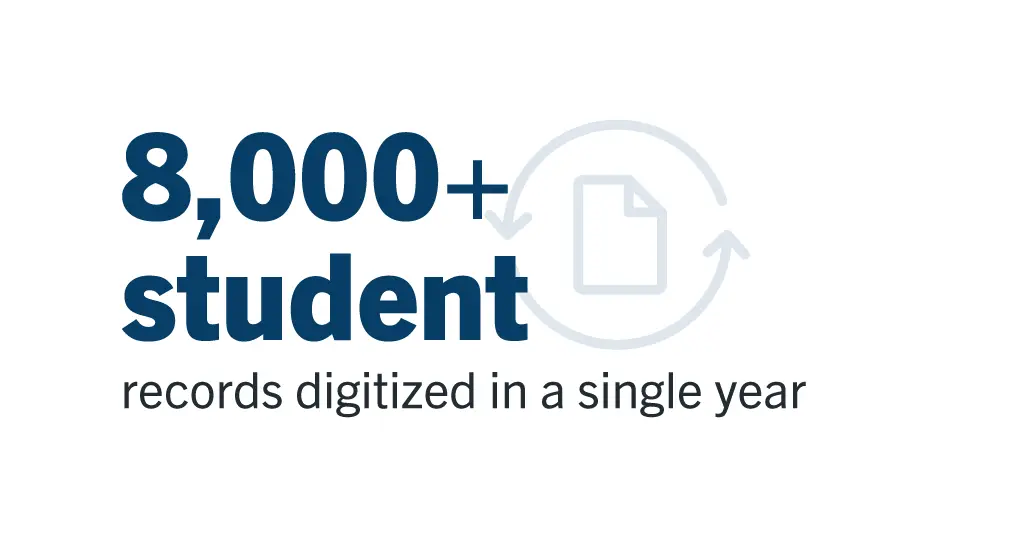
During the transition, an API automatically moved enrollment files from Salesforce to digital student folders in Laserfiche. The team also scanned more than 8,000 existing student records, replacing all physical files with digital versions in a single year.
The registrar’s office then turned its attention to digitizing high-impact workflows such as student record updates, program and major change requests, substitution requests and direct study registrations. Each of these forms previously required multiple handoffs and manual updates between offices.
“It was hard to know if a student’s withdrawal form was sitting on someone’s desk or lost in an inbox,” said Simpson. “Now we can see every stage.”
Laserfiche’s flexibility and ease of use enabled CBU to redefine the management of records and processes across departments. Among the key achievements:
- Automated approvals: Forms now move instantly between advisors, the registrar and students, with built-in routing and notifications. Clear audit trails provide full visibility into every step, for faster, more accurate approvals.
- Smart data capture: Key student information is now automatically extracted and validated from digital forms and uploaded documents. This reduces manual entry, minimizes errors, and ensures data integrity across systems.
- Digital records access: Staff can retrieve any student document within seconds through a centralized, searchable digital repository. This instant access eliminates manual searches through paper files, dramatically improving responsiveness to student and faculty inquiries.
- Compliance confidence: Automated retention schedules and approval workflows help maintain records securely and dispose of them in alignment with accreditation and regulatory requirements. The registrar’s office now operates with greater assurance and audit readiness.
Together, these advancements streamlined day-to-day operations and elevated the university’s overall student and staff service experience. Staff work more efficiently and collaboratively, while students benefit from faster, more reliable support.
Laserfiche’s no-code platform further simplifies complex document processes and approvals. “I’ve built dozens of forms,” said Martinez. “From withdrawals to graduation processes — anything that used to be paper, we’ve turned into a workflow.”
Delivering Results and Empowering Staff
Many requests that required students to print, sign and hand-deliver forms to multiple offices for approval or involved hands-on intervention from staff are now automated, including:
- Directed study form: Automates multiple approvals between students, faculty and deans.
- Withdrawal workflow: Routes through student accounts, financial aid and registrar in real time.
- Course variance and substitution requests: Faculty and chairs can approve electronically with full audit trails.
- Retention alerts: Faculty report student engagement issues via a single form instead of two legacy systems.
- Reinstatement forms: Streamlined coordination between financial aid, student accounts and the registrar for dropped students returning to class.
- Graduation and retention: Automatically stores all active and archived student files with retention set for five years.
“Tasks that once took days or even weeks, such as program or major change requests, substitution approvals, and registration adjustments are now completed in mere hours,” said Simpson. “Our staff no longer waste time chasing signatures or tracking down files. Instead, they’re focused on what matters most: supporting our students.”
Staff report that automation boosted morale by freeing them from repetitive, time-consuming tasks. They can easily monitor progress through dashboards, cutting down on email follow-ups and enabling them to assist other departments in expanding their own automation initiatives. Automation also reduced the potential for human error and data inconsistency.
“Laserfiche completely changed how we work,” said Martinez. “We’ve moved from reactive to proactive, anticipating needs and streamlining every step.”
Looking Ahead: Building on a Culture of Continuous Innovation
CBU’s success with Laserfiche in the registrar’s office created a ripple effect across the university. Departments identified additional paper-heavy and manual processes — ranging from accounting requisitions and HR student worker forms to facilities access and key requests — to further enhance the campus experience.
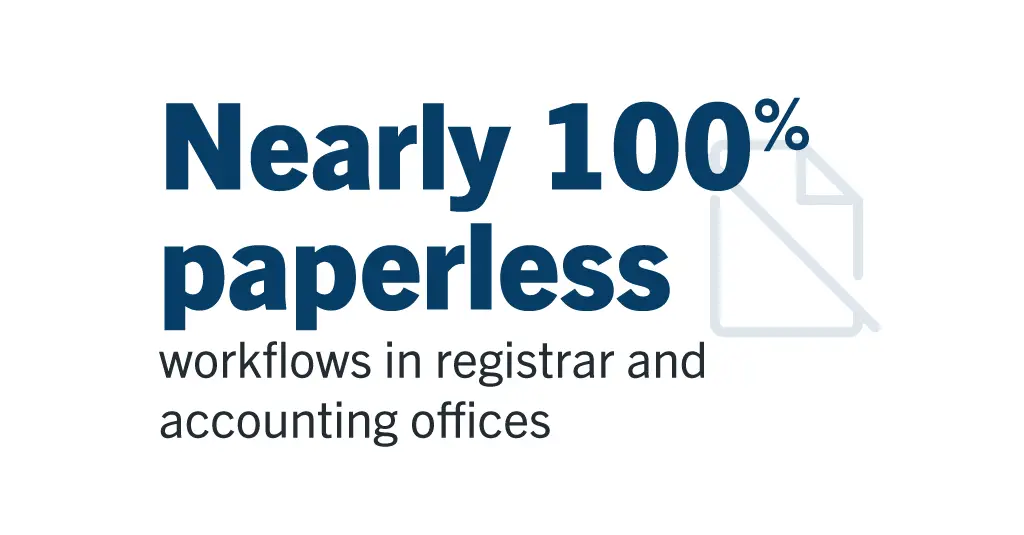
The registrar and accounting offices are now nearly 100% paperless and CBU is planning deeper integration with the university’s new Banner student information system.
“The beauty of Laserfiche is that it grows with us,” said Simpson. “We started with records management, but the platform’s capabilities mean we can continue to improve and innovate campus wide.”
“Laserfiche helped us redefine what’s possible,” added Martinez. “We’re building a foundation for a more connected, efficient and student-centered future that continues to evolve with every new process we automate.”