Laserfiche self-hosted includes a host of integration tools that you can leverage to connect external third-party systems to your automated Laserfiche solutions. Learn how to use web requests and database connections to tap into data in another system to streamline and simplify your Laserfiche automated processes. In this session, you’ll learn how to:
Create database connections in Workflow and Forms to retrieve and update information in third-party systems
Configure HTTP Web Request and Read JSON activities to connect with a third-party API platform
Build automated integrations with third-party applications while considering best practices
Laserfiche Cloud includes a host of integration tools that you can leverage to connect external third-party systems to your automated Laserfiche solutions. Learn how to use web requests, direct database connections, and lookup tables to tap into data in another system and streamline your automation. In this session, you’ll learn how to:
Create lookup tables to store data within Laserfiche Cloud
Configure Web Service Connections and Web Request Rule activities to connect with a third-party API platform
Connect databases directly to your Forms and Workflows to streamline automated processes
Laserfiche named a Leader for the second consecutive time based on its Completeness of Vision and Ability to Execute.
LONG BEACH, CALIFORNIA, MAY 5, 2026 — Laserfiche — the leading SaaS provider of intelligent content management — has been positioned as a Leader in the 2026 Magic Quadrant for Document Management. Laserfiche believes this recognition underscores the company’s commitment to empowering organizations to transform complex, operational business processes through AI-powered content management.
“It’s incredible to see Laserfiche recognized during the same week as our annual Empower conference, where we announced our latest agentic AI capabilities,” said Thomas Phelps, senior vice president of corporate strategy and chief information officer at Laserfiche. “We believe being positioned as a Leader — and receiving the highest overall rating among 16 vendors in Gartner Peer Insights, with a 4.7 out of 5.0 based on over 1,300 reviews as of April 30, 2026 — reflects our relentless focus on product innovation and delivering value to our customers.”
As the document management market continues to evolve and expand, the ability to bridge the gap between static content and actionable enterprise intelligence has become a defining competitive advantage. In the report, Gartner noted, “A key challenge for organizations is harnessing the potential of unstructured data (content) using AI, while simultaneously mitigating risks through robust control and governance.”
Governance-first AI Innovation
Laserfiche continues to accelerate its product capabilities to meet the demands of modern IT environments, focusing on features that turn structured and unstructured content into an enterprise asset. These features prioritize the rigorous information governance, security and compliance standards required by the world’s most demanding industries, including government, financial services and manufacturing.
The platform now features advanced AI-enabled data extraction via Smart Fields, the Smart Chat AI assistant, improved metadata experiences, and enhanced data lookups, all designed to optimize content, making it structured, accessible and ready for AI consumption.
The company’s roadmap includes the expansion of Laserfiche AI Agents functionality including the ability to embed agentic tasks directly into workflows, and the ability to run Agents in the background, monitoring the system for the specified conditions and then completing tasks ambiently. Laserfiche will also introduce additional security advancements in Q3 of 2026. These updates will further solidify Laserfiche’s ability to support highly regulated industries with secure, governed AI deployment.
“Laserfiche has served as the backbone of our finance operations for years, delivering the stability and granular governance we require for our critical documentation,” said Desiree Champaco, VP of information technology and supply chain at Diamond of California. “As Diamond optimizes how we work with suppliers, production partners and customers, Laserfiche’s AI capabilities will play a larger role in how we capture, deliver and leverage accurate, reliable data.”
“As a Top Digital City, Scottsdale is dedicated to using world-class technology to provide our residents with a responsive, modern experience,” said Bianca Lochner, chief information officer for the City of Scottsdale. “Laserfiche has been a collaborative partner in our digital evolution, providing a secure framework to transform complex data into better citizen services. This innovation helps us to continue to scale operations and deliver on our mission of excellence for our community.”
Empowering Modern Enterprises with High-Impact, User-Centric Solutions
Gartner® Peer Insights™ captures customer experience with Gartner-verified ratings and reviews. As of May 5, 2026, Laserfiche reviews include the following:
“Laserfiche transformed the way we worked, it provided the possibility to unify our Financial Services into one site and one set of work standards. Support has been great when I have had issues I could not solve on my own.” — Senior Finance Manager in Manufacturing [read full review]
“Laserfiche is an incredibly robust Forms solution that allows us to provide innovative automated processes and to improve existing legacy business processes. We have been thrilled with this product.” IT Manager in Healthcare and Biotech [read full review]
Gartner, Magic Quadrant for Document Management, Tim Nelms, Jed Cawthorne, Marko Sillanpaa, Rachel O’Farrell, Stephen Emmott, 30 April 2026
Gartner, Voice of the Customer for Document Management, Peer Contributors, 2025, 25 June 2025
This graphic was published by Gartner, Inc. as part of a larger research document and should be evaluated in the context of the entire document. The Gartner document is available upon request from Laserfiche. Gartner, Magic Quadrant and Peer Insights are trademarks of Gartner, Inc. and/or its affiliates. Gartner Peer Insights content consists of the opinions of individual end users based on their own experiences, and should not be construed as statements of fact, nor do they represent the views of Gartner or its affiliates. Gartner does not endorse any vendor, product or service depicted in this content nor makes any warranties, expressed or implied, with respect to this content, about its accuracy or completeness, including any warranties of merchantability or fitness for a particular purpose.
About Laserfiche Laserfiche is a leading enterprise platform for document management and content-centric workflow automation. Through scalable workflows, forms, no-code templates and AI-enabled capture, the Laserfiche® platform accelerates how business gets done.
Laserfiche pioneered the paperless office with enterprise content management. Today, Laserfiche’s cloud-first development approach incorporates innovations in machine learning and AI to enable organizations globally to transform into digital businesses. Customers in every industry — including government, education, financial services, healthcare and manufacturing — use Laserfiche to boost productivity, scale their business and deliver digital-first customer experiences.
Laserfiche employees are committed to the company’s vision of empowering customers and inspiring people to reimagine how technology can transform lives.
New agentic AI capabilities allow any user to automate intelligent, multi-step workflows using natural language.
LAS VEGAS, NEVADA, April 28, 2026 — Today at the Laserfiche Empower conference — the premier event for intelligent content management —Laserfiche announced the release of AI Agents. With simple, natural language prompts, these virtual assistants perform complex, multi-step tasks and work within the framework of Laserfiche’s robust security and compliance controls, transforming how you interact with your organization’s information.
Laserfiche AI Agents leverage advanced generative AI reasoning models to perform tasks that bridge the gap between building workflows and time-consuming manual effort. They can take actions based on document data and execute bulk changes from natural language user instructions.
“The introduction of AI Agents to content management signals a shift in how we handle the information lifecycle,” said Karl Chan, CEO of Laserfiche. “We are moving beyond manual processes by offloading mundane work to Agents that operate within a governance framework. We are enabling organizations to modernize operations while keeping compliance at the forefront.”
To celebrate the launch of Laserfiche AI Agents at Empower, Agents are available exclusively for all conference attendees who use Laserfiche Cloud and their organizations. Agents will be generally available for users of Laserfiche Cloud on May 7, 2026.
Introducing Laserfiche AI Agents
Accessible through Smart Chat — an intuitive AI-powered chat interface in the Laserfiche repository — Agents inherit the specific permissions and access restrictions of the initiating user. This upholds Laserfiche’s rigorous security and governance standards, enabling teams and users of all technical levels to save time and scale output by safely automating their own solutions.
By combining AI-powered content analysis with intelligent Agents, organizations can identify conditions in their documents and take impactful actions across departments, including:
Legal: Surface inconsistencies in contracts — such as missing or conflicting metadata — and route them for legal review.
Human resources: Identify demographic information in personnel records and move those documents to folders with different security settings.
Accounts Payable: Identify overdue invoices and route them for follow-up and resolution.
Users across industries can use Agents to reduce the burden on IT resources and process designers. Some common industry use cases include:
Government: Accelerate public records requests by flagging documents that may require exemption or legal review and routing them to the appropriate teams.
Education: Identify documents containing PII and apply security tags to protect sensitive information.
Financial services: Support internal data handling policies by identifying compliance signals and routing exemptions for review.
Manufacturing: Flag quality-related issues in inspection reports and identify incidents for investigation and resolution.
Transform Records Management with AI Agents and Search
With their ability to intelligently filter content from across the repository and take context-aware actions, Laserfiche AI Agents will also reshape how users search for and organize information.
“In the future, the ‘where’ of document storage is not going to be as important as it used to be,” said Justin Pava, Laserfiche chief product evangelist. “With automatically-extracted metadata, AI-assisted search and the autonomous capabilities of Laserfiche AI Agents, you won’t have to spend time organizing data, you will be able to simply act on it.”
Upon launch, users will be able to direct Agents to perform one-time actions from within Smart Chat. Subsequent updates will expand Agents’ capabilities to include running repeated processes on-demand, embedding Agents in business processes, and enabling Agents to run in the background, monitoring the system for the specified conditions and then completing tasks ambiently while your team works on other high-priority projects.
Laserfiche is the leading enterprise platform that helps organizations digitally transform operations and manage their content with AI-powered solutions. Through scalable workflows, customizable forms, no-code templates and AI-enabled capabilities, the Laserfiche® document management platform accelerates how business gets done. Trusted by organizations of all sizes — from startups to Fortune 500 enterprises — Laserfiche empowers teams to boost productivity, foster collaboration, and deliver a superior customer experience at scale. Headquartered in Long Beach, California, Laserfiche operates globally, with offices across North America, Europe and Asia.
The Harris Center for Mental Health and IDD serves tens of thousands of people in need of mental health services across all socioeconomic levels in Harris County, Texas. As the third-largest organization serving such needs in the United States, the center prides itself on providing high-quality, efficient and cost-effective services that impact every corner of the county.
The Harris Center previously relied on manual processes to handle administrative and operational workflows. This method led to inefficiencies: Documents were frequently misplaced; there was no visibility into process status, and the lack of trackable data created challenges in securing funding.
The IT team at the Harris Center leveraged Laserfiche to replace manual processes with Laserfiche Forms and process automation. “After evaluating several collaboration and content management platforms, we selected Laserfiche as our solution of choice due to its flexibility, scalability, user-friendly interface, and robust security features,” said Chief Information Officer Mustafa Cochinwala. “Laserfiche offers powerful workflow automation, seamless integration capabilities with our existing systems, and a strong compliance framework that aligns with our organizational and regulatory requirements.”
The Harris Center has since automated 90 tasks, with 171,267 submissions using Laserfiche Forms, significantly reducing the time it takes to complete processes by up to 99%. Additionally, the center consolidated data, enhanced executive reports, improved decision making, and strengthened document security.
Tackling Manual Tasks
The Harris Center aimed to significantly reduce manual, repetitive tasks with Laserfiche, addressing inefficiencies including inaccurate data, security, and resource allocation.
A game-changer for the center was the digitization of the low-level offender intake form. Previously, the organization required police officers to fill out paper forms on clipboards. This approach — fraught with handwritten notes and misplaced documents — compromised the accuracy and security of sensitive patient information.
The Information Technology team created a Laserfiche workflow to relieve staff from having to interpret handwriting, chase down information and re-enter data. As part of the solution, an intuitive digital intake form collects complete, consistent information — such as patient health background and situation — from law enforcement partners.
The Harris Center staff have since seen a dramatic improvement in their ability to quantify these services and measure their impact.
“The shift has enhanced operational efficiency and elevated the quality and reliability of our reporting — empowering us to serve our community with greater precision and accountability,” said Anthony Jones, director of information technology applications and development for The Harris Center.
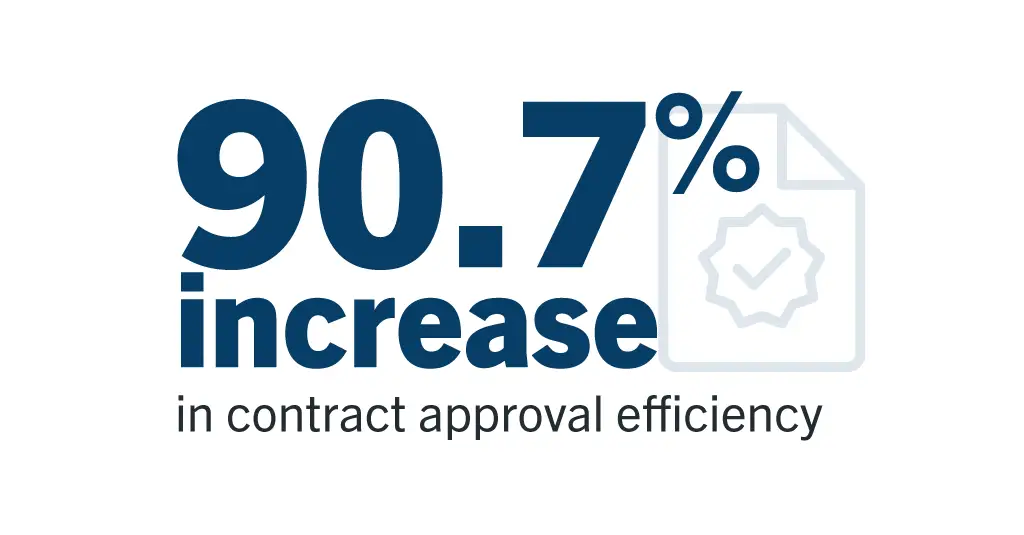
This efficiency can also be seen in the center’s contract approval process. Previously, it took 30 to 90 days to gather vendor information for contract approval from Leadership. The approval timeframe was reduced to an hour by using a Laserfiche Form for gathering information and approvals. The center saved approximately 479 working hours in this process, a 90.7% increase in efficiency.
“Overall, the adoption of Laserfiche has not only improved efficiency but also provided a strong financial return on investment for our organization,” said Jones.
Secure and Seamless Legal Processes
Beyond patient intake and contracts, The Harris Center has also implemented Laserfiche for legal processes. When courts send magistrate orders to the center, they expect responses within 24 to 48 hours.
The legacy process relied on manual routing, either through email or hand delivery. Staff had to print out, scan, sign, scan again, and return paper forms. And because of the strict deadlines, these orders often felt like an unwelcome fire drill. Now, an automated process delivers magistrate orders to the relevant staff members in Laserfiche, so staff can provide the necessary information digitally. To satisfy a legal requirement for signatures, staff use a signature pad to sign the form, which is then sent back to the court through an SFTP folder.
“The process was a mess before. Using a Laserfiche form — the difference is night and day,” said Jones. “Laserfiche has improved our court order handling, moving from a clunky email system to a seamless electronic process integrated with Epic.”
The solution is one of many examples of how optimized data management has greatly enhanced productivity across the organization.
“Laserfiche has delivered significant cost savings through reductions in manual processing time, operational inefficiencies, and paper-related expenses,” explained Jones. “By automating workflows and replacing outdated manual processes, the organization has realized over 50 hours of weekly savings.”
Easier Processes Enhance the User Experience
While forms have enabled faster processes, Laserfiche has also supported The Harris Center’s budget goals. The State of Texas requires health staff across the state to participate quarterly in the Medicaid Administrative Claims (MAC) survey. The MAC survey is critical in assisting states to secure federal reimbursement for certain Medicaid administrative activities. For The Harris Center, the survey aids in recovering costs for behind-the-scenes work, not related to medical services, that support Medicaid.
Before Laserfiche, the survey was conducted through SharePoint, which required staff to enter their employee ID and lacked tracking capabilities. Consequently, only 55-60% of staff completed the survey.
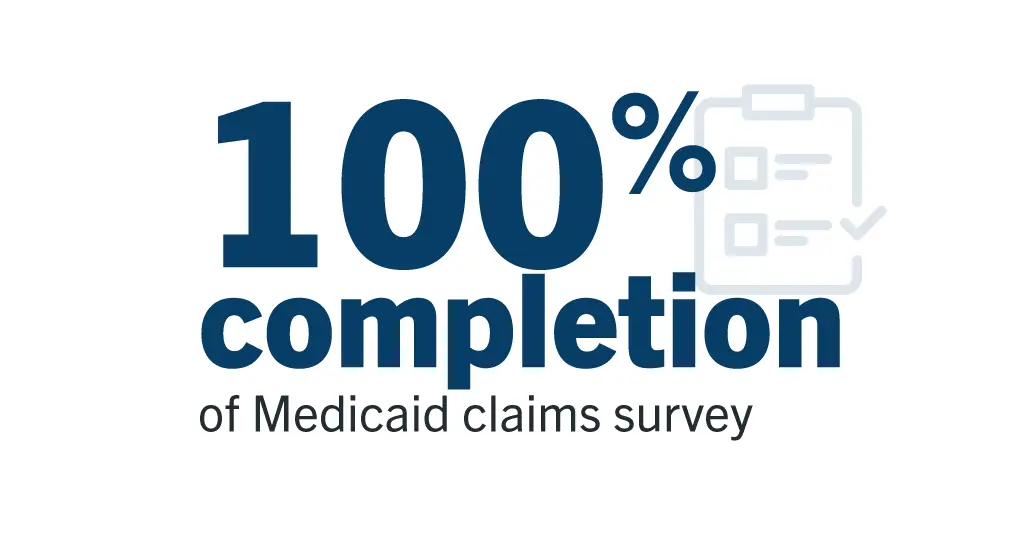
Using a Laserfiche Form, staff no longer need to waste time searching through their notes for their ID: Laserfiche auto-populates the information and tracks all submissions. As a result, the center increased the completion rate to 100%.
The center also uses Laserfiche Forms to consolidate previously scattered information and enhance the organization’s reporting. With Laserfiche Forms and supplemental Power BI reports, the organization now has a full overview of its processes in one secure location. “These reports allow us to have all the comprehensive information in one place and to make operational decisions from that data,” explains Jones. “We use these reports in an operational capacity daily. From top to bottom, dealing with patient care, employee care and daily operations.” Clinical activity, for example, is tracked by combining Laserfiche and EHR data to support the patient census and enable better resource allocation.
The Hunt for Manual Processes Continues
The center continues to redefine organizational workflows and transform outdated manual tasks into streamlined systems with Laserfiche. The team has seen dramatic improvements in their daily workflows and strategic planning. Task delegation ensures departmental accountability. Process automation expedites services. Data tracking enables meticulous documentation for enhanced reporting. Laserfiche repository security controls support compliance with industry standards and regulatory requirements.
The organization’s vision for Laserfiche is to drive further enhancements in operational processes. “We’ve done a lot of good things with Laserfiche forms since we went live with Laserfiche,” said Jones. “I’ve asked my team, if there’s any manual processes out there, let’s address it and automate it. Laserfiche allows employees to help people behind the scenes. If we did not support the people that help people, they would not be as successful as they are.”
The Laserfiche Run Smarter® Awards celebrate the visionaries and trailblazers who are redefining the possible, using Laserfiche to dismantle operational silos and catalyze a new era of enterprise-wide productivity. These winners are enhancing productivity, reimagining processes and improving lives with Laserfiche technology.
From municipal governments slashing process times by 92% to retail giants unlocking data from millions of invoices, the 2026 winners represent the gold standard of operational excellence. These organizations are reimagining what’s possible when technology and human ingenuity collide. Here is how this year’s elite class of innovators is redefining the way the world works:
Nien-Ling Wacker Visionary of the Year:
Doug Haubert, City Prosecutor, Long Beach City Prosecutor’s Office
Doug Haubert has provided visionary leadership for the Long Beach City Prosecutor’s Office through championing the GUIDES program (Government User Integrated Diversion Enhancement System). By using Laserfiche to turn siloed records into real-time, actionable intelligence, Haubert supports Long Beach officers in addressing complex social issues — from gang violence to mental health — with unprecedented precision and empathy. This digital ecosystem fosters seamless collaboration between law enforcement and service providers, shifting the focus from arrests to high-impact intervention. The result has been a measurable reduction in crime, faster access to critical social services, and a strengthened foundation of community trust.
Digital Transformation Leader of the Year:
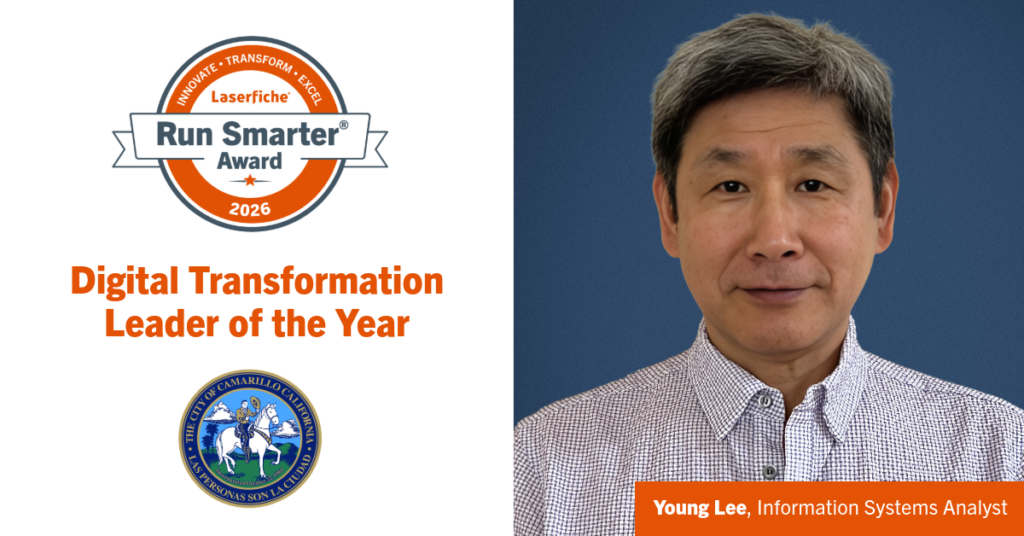
Young Lee, Information Systems Analyst, City of Camarillo, California
Under Young Lee’s leadership, the City of Camarillo transformed a daunting year-end HR and payroll marathon into a sprint. By fostering cross-departmental collaboration and launching a citywide workflow initiative, Lee’s upgraded automated workflow slashed processing time from 50 hours to just four — a staggering 92% increase in efficiency. This digital overhaul didn’t just eliminate administrative bottlenecks; it created higher accuracy and empowered staff to trade manual data entry for community impact. Lee proves that with the right workflow, administrative burdens vanish, delivering a clear ROI and better citizen service.
Laserfiche Champion of the Year:
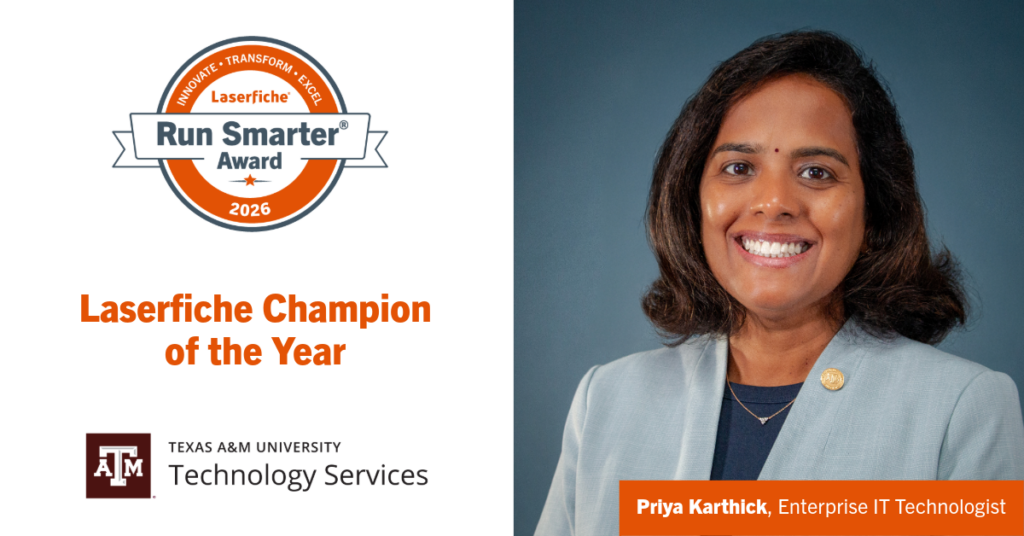
Priya Karthick, Enterprise IT Technologist, Texas A&M Technology Services
As a dedicated Laserfiche Champion, Priya Karthick has moved beyond simple implementation to true advocacy, mentoring peers and spearheading enterprise-wide Laserfiche initiatives that redefine the higher education experience. From automating complex onboarding processes to founding vibrant user groups, Karthick’s work ensures that hiring managers and new employees alike benefit from a seamless, digital-first environment. Her commitment to knowledge-sharing and community building has turned Texas A&M into a beacon of efficiency, proving that digital transformation is most powerful when it’s collaborative.
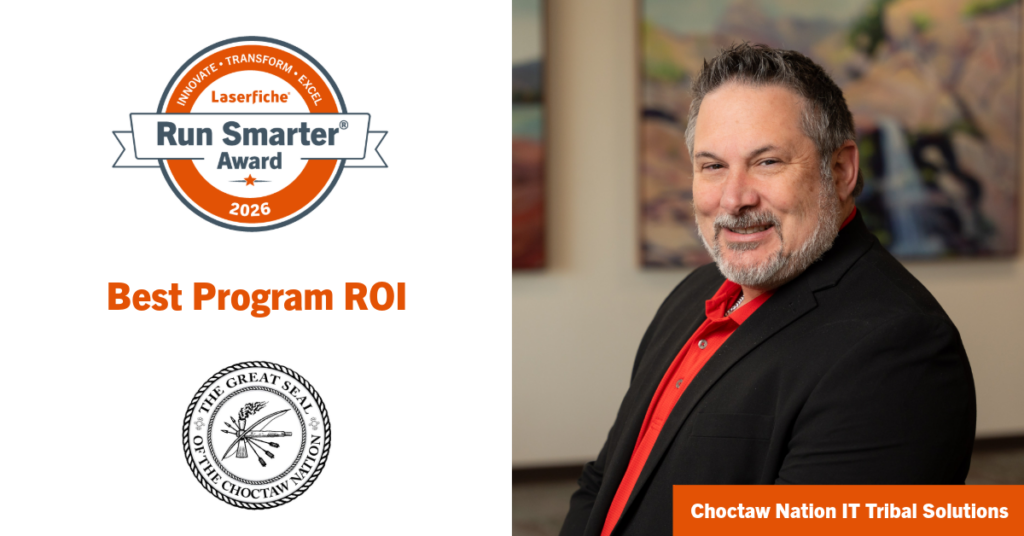
Best Program ROI:
Choctaw Nation IT Tribal Solutions
The Choctaw Nation is redefining how a tribal government serves its people. Since 2017, the organization has automated 111 distinct programs, turning what was once a months-long application process for tuition and emergency aid into a streamlined experience taking under two weeks. The impact is staggering: an 87% drop in incomplete submissions and over 107,000 staff hours reclaimed in a single year — a productivity boost valued at $3.76 million. By eliminating manual bottlenecks and saving $250,000 annually in administrative costs, the Choctaw Nation is proving that digital maturity isn’t just about efficiency; it’s about providing faster, more reliable support to every tribal member.
Palo Alto Unified School District Information Services
The Palo Alto Unified School District (PAUSD) turned a cloud migration into a complete operational rebirth. Through “Implementation 2.0,” the district upgrated to Laserfiche Cloud, choosing to rebuild critical business processes from the ground up rather than simply digitizing old habits.
By mastering APIs and modern data connectors, PAUSD successfully integrated Laserfiche with its student information system, automating everything from substitute teacher provisioning to enrollment. This shift has transitioned the IT team from “infrastructure maintenance” to strategic innovation partners. Through this effort, the team has affected profound cultural change where departments across fiscal, HR, and student services now collaborate to eliminate manual data entry and prioritize student success.
The team at Kansas State University aims to set the standard for inspiring learning and engagement for their over 21,000 students. Laserfiche has supported that mission by transforming student services through intelligent automation. By automating a process for academic program changes, the university now processes 85% of requests in under a day, and has reclaimed over 49,000 staff hours. This transformation not only enhances student experience but also strengthens operational efficiency and responsiveness.
Guernsey-based AlbanyTrustee turned its “Project Paperless” into a blueprint for modern fiduciary services. By embedding Laserfiche into the heart of operations, the firm transitioned from static spreadsheets to real-time visibility, ensuring that data integrity and compliance are built directly into their daily workflows. The results go beyond simple time savings; the organization has achieved structured AI adoption, driving higher accuracy in document creation and process analytics. By automating repetitive filing, Albany Trustee has empowered its team to focus on high-value client service. This transformation goes beyond streamlined operations and has sparked a culture of innovation where staff are digitally confident and actively seeking the next technological frontier.
Laserfiche Team of the Year:
City of Tucson Department Applications Team
The City of Tucson transformed digital compliance into a community asset. Facing upcoming federal requirements, the city’s Laserfiche team proactively overhauled 335 public-facing production forms to support full accessibility and ADA compliance, bridging a critical gap in resident services. Through rigorous research and a structured deployment strategy, the city eliminated screen reader errors and improved usability for all residents — all without additional software investments or vendor intervention. This initiative set a new standard for inclusive governance. By prioritizing dignity and access, Tucson has ensured that every citizen can navigate city services with ease and confidence.