
The most useful AI experiences are the ones that fit naturally into the systems and workflows employees already use every day. That’s where AI moves beyond isolated tasks and becomes part of how operational work actually gets done.
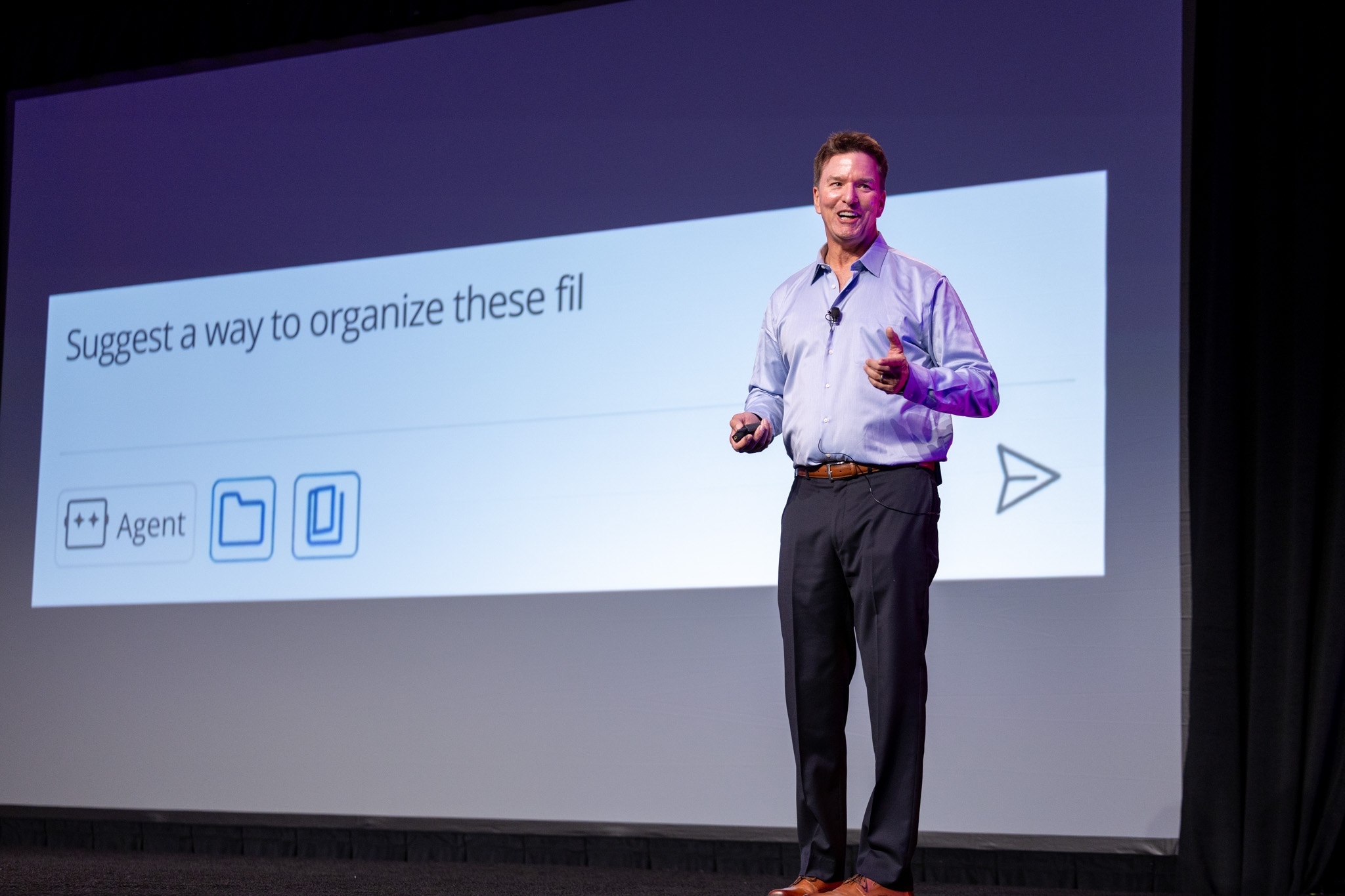
At Empower 2026 — Laserfiche’s premier annual conference— we introduced Laserfiche AI Agents, new virtual assistants designed to help teams bridge the gap between manual work and traditional automation. Using the Smart Chat interface in Agent mode, these digital coworkers tap into advanced generative AI reasoning models to analyze content and take meaningful action, all within the secure, governed environment of the Laserfiche repository.
Here’s what that looks like in practice.
Offload Tedious Tasks to AI Agents: Reorganize, Classify, Identify and Extract
Because so much work still gets stuck between manual effort and full automation, teams are often left managing repetitive operational tasks that don’t quite justify building a dedicated workflow. As anyone handling records at scale can tell you, that work multiplies quickly when policies or compliance requirements change, or large sets of records need to be reorganized.
One example we demonstrated at Empower involved the new California Senate Bill 513 (SB 513) that expanded the definition of personnel records to include employee training and education materials. For HR teams, that seemingly small change can create hours of tedious administrative work, from reviewing records to creating new folder structures to moving documents into the right employee files.
With Laserfiche AI Agents, an HR manager can simply use natural language prompts to tell Agents to move training records into matching employee personnel folders and create a new Training and Education subfolder. The Agent analyzes the request, recommends actions and carries out the work while still allowing the manager to review and approve each step before moving forward. With intelligent content management, tasks that previously required hours of manual effort can now be completed in seconds.
That same approach can help simplify a wide range of everyday work across departments:
- Reorganizing records and metadata based on updated business policies or compliance requirements
- Classifying incoming documents and automatically routing key business information into workflows and business systems
- Identifying sensitive information that may require additional review or governance controls
- Extracting action items, deadlines and responsibilities from unstructured emails or documents
- Improving knowledge discovery through semantic search that understands context, meaning and intent
Individually, these tasks might seem incremental, but together, they can dramatically improve how work moves through an organization.
Smarter Search for Instant Discovery
The first step in moving work forward is being able to find the right information quickly. Anyone who’s spent time digging through repositories and shared drives knows how frustrating this can be. Most organizations have enormous amounts of information spread across repositories and business systems, but finding what you need often depends on knowing precisely where to look.
Laserfiche’s agentic semantic search helps change that experience. Employees can search based on concepts, intent or meaning rather than relying entirely on exact keywords. For instance, a user can instantly surface vendor agreements related to “indemnification,” even if the document only uses terms like “liability” or “damages.”
The real-world speed of these capabilities was on full display at Empower. Business users configured AI prompts and extraction rules in minutes using natural language instructions instead of traditional technical configuration methods. In one internal onboarding demonstration, AI-powered document and metadata management reduced manual data capture work by 90%.
That accessibility empowers the employees closest to operational bottlenecks to solve them directly, allowing organizations to adapt instantly without waiting for IT support.
None of this works without trust. Laserfiche AI Agents prioritize human review, transparency and auditability, giving organizations total visibility. Agents strictly inherit your existing user permissions and governance policies, so you stay in control of every action.
The Next Phase of Autonomous AI Agents
The next phase of Laserfiche AI Agents will be even more dynamic, context-aware, and autonomous. Today, they help users complete one-off tasks interactively through natural language requests. Soon, process agents will seamlessly embed into existing workflows, replacing complex decision trees—like invoice approval routing—with intelligent automation.
The next evolution of Laserfiche AI will introduce background agents that run autonomously in the background to monitor repositories for specific business signals. For example, a marketing manager can task an agent with tracking files for a specific campaign. Using contextual reasoning rather than rigid keywords, the agent will automatically identify relevant documents the moment they are published and curate them for the team. Information actively helps move work forward rather than sitting inside siloed systems.
At its best, AI should help organizations reduce operational friction, adapt more quickly and give employees more time to focus on meaningful, high-value work. That vision shaped many of the conversations we had at Empower this year, and it continues to guide how we think about the future of work at Laserfiche.
Read more about What’s New with Laserfiche AI Agents or download our new eBook to discover how to drive digital transformation and operational efficiency using AI.
Published: June 12, 2026