


- Nearly half of employees are entering company-related information into public AI tools to complete their tasks and hiding their AI use, out of fear of seeming lazy, risky, or non-compliant
- 1 in 10 employees describe AI adoption in their workplace as “the Wild West,” unregulated, unclear, and out of control
LONG BEACH, CALIFORNIA, August 13, 2025 — Laserfiche, the leading SaaS provider of intelligent content management and business process automation, today released new survey findings on AI adoption in the workplace, revealing that nearly half of Americans (49%) who use AI at work keep it to themselves, with 15% deliberately avoiding telling their manager.
As AI tools become more embedded in daily life, the survey reveals a workplace reality that is far less aligned. While many employees are eager to harness AI to boost productivity, inconsistent policies and cultural hesitation are fueling secrecy around AI adoption at work. Employees who are hiding their AI use worry it will be seen as lazy (16%), risky (15%), or out of step with company policy (16%).
A Mixed Workforce Mood
Employee sentiment around AI remains divided. While 21% are optimistic, and 22% say AI already helps them work faster or more efficiently, others are more cautious. Nineteen percent are skeptical, citing concerns about accuracy or misuse, and 13% are anxious or resistant, uneasy about the risks and consequences of incorporating AI into their workflows.
Younger generations are more optimistic about AI at work: 24% of Gen Z and 20% of Millennials say they see its potential but are still learning how to use it, compared to just 10% of Baby Boomers.
A New Frontier — with New Risk
Only one in three employees (36%) say their workplace has clear policies and approved AI tools in place. Meanwhile, 1 in 10 describe their organization’s AI environment as “the Wild West,” an unregulated space where people do what they want.
That lack of structure has consequences. Nearly half of employees (46%) admit to pasting company information into public AI tools, such as ChatGPT or Google Gemini, sometimes without knowing if the content is sensitive or confidential. Many turn to these tools in an attempt to gain a competitive edge (24%) or because their company’s own tools are too limited or hard to use (23%).
Older employees are significantly more cautious about using unofficial AI tools at work: 69% of Baby Boomers and the Silent Generation, and 35% of Gen X, avoid these tools, compared to just 21% of Millennials and 17% of Gen Z.
The Path Forward: Build Culture Before Crisis
These findings highlight a growing AI governance gap. Usage is outpacing policy, and fear is replacing transparency. To solve this, organizations must do more than roll out AI tools. They need to foster a culture where employees feel informed, supported, and aligned on how and when to use them.
“When employees feel like AI is their ‘dirty little secret,’ that’s not a tech problem, it’s a leadership one,” said Karl Chan, CEO of Laserfiche. “Many employees are eager to embrace AI to work but often resort to unofficial tools when company-approved options are too limited or difficult to use. Innovative organizations can meet employee needs and unlock new potential by implementing guidelines, and adopting IT-vetted, intuitive AI tools that help employees reach productivity goals.”
Methodology
The survey was conducted by Veridata Insights and commissioned by Laserfiche. It included 1,000 U.S.-based individuals aged 18 and over, census-balanced by age and gender.
About Laserfiche
Laserfiche is a leading enterprise platform that helps organizations digitally transform operations and manage their content with AI-powered solutions. Through scalable workflows, customizable forms, no-code templates and AI-enabled capabilities, the Laserfiche® document management platform accelerates how business gets done. Trusted by organizations of all sizes — from startups to Fortune 500 enterprises — Laserfiche empowers teams to boost productivity, foster collaboration, and deliver a superior customer experience at scale. Headquartered in Long Beach, California, Laserfiche operates globally, with offices across North America, Europe, and Asia.
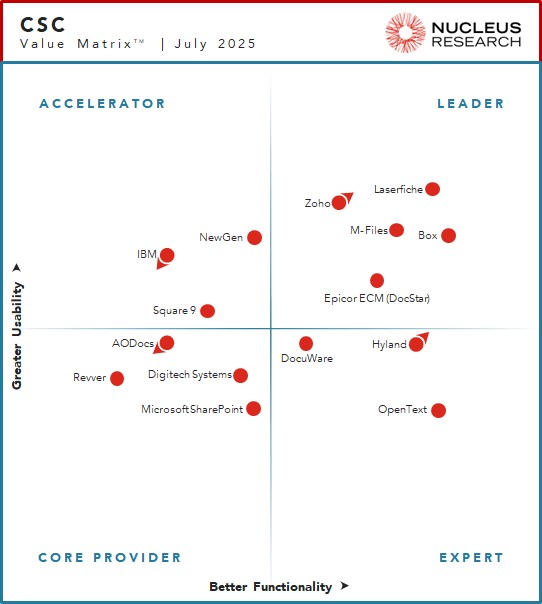
Laserfiche is a Leader for the 10th consecutive year, ranks highest in usability.
LONG BEACH, CALIFORNIA, JULY 23, 2025 — Laserfiche — the leading SaaS provider of intelligent content management and business process automation — is a Leader in the Nucleus Research Technology Value Matrix for Content Services and Collaboration for the 10th year in a row. Among the vendors evaluated, Laserfiche ranks highest overall in usability. Download a copy of the report here.
“As a leader in this year’s Value Matrix, Laserfiche was rated highest in usability for its AI productivity tools, new administration hub, process automation and integration capabilities,” said Evelyn McMullen, research manager at Nucleus Research and author of the report.
CSC as a Strategic Advantage: AI-powered Information Management
Recently released Laserfiche AI-powered features are aimed at boosting productivity even further and enabling automation at scale. Smart Fields, an out-of-the-box intelligent capture tool, allows customers to extract data automatically using natural language instructions, no matter the source or format. Smart Chat provides an intuitive chat interface that enables users to quickly gain insights from their repository content.
“As AI matures at an accelerated pace, vendors in the CSC market have the unique advantage of managing both structured and unstructured data from across the entirety of an organization,” the report’s Market Overview states.
Laserfiche AI features alongside powerful workflow automation, information governance and records management tools create new opportunities for organizational efficiency. Customers across industries use Laserfiche to increase productivity, create competitive advantage and drive growth.
“Laserfiche gives us the forms and workflow processes as well as data integration that enable efficiency at scale,” said Airline Hydraulics Chief Technology Officer Todd Schnirel. “Our Laserfiche-powered process improvements have supported us in achieving a significant increase in net revenue while adding very little operating expense.”
“Being ranked a leader for 10 consecutive years is a testament to our product innovation,” said Thomas Phelps, senior vice president of corporate strategy and CIO at Laserfiche. “Our top ranking in usability reflects our core value of putting people first and our commitment to delivering intuitive solutions that empower users.”
To learn more about Laserfiche’s position in the Content Services and Collaboration market, download the report here.
About Laserfiche
Laserfiche is a leading enterprise platform that helps organizations digitally transform operations and manage their content with AI-powered solutions. Through scalable workflows, customizable forms, no-code templates and AI-enabled capabilities, the Laserfiche® document management platform accelerates how business gets done. Trusted by organizations of all sizes — from startups to Fortune 500 enterprises — Laserfiche empowers teams to boost productivity, foster collaboration, and deliver a superior customer experience at scale. Headquartered in Long Beach, California, Laserfiche operates globally, with offices across North America, Europe, and Asia.
In recent months, the conversation around generative AI (Gen AI) has moved beyond productivity and hype. While early use cases in the public sector focused on time-saving and process efficiency, the broader narrative is evolving toward the transformational potential of AI to unlock insights, improve public services, and anticipate citizen needs. As public sector leaders confront rising service expectations, tight budgets, and growing data complexity, the strategic deployment of Gen AI particularly through enterprise content management (ECM) and process automation presents a powerful path forward.
Laserfiche is at the forefront of this evolution. By embedding Gen AI capabilities such as Smart Fields into our platform, we enable agencies, municipalities, and educational institutions to move beyond automating tasks and begin unlocking institutional knowledge at scale. This article explores the forces shaping Gen AI adoption in the public sector and the unique value Laserfiche brings to this new chapter.
Technological Innovation: From Automation to Insight
Across the public sector, Gen AI is transitioning from a tactical tool to a strategic enabler. Initial use cases centered on automating repetitive work summarizing documents, generating email drafts, or assisting with data entry. But the technology’s next wave is defined by its ability to reveal patterns, surface actionable insights, and synthesize complex information across siloed systems.
Laserfiche’s Smart Fields exemplify this shift. By using AI to detect and understand content in real time, Smart Fields reduce manual data tagging and improve metadata accuracy. This goes far beyond convenience. It allows public sector organizations to create more intelligent content repositories, where relevant information is surfaced proactively and used to inform decisions from public health trends to policy implementation to citizen engagement strategies.
Moreover, the Laserfiche platform integrates Gen AI into core business processes, enabling more responsive workflows. For instance, natural language processing (NLP) capabilities can be used to classify incoming service requests, assign priority based on urgency, and trigger automated routing ensuring faster and more consistent delivery of services.
Changing Customer Behavior: From Task Automation to Data Stewardship
To fully realize the benefits of Gen AI, public sector organizations must rethink how they manage data and measure outcomes. The old model of digitizing for the sake of efficiency is giving way to a new imperative: leveraging digital assets for continuous learning and improvement.
This shift demands a cultural change. Agencies need to embrace their role as stewards of public data not just curators of records but strategic users of information to drive policy and operational excellence. In this context, Laserfiche acts as a connective tissue between structured processes and unstructured data, enabling agencies to treat every document, form, or communication as a potential source of insight.
Equally important is the need for responsible innovation. Citizens and students expect transparency in how AI is used, especially in areas like eligibility determination, grading, or benefits administration. Public sector leaders must pair Gen AI adoption with robust governance, including audit trails, consent tracking, and AI explainability features. Laserfiche’s commitment to compliance and transparency ensures that agencies can adopt AI with confidence.
Navigating Regulatory Change: Building Trust and Alignment
Governments around the world are moving quickly to regulate AI, with a growing emphasis on fairness, accountability, and data protection. In the United States, executive orders and state-level legislation are beginning to shape expectations for the use of AI in public services. The European Union’s AI Act, although not directly binding on U.S. institutions, is setting the tone globally by categorizing AI use cases by risk and imposing strict obligations for public sector applications.
Laserfiche is designed with these realities in mind. Our platform includes role-based access controls, automated retention policies, and end-to-end encryption to help organizations align with privacy and data management requirements. More critically, the platform’s explainable AI capabilities provide clarity into how decisions are made an essential safeguard in regulated environments.
As regulations mature, public sector leaders will need technology partners that offer more than just AI features. They will need systems that are auditable, secure, and aligned with emerging compliance frameworks.
Growth Opportunities: Serving Citizens and Students More Intelligently
The greatest untapped opportunity for Gen AI in the public sector lies in its potential to personalize and improve the citizen and student experience. Today’s constituents expect the same responsiveness from government that they receive from the private sector yet many agencies are hampered by legacy systems and data silos.
With Laserfiche, organizations can unify disparate data sources and automate multi-step interactions, allowing for intelligent service delivery. Imagine a student applying for financial aid who is guided through the process via an AI assistant that understands eligibility rules, validates documentation in real time, and tracks application status all integrated with a secure ECM backbone. Or a constituent filing a complaint about street repairs who receives proactive updates based on workflow progress, without ever needing to make a follow-up call.
These scenarios are not science fiction. They are being implemented today by forward-looking agencies using Laserfiche to reimagine how the government and education serves its stakeholders.
Conclusion: The Strategic Role of Gen AI in Public Service
As the Wired article suggests, the real value of Gen AI is not just in how fast it operates but in how deeply it can transform how organizations think and act. For the public sector, this means using AI not simply to accelerate processes, but to deliver on the promise of better governance, equity, and trust.
Laserfiche’s AI-powered platform, including capabilities like Smart Fields, helps agencies shift from reacting to anticipating, from managing data to unlocking insight, and from compliance to transformation. For leaders seeking to modernize operations, improve service delivery, and embrace the future of digital governance, the time to act is now.
The opportunity is no longer just to do more with less. It is to do better with more, more intelligence, more context, and more strategic value from every interaction.
See More on how Laserfiche is unlocking a new era in productivity and insight.
AI is transforming how government agencies deliver services, streamline operations, and make smarter decisions. From improving response times at Veterans Affairs to modernizing 24 million property records in Santa Clara County, AI is proving its value across all levels of government.
An Uncertain Road Ahead
Government leaders are experiencing uncertainty with the federal transition and policy shifts stemming from the new administration.
That’s what I learned at Beyond the Beltway, an event where government leaders discuss their technology objectives and challenges. This event provides an opportunity to hear about technology priorities and pain points from industry leaders across the country.
Staying the Course
Teri Taki, Senior Vice President at the Center for Digital Government , pointed out that the response to this ongoing transition should be measured. Many state and local leaders reinforced this sentiment. They noted that their technology priorities remain steady despite shifting federal dynamics.
A Continued Focus: Efficiency, Modernization and AI
The ongoing push for modernization was a resounding theme across the event. This goes beyond upgrading legacy systems. It means delivering more efficient, citizen-centric services.
Leaders emphasized three major priorities:
- Enhancing the constituent experience – Making government services more accessible, seamless and user friendly.
- Leveraging AI and automation – Augmenting the workforce and streamlining service delivery.
- Ensuring security and compliance – Safeguarding data and privacy amid evolving threats.
While these priorities are not new, the accelerated adoption of AI-driven automationis what stood out.
Automation is meant to improve internal processes and service delivery. It is not only about cost savings, but also about reducing inefficiencies, breaking down silos and improving collaboration.
Laserfiche’s Role in Enabling Smarter Government
We help government work more efficiently, collaborate better and deliver improved services. Our secure content management and process automation platform enables agencies to:
- Automate manual workflows to free up staff for higher value work.
- Unlocking insights and improving decision-making with AI.
- Reduce bottlenecks and improve collaboration.
- Strengthen security and compliance while maintaining operational efficiency.
Hundreds of state and local governments use Laserfiche to modernize their processes. We remain committed to helping government leaders navigate the evolving #GovTech landscape. We work to ensure that automation enhances both the citizen and staff experience.
The Path Forward: Thoughtful, Measured Innovation
While the drive for efficiency is critical, the approach must be measured and strategic. Technology should enhance rather than disrupt service delivery.
Process automation can overcome manual roadblocks, promote collaboration, and deliver secure, scalable solutions. With process automation, government agencies can achieve both efficiency and long-term value.Cut Content Management Costs in Half
At Laserfiche, we are committed to working with government partners to turn their priorities into reality.
For example, the City of Long Beach implemented a three-pronged strategy: consolidating IT services, increasing transparency and digitizing processes. Working with Laserfiche, the city cut annual ECM costs by 50%.
Empowering the delivery of the next generation of smarter, more responsive public services is our mission. We would love to hear your thoughts—what modernization trends are you seeing in the government space? Let’s connect! Contact us to learn how we can help you accelerate service delivery.
The LA wildfires left behind more than just burned homes and scorched landscapes. They left thousands of residents waiting—waiting to rebuild, waiting for approvals, waiting for their lives to return to normal.
For local governments, the challenge is not about issuing permits; it’s about restoring hope and stability. And they need to do it as quickly as possible. But the traditional permitting process wasn’t designed for disasters. It’s slow, paper-heavy and frustrating for both officials and residents.
What if there was a way to cut through the backlog and get permits approved faster? Laserfiche is an industry-leading ECM platform that makes that possible.
When Every Day Counts
Imagine a homeowner who lost everything in the fire. They have insurance money ready, a contractor lined up and blueprints in hand. But before they can break ground, they need permits.
They submit their application, but local permitting offices are overwhelmed. Stacks of paperwork cover desks, phone lines are busy and approvals move at a snail’s pace. Weeks turn into months. Frustration builds.
Now, imagine a different scenario. The homeowner submits their permit online through a simple portal. The system automatically routes their application to the right department. Any missing information is flagged upfront. Officials review and approve it digitally, cutting out unnecessary back-and-forth. The homeowner gets their permit in days instead of weeks.
That’s the power of Laserfiche.
Make Permitting Faster and Easier
Laserfiche transforms outdated, manual permitting into a fast, automated process. This automation helps local governments do more with less and keep up with demand.
Digital Applications Instead of Paper Piles
Rather than requiring residents to stand in line at government offices, Laserfiche allows them to:
- Submit applications and supporting documents online.
- Track their permit status in real time.
- Receive digital approvals without having to visit multiple offices.
For government teams, this means fewer phone calls, fewer lost documents, and a smoother process from start to finish.
Streamline Workflows and Boost Efficiency with Automation After a wildfire, the volume of permit requests can overwhelm city staff. Laserfiche eliminates bottlenecks by:
- Automatically routing applications to the right people for review.
- Sending notifications when approvals are needed.
- Setting up reminders so permits don’t get stuck in the system.
This keeps things moving, reducing unnecessary delays and helping homeowners start rebuilding sooner.
Make Smarter Decisions with GIS
Rebuilding isn’t just about speed—it’s also about safety. Some areas may be too fire-prone to redevelop with standard building practices. Some properties may need extra environmental and safety reviews before construction can begin.
Laserfiche connects directly with Esri ArcGIS, allowing officials to:
- Link permits and inspection reports to real-time maps
- Identify high-risk zones and flag permits that need extra review
- Track rebuilding progress across the entire community
By combining permitting data with GIS mapping, governments can make informed, responsible decisions. These decisions can help protect communities and property owners from future disasters.
Keeping Up with FEMA and State Requirements
For local governments, disaster recovery isn’t just about issuing permit. It is about making sure everything is documented to receive state and federal funding.
Laserfiche simplifies compliance by:
- Storing all permit records in a centralized, searchable system
- Automatically tracking approvals, inspections, and changes
- Generating reports for FEMA and state agencies without digging through stacks of paper
This ensures local governments don’t miss out on critical funding due to missing paperwork or lost records.
Keep Communities Informed in the Recovery Process
For residents affected by wildfires or disaster, waiting for a permit can feel like waiting in the dark. When will their application be reviewed? Where does it stand in the process? What else do they need to provide?
Laserfiche helps keep communities informed by:
- Enabling residents to check their permit status via a public-facing portal.
- Making information easily accessible by streamlining public records requests.
- Improving collaboration between departments so everyone stays on the same page.
When people know what’s happening, trust in the process grows—and so does confidence in their local government.
Rebuilding Faster, Together
The wildfires may have destroyed homes, but they didn’t destroy the spirit of the communities they touched. Local governments have the power to clear the way for faster rebuilding—and Laserfiche can help.
With content management, automated approvals, GIS integration, and better compliance tools, cities and counties can:
- Reduce permit approval times from weeks to days.
- Prevent paperwork delays and lost documents.
- Ensure compliance with FEMA and state regulations.
- Speed up inspections and safe rebuilding efforts.
- Improve communication and transparency for residents.
For families and business owners eager to rebuild, every day matters. The faster the permits are issued, the sooner construction begins, and the sooner life can return to normal.
Let’s Get Started
If your city or county is struggling with permitting delays after the wildfires, Laserfiche can help. Contact us today to see how our automation and workflow solutions can support your recovery efforts. See why Laserfiche is a Leader:
In January 2023, the City of Long Beach launched the Government User Integrated Diversion Enhancement System (GUIDES), a transformative mobile application designed to assist the Long Beach Police Department (LBPD) and the Long Beach City Prosecutor’s Office (LBCP) in providing vital assistance to highly vulnerable populations. This innovative platform serves as an online information system powered by Laserfiche’s innovative document and records management software, enabling law enforcement and prosecutors to share data and access case information while connecting individuals in need to essential services.
Project Overview
The GUIDES app was conceived as a response to pressing social issues, particularly the dramatic rise in homelessness and associated challenges in Long Beach. The city declared an “Emergency on Homelessness” after witnessing a staggering 62% increase in homelessness between 2020 and 2022. By providing officers with immediate access to crucial information that is stored in the Laserfiche Repository, GUIDES empowers them to make informed decisions, diverting individuals away from the criminal justice system and toward necessary social services, like shelter housing, mental health treatment and drug rehabilitation.
Doug Haubert, Long Beach City Prosecutor, emphasizes the importance of this initiative, “We partnered with Laserfiche to create GUIDES, the first police-prosecutor data sharing app, to give more resources to officers in the field. We need technology like this more than ever to help get people off the streets, and into social services.”
Funding and Development
The development of GUIDES was funded by the United States Department of Justice through the Innovative Prosecution Solutions Grant Program, with a total award of $360,000. Laserfiche, a Long Beach-based software company with deep ties to the community, worked closely with Haubert’s office to develop GUIDES and ensure it met the specific needs of local law enforcement and the community at large.
Prior to the introduction of GUIDES, the LBPD had been leveraging Laserfiche technology since 2013 to improve access to information about court orders. As a trusted solution for document management and collaboration, Laserfiche supports the LBPD’s ability to centrally store information — such as PDFs, images and documents — apply appropriate metadata, and retrieve content while addressing necessary regulatory, security and privacy requirements. Building on this foundation, the Laserfiche-driven GUIDES app represents a significant advancement in the city’s approach to public safety.
Key Features and Functionality
The GUIDES app enables officers to quickly ascertain context about individuals they encounter in the field, enhancing their ability to provide appropriate assistance. The app provides real-time information regarding individuals’ probation status, stay-away court orders, and active warrants, streamlining the decision-making process for officers. For example, if an individual is already part of the Law Enforcement Assisted Diversion (LEAD) diversion program, officers can easily identify and reconnect them with their case managers, offering alternatives to arrest or incarceration. By facilitating this connection to social services, GUIDES helps to improve outcomes for individuals in need.
Results and Impact
The initial evaluation of the GUIDES initiative has yielded promising results. A survey of police respondents indicated that 75.6% are likely to use the app in the field, and 70% believe it will aid them in their duties. This positive reception highlights the potential for GUIDES to enhance law enforcement practices and improve outcomes for individuals experiencing homelessness or mental health challenges.
Long-term goals for the project include:
- Reduction in arrests and prosecutions due to having more options
- Increased referrals to social services
- Improved outcomes for individuals with social service needs
- Decrease in violent crime and recidivism rates
By focusing on these objectives, GUIDES allows law enforcement agencies to concentrate their resources on cases that truly require traditional criminal justice interventions.
Future Potential
Looking ahead, there is significant potential for the GUIDES app to evolve and expand its capabilities. The app’s architecture is designed to incorporate additional features over time, allowing for the integration of further data types that can enhance its utility. The ultimate goal is to build a more interconnected ecosystem of government agencies and NGOs, fostering collaboration to address pressing community needs.
As Haubert notes, “This project requires organizational commitment and a long-term vision. If we invest in the right resources, GUIDES can serve as a model for other communities grappling with similar challenges.”
The GUIDES app exemplifies how innovative technology from Laserfiche can play a crucial role in modernizing public safety efforts and addressing complex social issues. By bridging the gap between law enforcement and social services, Laserfiche and the City of Long Beach are taking a proactive approach to support its most vulnerable residents. In a world where traditional methods often fall short, GUIDES represents a forward-thinking solution, demonstrating the power of collaboration and technology in fostering a more equitable society.