


Join us at the Government Innovation Virginia 2026 to explore insights in data management, modernized infrastructure, citizen-focused digital services, digital inclusion, and inter-agency collaboration. This event will highlight Virginia’s innovative approaches and provide a platform for sharing ideas with peers across the state while addressing critical topics such as cybersecurity resilience, responsible AI and data stewardship, and workforce readiness.
This summit brings together IT leaders looking to redefine what’s possible. From scaling AI, simplifying infrastructure to unlocking data-driven decisions and leading with empathy, you’ll explore how to drive meaningful change across people, platforms, and performance – while keeping your organization resilient, agile, and ready for what’s next.
The North Carolina Department of Environmental Quality (NCDEQ) safeguards the health and prosperity of all North Carolinians by protecting the state’s air, water and natural resources. Guided by this mission, the department uses technology as a means to improve lives and preserve the environment.

For years, each of NCDEQ’s 11 divisions relied on paper applications, shared drives and emails to manage essential programs such as construction permits. Each division operated its own systems, creating duplicate work and fragmented records. The result was slow permit processing for citizens and missed revenue from untracked permit renewals.
“Before Laserfiche, we had multiple versions of the same file stored in different places, and no easy way to verify which was the most current,” said Chief Data Officer Miriam Patrocinio.
As North Carolina’s population and development grew, so did the department’s responsibilities — from managing a growing volume of annual construction permits to coordinating data for billions of dollars in federal environmental funding.
The NCDEQ needed a reliable, centralized system that could connect data, streamline processes and make compliance with environmental regulations easier for both staff and citizens.
Turning Change into Opportunity
When Patrocinio joined NCDEQ in 2022, the agency had used Laserfiche on a limited scale for several years, primarily within individual divisions managing their own processes. She quickly saw the potential of Laserfiche to underpin a unified digital transformation strategy that would align people, data and mission under one cohesive vision.
“Laserfiche was already established, supported by a small team that developed workflows and forms to support digitization,” she said. “Those efforts gave us a strong foundation to build on.” As a result, Laserfiche became the agency’s official document repository.
The next step was to build support. Patrocinio visited division offices statewide, listening to staff and learning what stood in their way. By connecting personally with teams and translating technical goals into everyday language, she built the trust needed for change to take root.
Building a Foundation for Statewide Data Management
Once staff were on board, Patrocinio led a structured effort to unify data management across the agency, outlining a four-phase plan:
- Conduct health assessments for each existing repository.
- Implement integrations, including a federated search tool across Laserfiche repositories and SharePoint to locate documents.
- Establish consistent standards for data management and governance.
- Develop public-facing resources that make environmental information more accessible.
After completing the first two phases, Patrocinio’s team eliminated redundancies and created a shared framework for collaboration.
Using the newly centralized system, NCDEQ deployed a federated search capability that allows staff to locate content across multiple Laserfiche repositories and SharePoint sites, eliminating information silos and improving visibility.
The department also integrated Laserfiche with Microsoft Dynamics to link environmental records and permit workflows as well as with its GIS (geographic information system) to provide spatial context for projects and support data-driven environmental decisions.
Together, these integrations strengthened the agency’s data ecosystem, giving staff a complete, real-time view of projects and their environmental context.
“With the agency’s data foundation in place, we could finally focus on transforming the processes that touch the public every day,” Patrocinio said.
Bringing Clarity and Speed to Permit Management
The first major application of this new foundation was one of NCDEQ’s most complex, high-volume workflows: the construction permit process for projects involving more than 1 acre of land.
Previously, developers submitted lengthy paper permit applications, renewals and payments by mail. Tracking compliance was cumbersome, and staff had no way to confirm that all fees were collected.
Patrocinio’s team rebuilt the process in Laserfiche, creating a digital foundation with secure document storage and online forms. Automated workflows route and track permit submission through payment and renewals. Integrations with NCDEQ’s internal payment and compliance systems keep permit information accurate and up to date, allowing the agency to provide more timely, reliable service to the public.
Now, applicants complete and submit electronic forms online instead of mailing paper applications or waiting for in-person processing. Once submitted, the application automatically moves through review and approval in Laserfiche, providing staff with real-time visibility into the status. Fees are generated and tracked digitally, so payments are processed quickly and securely. Applicants receive automatic updates and renewal reminders, reducing delays and improving environmental compliance.
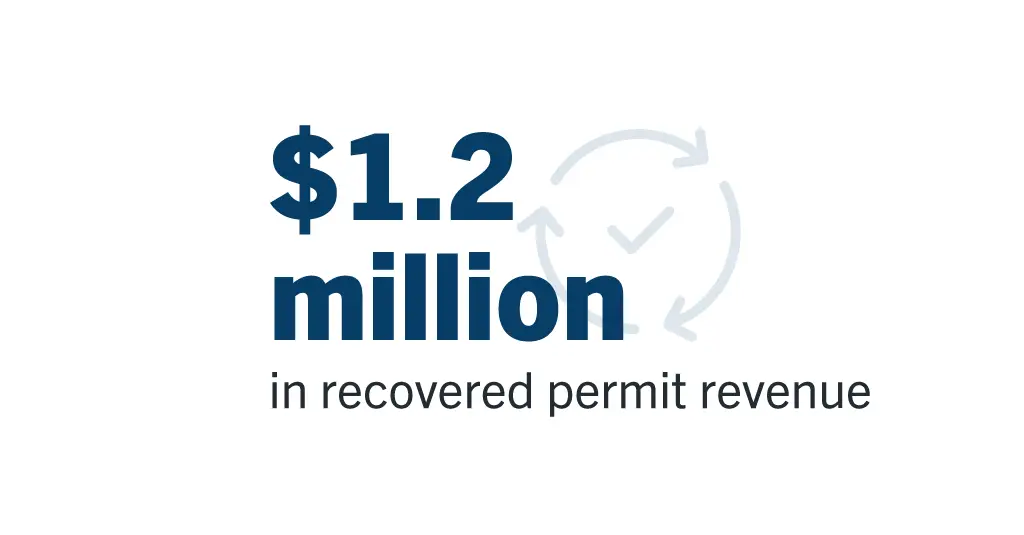
With the new solution, NCDEQ collected over $1 million in permit fees and eliminated long-standing backlogs. For citizens and businesses, the shift to digital processing significantly reduced approval times, speeding up construction while maintaining rigorous environmental oversight.
Delivering Measurable Impact and Public Value
The project delivered results that reached far beyond a single process, including:
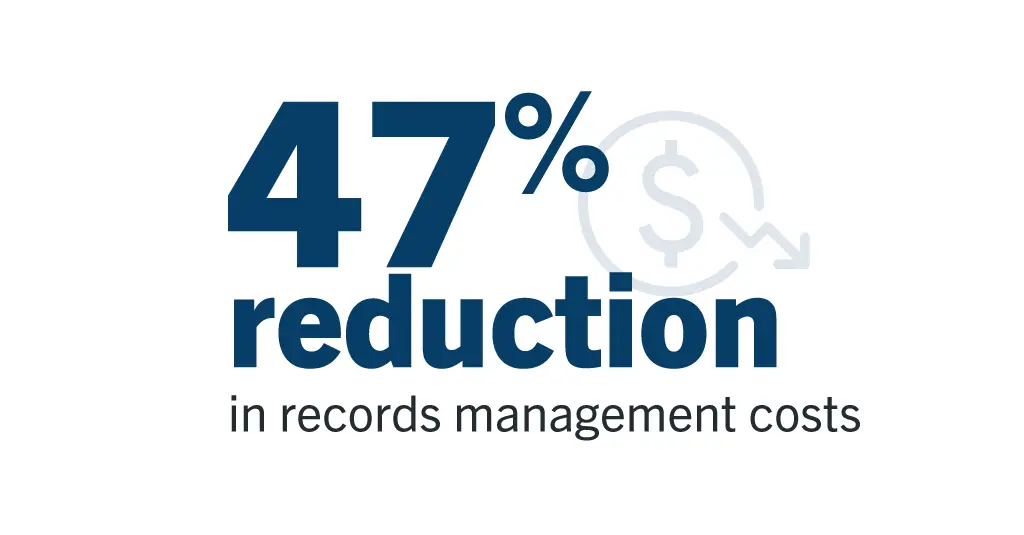
- A 47% reduction in records management costs within two years by eliminating physical storage and redundant workflows.
- Over $1 million in recovered permit revenue
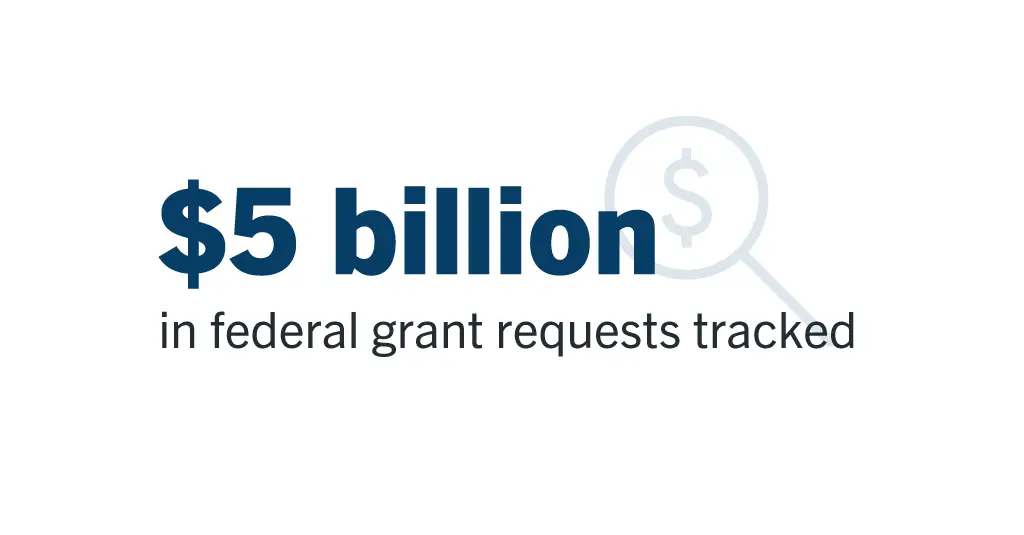
- $5 billion in federal grant requests tracked, accelerating community access to environmental and infrastructure funding.
Automation within Laserfiche reduced manual data entry, improved accuracy and gave teams full visibility into document lifecycles. Staff reported higher satisfaction and less time spent chasing paper, while the public benefited from faster, more consistent service.
Beyond operational gains, the new system strengthened NCDEQ’s core mission of environmental stewardship. With proper permit tracking now automated, the agency can ensure stronger compliance with environmental regulations, preventing pollution and safeguarding North Carolina’s natural resources. Improved fee collection also allowed NCDEQ to hire additional permit reviewers, expanding the department’s capacity to support sustainable development across the state.
“Technology is only the tool,” Patrocinio said. “What drives us is protecting the environment, which means safeguarding the air, water and communities that make North Carolina home.”
Sustaining Progress for People and Nature
Building on this success, NCDEQ is expanding its Laserfiche strategy across all 11 divisions statewide. Patrocinio and her team are now standardizing data management practices in preparation for making more of the agency’s environmental data available to the public online.
“Laserfiche helped us modernize our systems and rethink what service means to the people and communities we serve, and to the environment we’re entrusted to protect,” she said. “We’ve built a foundation that will continue to grow and deliver value for years to come.”

Over the past few years, government agencies, counties and municipalities have accelerated modernization efforts through digitization and, in 2026, that momentum will only grow. The year ahead will usher in an automation-first era, where AI and intelligent content management play a central role in advancing transformation efforts and strengthening public trust.
By unifying fragmented data, addressing ghost content and embedding compliance-by-design, agencies can shift from reactive recordkeeping to proactive, transparent and data-driven governance. Below are three key predictions for the year ahead.
1. Automation-first will become the new standard for state and local government
In 2026, government agencies will begin looking at digitization more holistically. they will become the standard operating model for content management, with AI continuously identifying and classifying ghost content across legacy and siloed systems.
Agencies will leverage AI-powered content management to continuously identify and classify ghost content buried across legacy or disconnected systems.
If the Department of Transportation were to find thousands of outdated project plans across multiple servers, the agency could use AI-led classification and low-code automation to instantly identify expired records, archive them based on retention policies and highlight pertinent data sets. By surfacing this ghost content and connecting once isolated systems, agencies will reclaim valuable storage, reduce compliance risks and accelerate modernization.
Automation can connect agencies beyond just IT departments, enabling processes that routinely classify, clean and govern data at scale. This enables leaders to make decisions based on the full scope of trusted, actionable information while illuminating any duplicate or hidden content.
2. Trust-centered AI will transform records from static archives into living intelligence
A recent survey found 50% of Americans felt “uncomfortable” with AI use in government services while 59% believed the technology would aid in efficiently serving residents. The public knows AI will streamline their experiences with government agencies but need transparency in these tactics to gain trust.
In 2026, I see AI shifting from a back-office productivity tool to a front-line intelligence partner providing both efficiency gains and transparency to cultivate trust with constituents. For example, agencies can use AI-driven content management to classify sensitive documents, respond to Freedom of Information Act (FOIA) requests faster and strengthen audit-ready compliance with greater transparency.
Instead of relying on AI as a black box, trust-by-default systems will combine human oversight with explainable AI to ensure decisions made from historical and real-time data are verifiable and equitable. AI tools used in allocating public resources will provide audit trails and reasoning to uphold public accountability. As a result, AI will become a force for accountability and clarity, turning decades of ghost content into a foundation for public confidence.
3. Interoperability and compliance-by-design will bridge the data divide
Inconsistent compliance and fragmented systems are some of the most significant barriers to seamless government services. In the year ahead, interoperability will be less centered around the movement of data between platforms and more about consistent governance.
AI-driven content management will aid in unifying information from multiple systems while automatically enforcing retention, security and compliance policies. As an example, a justice agency might manage records across law enforcement, courts and corrections. With embedded governance, sensitive data can be identified early, content will be consistently categorized and frameworks like those of the Criminal Justice Information Services (CJIS) and National Institute of Standards and Technology (NIST) can be applied in real time.
A compliance-by-design approach reduces risk without hindering work. Embedded controls and audit trails will make governance automatic, while open APIs give organizations the opportunity to connect aging systems with modern, cloud-secure platforms. All of this will enable more rapid service delivery and increased transparency while maintaining the level of governance expected by the public.
Building a Smarter, More Resilient Government
Agencies that align automation, AI and governance will move beyond record management, to governing intelligence, enabling better decisions, stronger accountability and greater public trust. This shift is already underway, and the next chapter of government modernization will be defined by how well agencies turn information into insights.
Laserfiche offers intelligent orchestration and documentation tools that help government agencies modernize to meet the demands of 2026 and beyond. Discover how Laserfiche could advance your goals in the year ahead now.

During National Data Privacy Week, Laserfiche attended Public Sector Network’s latest Government Innovation Showcase in Sacramento, California to discuss California’s Digital Future. Californians dedicated to data, AI and IT modernization discussed best practices in implementing technology, ensuring data security and leading IT modernization projects to drive efficient, future-ready infrastructure.
Laserfiche was part of the Technology, Data and AI Integration track discussing AI’s impact on digital transformation and how to leverage AI to transform government operations and public safety. Laserfiche also hosted a roundtable on modernizing government with AI without losing governance. Through the event’s keynotes and panels, attendees gained practical strategies for modernizing infrastructure, improving data-driven decision-making and driving innovation in public agencies, with one clear theme standing out: Innovation in government only succeeds when it is grounded in trust. Trust in data, trust in decision-making, and trust that new technologies are being applied with clear accountability.
California’s Investing in a Future That is Smart, Inclusive and Citizen-Centric
California continues to lead in using AI to advance digital government. The state is home to 32 of Forbes’s top 50 AI companies worldwide. Additionally, “California leads U.S. demand for AI talent,” according to the press office of Governor Gavin Newsom. “In 2024, 15.7% of all U.S. AI job postings were in California — #1 by state, well ahead of Texas (8.8%) and New York (5.8%), per the 2025 Stanford AI Index.”
With billions allocated toward modernizing critical infrastructure and enhancing data-driven programs, the state is committed to delivering faster services to its more than 39+ million residents. The showcase demonstrated the ethos Governor Newsom invoked when he said:
California has proven that we can establish regulations to protect our communities while also ensuring that the growing AI industry continues to thrive. This legislation strikes that balance. AI is the new frontier in innovation, and California is not only here for it — but stands strong as a national leader by enacting the first-in-the-nation frontier AI safety legislation that builds public trust as this emerging technology rapidly evolves.
Governor Gavin Newsom, Sept. 29, 2025
From reimagining service delivery in health and human services to advancing climate resilience and equitable access, California is setting the pace for what modern governance looks like. AI-powered tools like Laserfiche are helping the state improve citizen outcomes, foster interagency collaboration and meet California’s urgent challenges today and in the future.
AI is the future and California companies are leading.
In Sacramento, several conversations reflected a shared concern for agencies today: the pressure to adopt AI quickly, balanced against the responsibility to ensure transparency, security and public confidence. The answer was not to avoid AI altogether, but to strengthen AI governance. The keynote reiterated this strategic insight.
AI vs. AI: California’s New Frontier in Innovation, Building Trust and Defending the Digital State
Thea Man, chief information security officer, Office of Data and Innovation, presented the keynote of the day centered on California’s innovative future built on trust.
The message?
California is one of the world’s most targeted cyber battlegrounds. AI now operates on both sides of the security equation — accelerating discovery and defense, while enabling new forms of automated cyber-attacks. The result is a digital future where speed, adaptability and foresight define success.
In the era of AI vs. AI, California’s next leadership challenge is clear: to ensure AI not only powers progress, but protects the state from adversaries.
The session, and much of the discussion of the day, was on how California can use AI to outpace AI-driven threats to innovate and protect us in the digital future. Key highlights included how AI can power the next generation of cyber defense across critical sectors and why ethics, transparency and public trust will define the future of AI-enabled governance.
Modernizing Government with AI — Without Losing Governance
During a roundtable I facilitated with department leaders, the conversation moved beyond theory to lived experience with a discussion on the realities of responsible AI in practice. Beyond tools and pilots, AI now impacts day-to-day operations.
AI is already present in government, whether through sanctioned initiatives or informal use by individuals trying to work more efficiently. Participants agreed avoiding AI altogether does not prevent risk — it often increases it by pushing experimentation outside established controls. Participants agreed that a proactive governance approach is essential to maintaining public trust.
Several shared how uncertainty at the executive level unintentionally slowed formal AI efforts, creating space for unsanctioned projects to emerge. In contrast, agencies making progress described taking a measured path — defining clear guardrails around what data could be used, how it would be applied, who could access it, and how outcomes would be evaluated. Governance, in these cases, was not a constraint but a confidence-builder.
Another key insight was that AI adoption does not need to look the same across agencies and departments. Participants emphasized the importance of aligning AI capabilities to mission needs and organizational maturity, rather than pursuing sophistication for its own sake. Governance frameworks helped agencies right-size their approach while preserving consistency and accountability.
Two success factors surfaced repeatedly:
- Trusted data: Agencies that had moved forward successfully invested early in establishing confidence in their information through clear policies, records management practices and shared evaluation criteria before introducing AI into workflows.
- A people-first approach: One agency shared a lesson learned after realizing that while its data and policies were trusted, its initial AI deployment failed to reflect how staff actually interpreted and used information. By incorporating end users into the development process, the agency was able to course-correct and improve adoption.
The roundtable reinforced that AI in government is not solely a technical challenge. It is a governance and leadership discipline — one that depends equally on trusted data, clear oversight and meaningful human involvement.
The birthplace of AI: Governance and Trust in California
The event united government leaders, technology experts and industry partners across the Golden State to explore how data, AI innovation and secure digital tools can strengthen service delivery while building public trust. Our roundtable had leaders express the importance of involving the people who use data and interpret information daily. This ensures AI systems reflect real operational language and workflows rather than policy assumptions alone.
The takeaway for government leaders was clear: Successful AI adoption is defined by discipline — building governance, trust and human context into systems before scaling them.
For more about Laserfiche’s AI capabilities for California’s future, watch AI’s Impact on Information Management on-demand now.
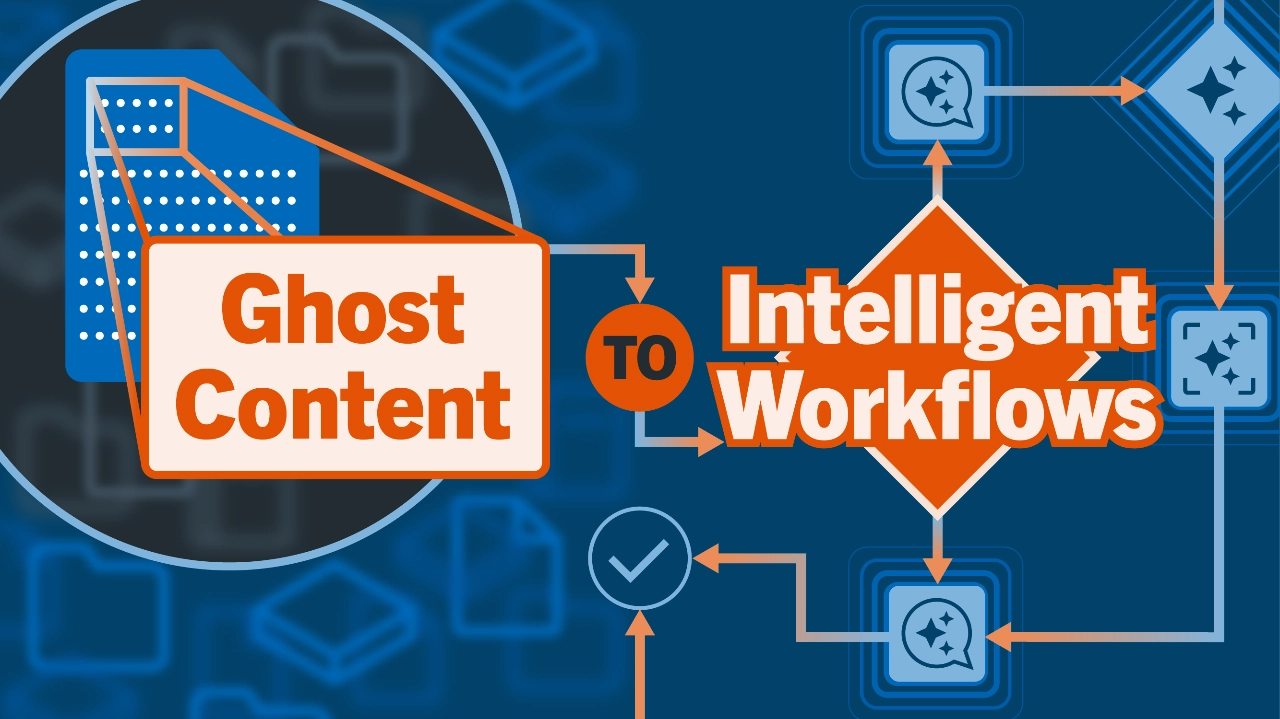
Ghost content refers to the data your organization technically owns but can’t find or use effectively — or may not even realize exists. The first step in unlocking the potential of your ghost content is to turn it into structured data.
After uncovering ghost content, and extracting and structuring it with a content management system, you can leverage that data for impactful business process automation. Process automation ensures that valuable information doesn’t just sit in a repository but actively drives productivity.
Why Intelligent Workflow Automation Matters After Unlocking Your Data
Strategically, automating process is a natural step after uncovering ghost content. Not only can you leverage AI to structure and classify your ghost content but this structured data is the foundation for meaningful automation. With AI-powered workflows working to not only structure your ghost content, but can also enable workflow automation to reduce the time and effort employees spend on repetitive tasks or even outdated or disparate automation processes. The benefits of intelligent workflow automation are significant: you can streamline your workflows, improve accuracy improve your compliance and audit readiness, increase your operation visibility and transparency, and empower your employees to focus on higher-value work.
With Laserfiche, these advantages are amplified; workflows are scalable, secure and accessible from anywhere, enabling enterprise-wide workflow automation that connects teams and systems seamlessly. Once you transform insight into action, you can harness the value hidden in your data to drive real results across the organization.
The Three Key Areas Where Automated Workflows Drive Impact
Automated workflows don’t just save time; they transform the way work gets done across an organization. By streamlining processes in the right areas, businesses can maximize efficiency, accuracy, and insight-driven decision-making. Three key areas where automated workflows drive impact are:
1. Repetitive, manual operational tasks
Tasks like data entry or routine approvals are prime candidates for automation. By letting workflows handle these processes, you can free employees from tedious work, reduce errors and run processes faster and more consistently.
2. Cross-functional or siloed workflows
Workflows that span departments or teams often get slowed down by handoffs, miscommunication or siloed information. Automating these processes ensures smooth coordination, visibility into progress, and accountability, making it easier to achieve enterprise-wide alignment and efficiency.
3. Unstructured workflows
Even workflows that rely on unstructured or semi-structured data, like documents, emails, or scanned forms, can be automated. Laserfiche, combined with AI-powered tools like Smart Chat, enables natural language querying of content, allowing automated decision-making and reporting, so you can act on insights quickly and accurately.
How Automation Transforms Data into Actionable Workflows
Process automation brings the value of structured data to life. Once information is organized, employees no longer need to spend time and effort extracting data to access what they need; automation does the heavy lifting.
At the heart of this transformation is intelligent orchestration, a holistic approach that integrates enterprise processes, data, technology and operations into one connected ecosystem. Like a conductor leading an orchestra, intelligent orchestration ensures every part of the business moves in sync, harmonizing data and workflows to deliver consistent, high-quality outcomes. By integrating processes and data intelligently, organizations can deliver personalized customer experiences efficiently and at scale. This allows organizations to not only meet customer needs in the moment but anticipate them, ensuring every interaction is relevant and engaging.
AI-powered tools within Laserfiche, like Smart Fields and Smart Chat, make this even more powerful. Smart Fields intelligently extracts information from documents, regardless of the document’s source or format, while Smart Chat delivers information and insights directly through natural language querying, so that employees can quickly receive concise and tailored responses.
This combination of automation and AI allows organizations to move faster and make smarter decisions without requiring deep technical expertise. This impact spans every department.
- Legal teams can automate contract reviews and approvals;
- Finance departments can streamline purchase orders and quarterly reporting
- Engineering and project teams can ensure documents move smoothly through revisions
Across the enterprise, employees spend less time on manual work, teams collaborate seamlessly, executives gain visibility, and the organization scales more effectively.
Ultimately, intelligent orchestration transforms structured data into synchronized action.
The Path Ahead: From Insight to Impact
The journey from uncovering ghost content to achieving intelligent workflow automation represents a complete transformation in how organizations manage information. It begins with bringing hidden or unstructured data to light, using AI tools to structure information into usable, actionable insights, and finally, using process automation to turn those insights into positive benefits for your organization.
With Laserfiche, this transformation is not only achievable but scalable. Cloud-based, AI-enabled automation makes it possible for organizations to access, manage and act on information from anywhere. What was once hidden or siloed becomes part of a unified and strategic system that drives productivity, transparency and innovation.
New intelligent features automatically organize and classify documents, transforming how organizations manage information at scale.
LONG BEACH, CALIFORNIA, Jan. 28, 2026 – Laserfiche — the leading SaaS provider of intelligent content management — today announced major enhancements to its AI-powered data extraction tool, Smart Fields. The update introduces automated document classification and tagging, allowing organizations to move from unstructured content to informed decisions in seconds.
Using natural language prompts instead of rigid, ruled-based OCR, Smart Fields can now identify document type — such as invoices, taxpayer identification forms, or student transcripts — and automatically apply the correct metadata template using AI. Users can also use Smart Fields to automatically add informational and security tags to files that meet certain criteria, defined using a natural language prompt. Users can capture key details, route documents, and apply the proper metadata tags instantly and at scale.
“Success in today’s AI-driven landscape is defined by speed to insight,” said Michael Allen, chief technology officer at Laserfiche. “By using AI in Laserfiche content management, we are transforming organizations’ digital repositories into active engines for business intelligence. Smart Fields allows users to bypass the friction of manual data entry, saving time for more high-value decision-making.”
Redefining Document Capture for the AI Era
Traditional capture methods often require specialized technical knowledge and complex configuration. Laserfiche Smart Fields, first launched in 2025, eliminates this barrier by allowing users to describe the data they need using natural language. Key updates include:
- Automatic classification: Smart Fields recognizes document types and matches them to the appropriate template.
- Intelligent auto-tagging: Administrators define tags once, and the Smart Fields applies them during ingestion to help organizations with consistent security and findability.
Smart Fields has helped customers capture metadata from content such as financial documents, vendor forms and legal contracts, cutting document management processes down from months to seconds. These enhancements reduce operational overhead and human error, and support enterprise-wide data consistency while freeing up technical resources.
Key benefits include:
- Automated organization: Smart Fields eliminates manual sorting by classifying documents on entry.
- Dynamic security controls: Auto-tagging supports both informational and security classifications, enabling organizations to automatically protect sensitive content.
- Simplified automation: Classification data can trigger workflows, like approvals or retention schedules, without complex coding.
“The true value of AI in the enterprise is its ability to shed light on dark data, or what Laserfiche calls ‘ghost content,’” said Andrea Malick, principal advisory director at Info-Tech Research Group. “By automating the foundational work of document organization, organizations can finally bridge the gap between content silos and actionable insights, making sure that information is not just stored, but systematically ready for the AI era.”
For More Information
- Learn more about Laserfiche’s AI-powered document management capabilities at laserfiche.com/products/ai.
- Explore insights into automation, document management and digital transformation in AI era by downloading the Laserfiche report, “The State of Document Management and AI.”
- Find out more about ghost content and how it impacts your data strategy in the Laserfiche Blog.
About Laserfiche
Laserfiche is the leading enterprise platform that helps organizations digitally transform operations and manage their content with AI-powered solutions. Through scalable workflows, customizable forms, no-code templates and AI-enabled capabilities, the Laserfiche® document management platform accelerates how business gets done. Trusted by organizations of all sizes — from startups to Fortune 500 enterprises — Laserfiche empowers teams to boost productivity, foster collaboration, and deliver a superior customer experience at scale. Headquartered in Long Beach, California, Laserfiche operates globally, with offices across North America, Europe and Asia.
GITEX AI ASIA X AI EVERYTHING SINGAPORE is where the world’s most ambitious tech ecosystems converge — uniting AI pioneers, digital infrastructure leaders, frontier startups, and strategic investors to accelerate transformation across every major sector.
From public-private collaboration to enterprise adoption, the show delivers real outcomes, deep partnerships, and future-defining breakthroughs — live from Singapore, Asia’s capital of Innovation.