EDUCAUSE 2025 & Laserfiche: Higher education technology for the modern era

Laserfiche employees at Educause discussing opportunities for workflow automation with a visitor

Each year at the annual EDUCAUSE conference, hosted in Nashville this year, the Laserfiche team gets the chance to connect with the higher education technology professionals driving campus innovation. It’s an enriching experience and an opportunity to discuss how content management can help higher ed teams drive student success. It’s also a forum to explore upcoming challenges higher education will face in the year ahead, and discuss potential solutions to those upcoming challenges. 

Based on our conversations with technology leaders at EDUCAUSE, we’ve identified three upcoming challenges and how to face them head on. 

Meeting the Looming Enrollment Cliff with Modern Services 

With demographic shifts already driving persistent enrollment declines, higher education institutions must pivot from simply attracting applicants to actively fostering an environment that makes students want to stay at their schools which makes administrative efficiency a key value driver. 

Students today are digital natives; they expect their university to provide technology and services as accessible and intuitive as the leading consumer apps they use every day. 

Institutions can no longer rely on paper-based or clunky legacy digital processes. Successfully navigating enrollment requires a full embrace of modern, technology-driven processes, including: 

  • Easy-to-use digital student forms 
  • Seamless self-service portals  
  • Quick resolution of administrative tasks 

When core processes like registration, financial aid applications or petitioning are streamlined and effortless, the institution itself stands out in the eyes of applicants. 

Using AI For Back-Office Efficiency

The impact of AI when it comes to modernization continues to grow and is quickly becoming an advantage to higher education institutions. By implementing AI tools for intelligent data capture, automated records routing and document processing, institutions can dramatically reduce the time and cost for back-office tasks like invoice processing or records management. This newfound efficiency and savings can then be strategically reallocated to high-touch student services. 

AI can add value across campus departments, including: 

  • Admissions: Speed up reviews with automatic data capture for all admissions documents. 
  • Financial Aid: Accelerate awards timing by automatically extracting tax and FAFSA data. 
  • Credit: Read transcripts in any format to process course equivalencies faster.  

Responding to Financial Retrenchment with Technology Audits

The most pressing theme at this year’s conference was the widespread acknowledgment that financial retrenchment is a permanent reality for many institutions. IT leaders are evaluating their tech stacks and identifying where multiple departments may have purchased tools with overlapping capabilities. 

IT teams are looking to optimize digital transformation and adopt tools that have the flexibility to adapt across multiple departments and streamline admissions, student services and back-office operations. These platforms should also seamlessly integrate with other solutions, such as a school’s SIS system, so administrators don’t have to duplicate efforts and data can flow freely between departments and processes. 

Strategic Efficiency Drives Success

The key message from EDUCAUSE is clear: success in the coming year depends on strategic efficiency. By addressing financial retrenchment through vendor consolidation, improving recruitment via exceptional digital student experiences and leveraging AI to free up staff resources, institutions can thrive. 

Interested in learning more about higher education technology, showcased at EDUCAUSE? Learn more now. 

Laserfiche waves to the camera at Educause

City of Acworth, GA

City of Mount Pearl

Right Data, Right Time, Real Impact: How Data Helps Government Improve Public Services

Banking Industry Report: The State of Information Management and the Customer Experience

JavaScript in the Form Designer

Overcome Data Challenges with AI tools in Insurance

In today’s rapidly changing insurance landscape, insurers face mounting pressures from economic and environmental uncertainty, coupled with rising policyholder expectations. Navigating these challenges means they need to improve how they operate, enhance customer experience and manage compliance costs. A recent industry survey, however, revealed a problem: Many insurers aren’t set up to tackle these strategies effectively. In fact, over half of them cited data fragmentation as their top operational hurdle.

Insurance companies continue to rely on inefficient data collection such as paper-based forms and static PDFs, forcing policyholders into tedious, error-prone data submissions. These outdated processes lead to manual data entry, repeated follow-ups, and inconsistent service. As a result, customers churn and bring down net promoter scores (NPS). Meanwhile, policyholder data is scattered across line-of-business applications, forcing staff into a “swivel chair” routine as they search for crucial data. This disconnected approach not only delays decision-making but also creates significant operational inefficiencies.

At the same time, insurers are grappling with increasing volumes of data from connected devices like telematics, smart home systems, and wearables. While this influx of data represents a tremendous opportunity to tailor policies and set accurate premiums, many insurers lack the capabilities to capture business-critical metadata efficiently.

Harness Your Data: From Overwhelmed to Supercharged

So, what can insurers do to turn data into business intelligence? The answer lies in embracing an enterprise content management (ECM) system as a unified source of truth and data orchestration engine.

With an ECM as the data backbone, insurers can:

  • Deliver a superior customer experience through intuitive forms for policyholders that automate and standardize data intake for staff, ultimately speeding up service delivery.
  • Harness the power of data by breaking down silos and integrating data across core systems to gain a complete view of policyholders.
  • Navigate a complex regulatory landscape using records retention schedules and security tools that strengthen the organization’s information governance practices.

Leading ECM systems also incorporate generative AI features with the potential to revolutionize the way insurers intake claims, policy updates, and service requests from multiple channels.

These strategies not only improve productivity and cut costs but also elevate the overall policyholder experience – a vital factor in today’s competitive market.

Ready to learn how to turn data into strategic actions with an ECM platform? Download our free whitepaper, “Connect the Dots and Unlock the Power of Data in Insurance,” to discover how AI-powered data management can unlock the full potential of your data and lead your organization into a more efficient, customer-centric, data-driven future.

Download the Free Whitepaper Now

Coppell Independent School District

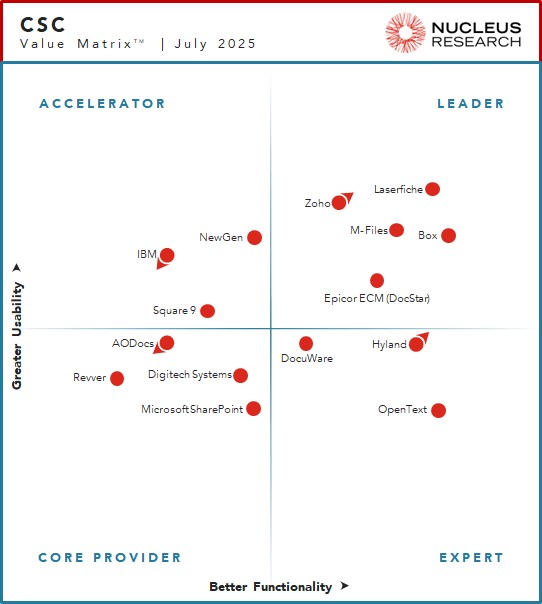
Laserfiche Named a Leader in Nucleus Research Content Services and Collaboration Value Matrix 2025

Laserfiche is a Leader for the 10th consecutive year, ranks highest in usability.

LONG BEACH, CALIFORNIA, JULY 23, 2025Laserfiche — the leading SaaS provider of intelligent content management and business process automation — is a Leader in the Nucleus Research Technology Value Matrix for Content Services and Collaboration for the 10th year in a row. Among the vendors evaluated, Laserfiche ranks highest overall in usability. Download a copy of the report here.

“As a leader in this year’s Value Matrix, Laserfiche was rated highest in usability for its AI productivity tools, new administration hub, process automation and integration capabilities,” said Evelyn McMullen, research manager at Nucleus Research and author of the report.

Nucelus Research CSC Technology Value Matrix™ 2025.

CSC as a Strategic Advantage: AI-powered Information Management

Recently released Laserfiche AI-powered features are aimed at boosting productivity even further and enabling automation at scale. Smart Fields, an out-of-the-box intelligent capture tool, allows customers to extract data automatically using natural language instructions, no matter the source or format. Smart Chat provides an intuitive chat interface that enables users to quickly gain insights from their repository content.

“As AI matures at an accelerated pace, vendors in the CSC market have the unique advantage of managing both structured and unstructured data from across the entirety of an organization,” the report’s Market Overview states.

Laserfiche AI features alongside powerful workflow automation, information governance and records management tools create new opportunities for organizational efficiency. Customers across industries use Laserfiche to increase productivity, create competitive advantage and drive growth.

“Laserfiche gives us the forms and workflow processes as well as data integration that enable efficiency at scale,” said Airline Hydraulics Chief Technology Officer Todd Schnirel. “Our Laserfiche-powered process improvements have supported us in achieving a significant increase in net revenue while adding very little operating expense.” 

“Being ranked a leader for 10 consecutive years is a testament to our product innovation,” said Thomas Phelps, senior vice president of corporate strategy and CIO at Laserfiche. “Our top ranking in usability reflects our core value of putting people first and our commitment to delivering intuitive solutions that empower users.”

To learn more about Laserfiche’s position in the Content Services and Collaboration market, download the report here.

About Laserfiche

Laserfiche is a leading enterprise platform that helps organizations digitally transform operations and manage their content with AI-powered solutions. Through scalable workflows, customizable forms, no-code templates and AI-enabled capabilities, the Laserfiche® document management platform accelerates how business gets done. Trusted by organizations of all sizes — from startups to Fortune 500 enterprises — Laserfiche empowers teams to boost productivity, foster collaboration, and deliver a superior customer experience at scale. Headquartered in Long Beach, California, Laserfiche operates globally, with offices across North America, Europe, and Asia. 

Make Digital Change Easier for Your Government Agency

Help employees adapt to new technology and improve citizen services.

Technology helps drive progress, but people make change happen. Adopting a new systems approach is challenging work. Government system upgrades work when employees see new tools as a help, not a hassle.

Lasting improvements come from fostering a growth mindset. Teams must see more efficient processes as opportunities and recognize the potential for positive change. When they believe in the benefits, digital upgrades have lasting success.

If you’re working to build that culture in your agency, we’re sharing what we’ve learned to help you get started.

How to Build a Digital-First Mindset

Help your team get on board with change. Here’s how:

  • Keep the mission in focus. Make sure digital upgrades help staff work efficiently, save money, and deliver better citizen services.
  • Get input from stakeholders. Work with employees, IT, and leadership to choose the right tools and automation for your agency’s needs.
  • Set up a steering committee. A small group of department heads, IT leaders, key staff, and other stakeholders can guide decisions, keep projects on track, and ensure alignment with team needs.
  • Use a step-by-step rollout. Clear communication on proven strategies and phased rollouts helps employees adjust without feeling overwhelmed.
  • Offer hands-on training. Give employees time to learn new systems with real examples from their daily work. Allocate resources for staff training and vendor support.

Start small and grow. Test changes with low-risk projects before rolling out a new process agency wide.

Build Buy-In for Shared Digital Services

Tompkins County, NY brought together more than 20 departments under one shared Laserfiche system—standardizing processes, automating forms, and giving staff user-friendly tools to adapt quickly.

What would your agency gain if every department worked from the same playbook and felt confident using digital tools? Learn how an ECM system can encourage collaboration and improve productivity, as well as how to find the right platform for your organization with our ebook, the ECM + AI Buyer’s Guide.

Laserfiche Series: Your Guide to Upgrade State and Local Government Service Technology

Learn from public sector leaders who have successfully modernized their government services with Laserfiche.