


This summit brings together IT leaders looking to redefine what’s possible. From scaling AI, simplifying infrastructure to unlocking data-driven decisions and leading with empathy, you’ll explore how to drive meaningful change across people, platforms, and performance – while keeping your organization resilient, agile, and ready for what’s next.
The Government Innovation Showcase Florida offers a unique opportunity for state agencies to highlight their achievements and dive into the strategies that contributed to their success. This event serves as a platform for agency leaders to showcase their innovative approaches and the operational improvements that have enabled them to excel.
By focusing on the methods that helped drive these successes, the summit aims to assist other agency leaders in replicating similar results. Attendees will gain insights into best practices around collaboration, technology, digital transformation, cybersecurity, workforce development, vendor collaboration, and procurement processes that have proven effective in advancing agency missions.
Join your fellow leaders to explore how Florida’s state agencies can continue to support one another in achieving shared goals for the benefit of all Floridians.
The Summer Higher Ed CIO Congress will focus on 75 c-level executives on the technology side of higher education (CIOs, CTOs and VPs of Technology). These leaders are mainly focused on cybersecurity, maximizing student success, and the quality and practices associated with undergraduate, graduate, and professional study at the college/university. Conference sessions will address how technology leaders can improve their institution’s technology programs, support services, and organizational design to drive innovation and help students from all backgrounds succeed.
Bringing together the brightest minds in state and local government, this summit empowers public-sector leaders to explore cutting-edge technologies, modernize operations, and solve pressing challenges. From cybersecurity and AI to data governance and digital service delivery, sessions are designed to spark insight, foster collaboration, and accelerate real-world results. Whether you’re shaping strategy or implementing solutions, the Summit delivers valuable peer connections and actionable guidance to help move your mission forward.
Join us at the Government Innovation Virginia 2026 to explore insights in data management, modernized infrastructure, citizen-focused digital services, digital inclusion, and inter-agency collaboration. This event will highlight Virginia’s innovative approaches and provide a platform for sharing ideas with peers across the state while addressing critical topics such as cybersecurity resilience, responsible AI and data stewardship, and workforce readiness.
This summit brings together IT leaders looking to redefine what’s possible. From scaling AI, simplifying infrastructure to unlocking data-driven decisions and leading with empathy, you’ll explore how to drive meaningful change across people, platforms, and performance – while keeping your organization resilient, agile, and ready for what’s next.
The ALB Regulatory Summit event series is dedicated to providing a forum for regional and global regulatory bodies and policymakers across industries with an emphasis on the financial services industry across the Asia-Pacific region.
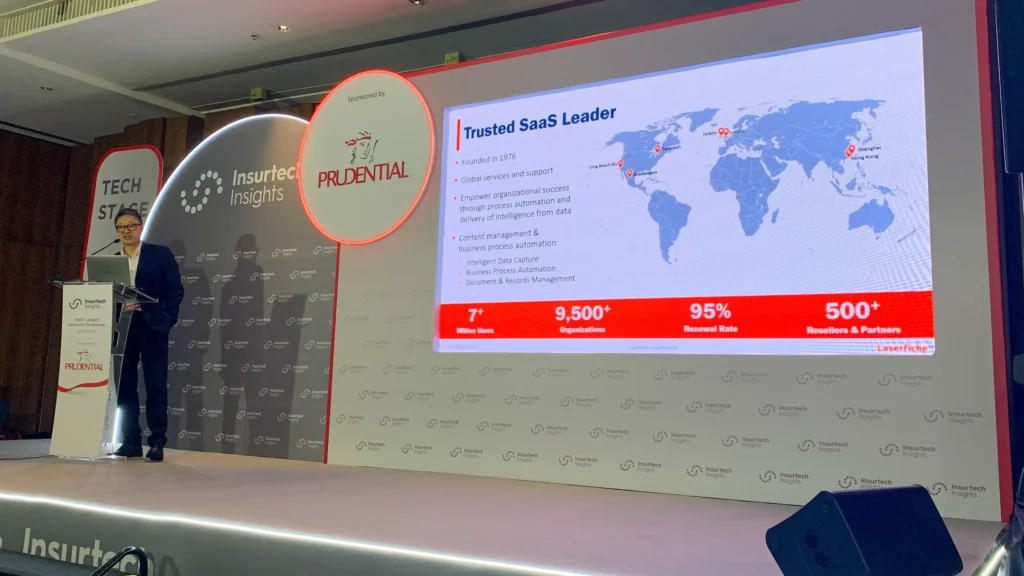
During our time at Insurtech Insights Asia 2025, Asia’s largest insurance conference, it became clear insurers are stepping into a new era — one where data, content and AI shape how they work and grow. The next step in digital transformation is here: it’s time to move past proof-of-concept projects and implement and adopt AI enterprise-wide.
Gen AI and agentic AI are reshaping the entire value chain — including claims processing, underwriting, policyholder onboarding, policy services, and more. Leaders at the event were clear: to keep up with policyholder expectations and stay competitive, the industry needs connected data, processes and systems.
Debrief: The Top 4 Challenges Facing Insurers
Across keynote sessions and conversations, several challenges stood out. These are no isolated problems — they affect the entire business:
- Silos that hinder data accuracy and accessibility across the value chain.
- Manual or unsophisticated workflows that slow productivity, delay processing times and increase operational risk.
- Growing compliance and audit pressures with evolving HKIA (Hong Kong Insurance Authority) and regional regulatory changes.
- Demands from policyholders for instant, digital experiences.
These challenges showcase the rising expectations from policyholder, regulators and the market.
Laserfiche’s latest survey reflects this wider shift across the industry:
• 80% of organizations are focused on automating manual processes
• 48% want smoother data flow through system integrations
This growing push toward automation and integration is driving insurers to rethink how they manage data across the enterprise — which brings us to one of the biggest barriers: ghost content.
The True Barrier in Digital Transformation: Ghost Content
As more services than ever are digitized, a major issue — ghost content: the unstructured data hidden inside claims files, medical records, policy documents, scanned forms, handwritten notes, and more.
This creates downstream consequences:
- Longer processing times and delayed service
- Inconsistent decisions due to lack of complete information
- Higher compliance and audit risk
Without solving the ghost content problem, digital transformation becomes much harder — and AI cannot reach its full potential.
The AI Shift: From Paperwork to Enterprise Content Management
What was apparent in all of our conversations at Insurtech Insights, modern companies require modern solutions and are looking how AI can improve the entire flow of information management. Laserfiche was on site to discuss how AI-driven content management is the essential solution to fix these modern challenges:
- AI-driven data extraction, using Smart Fields, to turn unstructured data into usable, insightful data with a single click.
- AI-powered summarization to get key information for claims adjusters, underwriters and servicing teams with Smart Chat intuitive interface.
- Automated end-to-end workflows across first-notice-of-loss (FNOL), claims processing, onboarding and policy services to reduce manual work and increase accuracy.
- Real-time data through integrations that consolidates policyholder information.
- Compliance-ready data and records governance to support auditability and regulatory alignment.
The Importance of Leveraging AI
The message from Insurtech Insights Asia was clear: modernization is no longer about adopting point solutions — it’s about transforming the enterprise through:
- Better policyholder experiences through hyper-personalized, digital services
- Strategic alignment, so teams share real-time, accurate data
- Operational efficiency through automation and integration
- High-quality data to support AI models and decision making
- Greater flexibility using low-code tools that allow teams to adjust processes without IT
The Main Takeaway from Insurtech Insights Asia 2025
Insurtech Insights attendees told us what they want – clear insights into their ghost content and strategic action – and looking for efficiency gains, long-term agility and scalable growth. By eliminating ghost content enterprise-wide, you can boost productivity, lower operational risk and open the door to new opportunities for growth.
To learn more about Laserfiche’s AI-powered insurance solutions, visit our Insurance Solutions page.
GITEX AI ASIA X AI EVERYTHING SINGAPORE is where the world’s most ambitious tech ecosystems converge — uniting AI pioneers, digital infrastructure leaders, frontier startups, and strategic investors to accelerate transformation across every major sector.
From public-private collaboration to enterprise adoption, the show delivers real outcomes, deep partnerships, and future-defining breakthroughs — live from Singapore, Asia’s capital of Innovation.