The Harris Center Enhances Organizational Processes with Laserfiche 

The Harris Center for Mental Health and IDD serves tens of thousands of people in need of mental health services across all socioeconomic levels in Harris County, Texas. As the third-largest organization serving such needs in the United States, the center prides itself on providing high-quality, efficient and cost-effective services that impact every corner of the county. 

The Harris Center previously relied on manual processes to handle administrative and operational workflows. This method led to inefficiencies: Documents were frequently misplaced; there was no visibility into process status, and the lack of trackable data created challenges in securing funding. 

The Harris Center for Mental Health\

The IT team at the Harris Center leveraged Laserfiche to replace manual processes with Laserfiche Forms and process automation. “After evaluating several collaboration and content management platforms, we selected Laserfiche as our solution of choice due to its flexibility, scalability, user-friendly interface, and robust security features,” said Chief Information Officer Mustafa Cochinwala. “Laserfiche offers powerful workflow automation, seamless integration capabilities with our existing systems, and a strong compliance framework that aligns with our organizational and regulatory requirements.”

The Harris Center has since automated 90 tasks, with 171,267 submissions using Laserfiche Forms, significantly reducing the time it takes to complete processes by up to 99%. Additionally, the center consolidated data, enhanced executive reports, improved decision making, and strengthened document security. 

Tackling Manual Tasks 

The Harris Center aimed to significantly reduce manual, repetitive tasks with Laserfiche, addressing inefficiencies including inaccurate data, security, and resource allocation.  

A game-changer for the center was the digitization of the low-level offender intake form. Previously, the organization required police officers to fill out paper forms on clipboards. This approach — fraught with handwritten notes and misplaced documents — compromised the accuracy and security of sensitive patient information.  
 

The Information Technology team created a Laserfiche workflow to relieve staff from having to interpret handwriting, chase down information and re-enter data. As part of the solution, an intuitive digital intake form collects complete, consistent information — such as patient health background and situation — from law enforcement partners.  

The Harris Center staff have since seen a dramatic improvement in their ability to quantify these services and measure their impact.  

“The shift has enhanced operational efficiency and elevated the quality and reliability of our reporting — empowering us to serve our community with greater precision and accountability,” said Anthony Jones, director of information technology applications and development for The Harris Center.  

The Harris Center for Mental Health

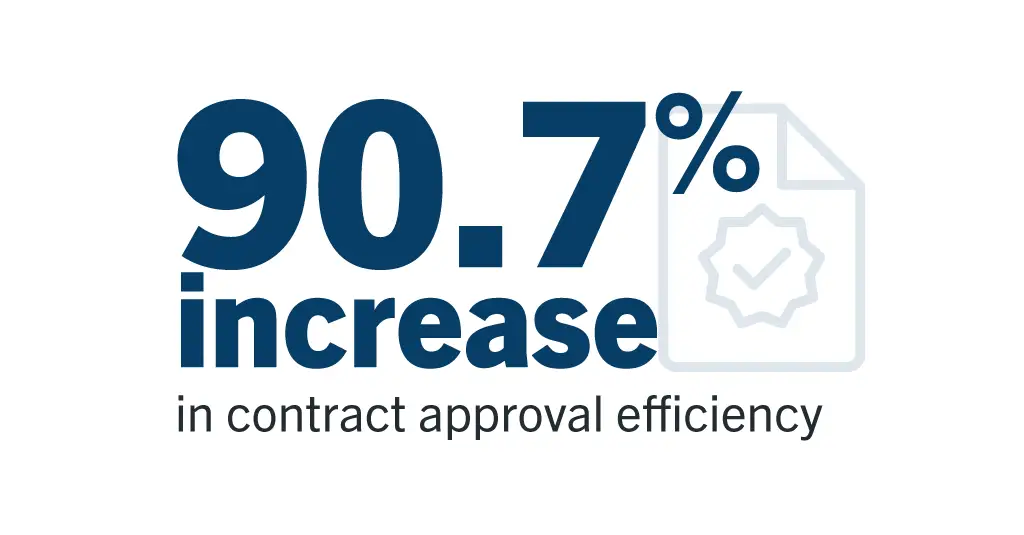
This efficiency can also be seen in the center’s contract approval process. Previously, it took 30 to 90 days to gather vendor information for contract approval from Leadership. The approval timeframe was reduced to an hour by using a Laserfiche Form for gathering information and approvals. The center saved approximately 479 working hours in this process, a 90.7% increase in efficiency. 

“Overall, the adoption of Laserfiche has not only improved efficiency but also provided a strong financial return on investment for our organization,” said Jones.  

Secure and Seamless Legal Processes 

Beyond patient intake and contracts, The Harris Center has also implemented Laserfiche for legal processes. When courts send magistrate orders to the center, they expect responses within 24 to 48 hours. 

The legacy process relied on manual routing, either through email or hand delivery. Staff had to print out, scan, sign, scan again, and return paper forms. And because of the strict deadlines, these orders often felt like an unwelcome fire drill. Now, an automated process delivers magistrate orders to the relevant staff members in Laserfiche, so staff can provide the necessary information digitally. To satisfy a legal requirement for signatures, staff use a signature pad to sign the form, which is then sent back to the court through an SFTP folder.  

“The process was a mess before. Using a Laserfiche form — the difference is night and day,” said Jones. “Laserfiche has improved our court order handling, moving from a clunky email system to a seamless electronic process integrated with Epic.”  

The solution is one of many examples of how optimized data management has greatly enhanced productivity across the organization.  

The Harris Center for Mental Health

“Laserfiche has delivered significant cost savings through reductions in manual processing time, operational inefficiencies, and paper-related expenses,” explained Jones. “By automating workflows and replacing outdated manual processes, the organization has realized over 50 hours of weekly savings.”  

Easier Processes Enhance the User Experience 

While forms have enabled faster processes, Laserfiche has also supported The Harris Center’s budget goals. The State of Texas requires health staff across the state to participate quarterly in the Medicaid Administrative Claims (MAC) survey. The MAC survey is critical in assisting states to secure federal reimbursement for certain Medicaid administrative activities. For The Harris Center, the survey aids in recovering costs for behind-the-scenes work, not related to medical services, that support Medicaid.  

Before Laserfiche, the survey was conducted through SharePoint, which required staff to enter their employee ID and lacked tracking capabilities. Consequently, only 55-60% of staff completed the survey. 

The Harris Center for Mental Health

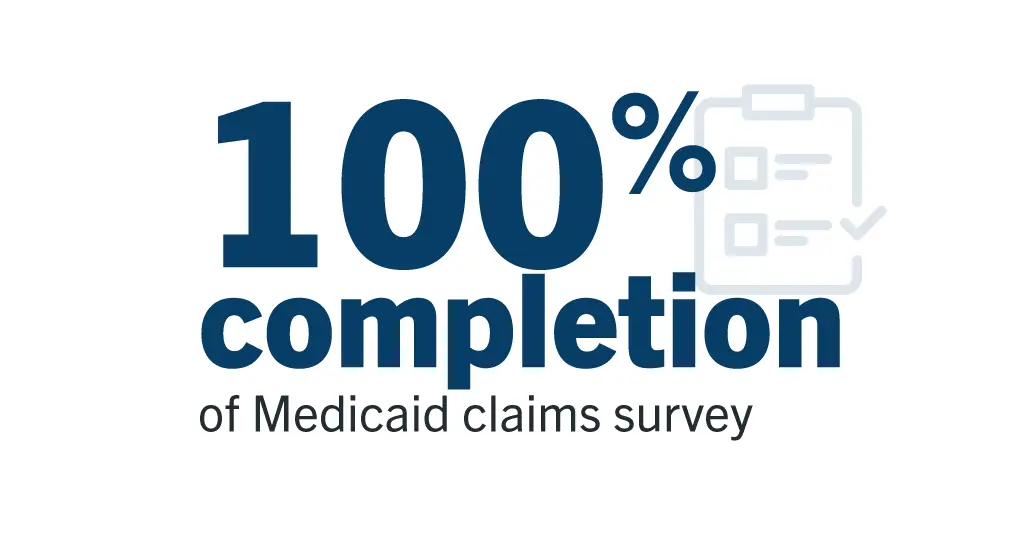
Using a Laserfiche Form, staff no longer need to waste time searching through their notes for their ID: Laserfiche auto-populates the information and tracks all submissions. As a result, the center increased the completion rate to 100%.  

The center also uses Laserfiche Forms to consolidate previously scattered information and enhance the organization’s reporting. With Laserfiche Forms and supplemental Power BI reports, the organization now has a full overview of its processes in one secure location. “These reports allow us to have all the comprehensive information in one place and to make operational decisions from that data,” explains Jones. “We use these reports in an operational capacity daily. From top to bottom, dealing with patient care, employee care and daily operations.” Clinical activity, for example, is tracked by combining Laserfiche and EHR data to support the patient census and enable better resource allocation.   

The Hunt for Manual Processes Continues 

The center continues to redefine organizational workflows and transform outdated manual tasks into streamlined systems with Laserfiche. The team has seen dramatic improvements in their daily workflows and strategic planning. Task delegation ensures departmental accountability. Process automation expedites services. Data tracking enables meticulous documentation for enhanced reporting. Laserfiche  repository security controls support compliance with industry standards and regulatory requirements.  

The organization’s vision for Laserfiche is to drive further enhancements in operational processes. “We’ve done a lot of good things with Laserfiche forms since we went live with Laserfiche,” said Jones. “I’ve asked my team, if there’s any manual processes out there, let’s address it and automate it. Laserfiche allows employees to help people behind the scenes. If we did not support the people that help people, they would not be as successful as they are.” 

From Insight to Impact: How AI-Powered Content Management Can Advance Community Colleges

Laserfiche AI at Innovations Conference 2026

At this year’s Innovations Conference, one theme was impossible to ignore, especially at Tuesday’s general session “AI in Action: A Conversation with League AI Fellows”: artificial intelligence is rapidly improving how the back office of community colleges impacts student outcomes.  

From preparing students for an AI-enabled workforce to rethinking how institutions deliver support services, leaders are being asked to evolve on multiple fronts at once. Beneath the excitement, however, there was also trepidation about where to start or find impact.  

Community colleges are being asked to improve retention, increase completion rates, expand access and deliver workforce-ready outcomes with constrained resources and increasingly complex student needs. The question is no longer whether AI has a role to play but how institutions can meaningfully leverage AI to improve the student experience. 

The New Reality of Student Success 

Community colleges serve some of the most diverse and dynamic student populations in higher education. Many students balance work, family and financial pressures. Others are navigating college systems for the first time. Success, in this context, depends on more than academic performance. It depends on whether the institution can deliver timely, coordinated and personalized support. 

At the conference, I heard about the promise of AI to identify at-risk students earlier, recommend interventions and even personalize learning pathways. These capabilities are powerful, but also surface a critical gap: Insight alone is not enough. 

Many institutions struggle with fragmentation across departments and systems, making it difficult to act on even the best data. Student services, advising, financial aid and registrar functions often operate in silos. Information is scattered. Processes are manual and follow through is inconsistent. AI can help by highlighting where aide is needed.   

From AI Insight to Institutional Action 

At Innovations, several discussions pointed toward this emerging model: combining AI-driven analytics with process automation and enterprise content management (ECM), to create a connected, responsive student support ecosystem. 

In practical terms, this means:  

  • When AI identifies a student at risk, a case is automatically created  
  • Tasks are routed to the appropriate advisor or support team  
  • Required documentation and communications are managed in one place  
  • Interventions are tracked, measured, and continuously improved  

This is not just about efficiency but also consistency and accountability to ensure no student falls through the cracks simply because a process broke down or information was not visible to the right person at the right time. 

Building a 360-Degree View of the Student 

Another key theme from the conference was the need for a more holistic understanding of the student journey. Student success is shaped by a combination of academic progress, financial stability, administrative processes and personal circumstances, yet most institutions still lack a unified view of this experience. 

AI has the potential to connect these signals with governed access to well-managed, trustworthy information. This is where content management becomes foundational: AI is only as effective as the information environment beneath it. Without structured, governed, and accessible content, AI can amplify gaps rather than solve them. 

For community colleges, this means investing in tools to: 

  • Centralize student records, documents, and interactions  
  • Apply consistent governance and security policies  
  • Enable secure sharing of information across departments  
  • Provide a complete, auditable view of student support activities  

When these elements are in place, institutions can move closer to a true 360-degree view of the student, one that allows staff to respond with context and precision. 

We’ve seen that with customers already. 

“Everyone is happy with our Laserfiche solution, especially our students. The transparency and collaboration that the system provides has been well received, and we look forward to expanding our use throughout the college.”  

— Nishika Gupta, Managing Director of Records and Information Management at Bergen Community College 

AI Governance for Community College Success 

One of the more grounded conversations at Innovations was not about what AI can do, but how it should be used. In education, trust is everything. Students need to trust their data is handled responsibly, and faculty and staff need to trust that AI-supported processes are transparent and fair. Leaders need confidence that decisions can be explained and audited. 

This mirrors what we are seeing across the public sector more broadly: AI adoption succeeds when it is built on strong governance, trusted data, and human oversight. 

For community colleges, this is particularly important. The goal is not to replace human connection with automation, but to augment it and give staff the tools they need to focus on meaningful student engagement rather than administrative overhead. 

“We’ve saved the college 20,000 hours, at a minimum, just by automating processes that used to be manual. That’s upwards of $750,000, probably approaching $1 million dollars by now, in hard cost savings.”  

— Ron Spaide, Chief Information Officer at Bergen Community College 

Advancing the Mission 

Community colleges have always played a critical role in expanding access to education and preparing students for the workforce. That mission has not changed. But the environment in which they operate has. 

AI offers a powerful opportunity to rethink how institutions deliver on that mission. Not by adding more complexity, but by creating more connected, responsive, and student-centered operations. 

The institutions that will lead in this next phase are not those that simply adopt AI tools; they are the ones that build the infrastructure to act on what AI reveals. 

Because in the end, student success is not driven by insight alone. It’s driven by what institutions do with it.  

To learn how to reimagine the community college’s student experience and power your processes, read more about Bergen Community College. 

From Ghost Content to Strategic Advantage: AI-Powered Transcript Processing

Ghost Content in Higher Ed

At this year’s Innovations Conference in Indianapolis, we talked about AI’s impact on document and records management with one key use case stood out across conversations with higher education leaders. Institutions are no longer exploring artificial intelligence as an abstract idea but are actively applying it to core administrative processes that shape the student experience.  

Transcript processing is emerging as one of the clearest opportunities to create both immediate and long-term impact. 

For CIOs and senior academic and administrative leaders, transcript processing is not simply a back-office task. It reflects deeper institutional challenges that slow decisions, increase operational costs and limit the ability to use data effectively. When transcripts move from unstructured documents to governed, trusted data, they deliver far more than faster turnaround times. They help build a stronger digital foundation for institutional agility. 

Bottlenecks That Slow the Entire Student Journey 

Transcript delays influence far more than admissions decisions. Slow evaluation leads to late course placements, delayed advising, inaccurate forecasting and a confusing start for students. When transcript review takes days or weeks, downstream academic and administrative processes stall. 

Data Silos That Limit Insight 

Transcripts arrive in a wide range of formats and quality levels. Without modern data extraction and classification, these documents become ghost content, meaning information the institution stores but cannot easily find or use. When transcripts fall into this category, leaders lose visibility into essential academic data that informs planning and student support. 

Technology Debt and Fragmented Systems 

Many institutions rely on legacy repositories, shared drives and departmental workarounds. These disconnected systems make it difficult to create consistent workflows, manage risk or scale operations. Leaders are increasingly seeking clearer processes, fewer tools and stronger governance. 

Ghost Content as a Hidden Obstacle 

The challenge of ghost content is especially pronounced in higher education. Institutions hold large volumes of transcripts and other critical documents that are unstructured, poorly indexed or buried in isolated systems. These files contain important academic data, but without structure they cannot support reliable decision making. 

Transcripts arrive as scanned images, emailed PDFs, or exports from student information systems. If the information inside them cannot be extracted or trusted, it results in slow processes, inconsistent decisions and compliance concerns. 

AI-driven content management directly addresses this problem by transforming unstructured documents into usable data. It turns static files into active institutional knowledge, reduces uncertainty,and increases operational efficiency. 

The AI Shift: Moving from Manual Review to Content Intelligence 

Institutions that are making the most progress with AI are not treating it as a small technology upgrade. They are building a modern foundation for content intelligence, and transcript processing is one of the best places to begin. It touches every part of the student lifecycle and supports high volume, high-stakes decisions. 

Here is how Laserfiche is supporting higher education in this shift. 

Smart Fields for Structured and Governed Data 

Smart Fields can extract key transcript data such as course names, grades, terms, GPA and credit hours. The information becomes searchable metadata instead of buried text. Institutions gain structured data that improves accuracy and supports academic and operational decision making. 

Campus-Wide Visibility and Governance 

Once transcript data is structured, it integrates seamlessly with workflows across enrollment, advising, academic records and IT. Records become easier to validate, secure and audit. Leaders gain confidence that sensitive academic information is managed consistently and in compliance with institutional policies and accreditation requirements. 

Scalable Operations 

AI-driven content management increases resilience during peak periods. Institutions can manage higher transcript volumes without adding staff or sacrificing accuracy. With staffing shortages and increasing service expectations, this scalability is becoming essential. 

Improved Student Experience 

Fast and accurate transcript processing supports timely advising, clear communication, smoother onboarding and fewer delays for students. When information moves quickly and accurately, the student journey improves. 

Why This Matters to CIOs and Senior Leaders 

Transcript processing is not often highlighted in strategic planning documents, yet it is one of the clearest indicators of an institution’s digital maturity. When institutions modernize transcript processing with AI-driven content management, they unlock benefits across the entire organization. 

Strategic Alignment 

Modern transcript workflows bring enrollment, academic records, IT and student services into closer alignment through consistent data and shared processes. 

Operational Efficiency 

Processing times can decrease from weeks to hours, allowing staff to focus on higher value work rather than repetitive manual tasks. 

Improved Data Quality 

Structured transcript data supports better analytics, forecasting and planning efforts. 

Technology Simplification 

Institutions can reduce redundant tools and move toward a more modern cloud-focused architecture. 

Long Term Agility 

A strong content foundation enables faster adaptation to enrollment changes, evolving compliance requirements and shifting student needs. 

Institutions that view AI as a set of isolated tools will struggle to gain traction. Those that adopt AI-driven content management as an enterprise capability will build more adaptive and resilient organizations. 

The Road Ahead 

Transcript processing is only the beginning. Once institutions create a strong content and data foundation, they can apply the same approach to financial aid, academic records, HR, procurement and student services. Each of these areas contains large volumes of ghost content that hinder performance and create opportunities for improvement. 

AI-driven content management is no longer a departmental project. It is a strategic capability that strengthens operational performance, data governance and the student experience. Laserfiche is helping higher education leaders transform the information they already have into knowledge that supports strong effective operations. 

Learn more about streamlining student records best practices by seeing how California Baptist University digitized more than 8,000 student records in a single year. 

Laserfiche Announces 2026 Run Smarter® Award Winners

LONG BEACH, CALIFORNIA, March 18, 2026 — Laserfiche — the leading SaaS provider of intelligent content management — today announced the winners of the 2026 Laserfiche Run Smarter® Awards.

These awards celebrate the visionaries and trailblazers who are redefining the possible, using Laserfiche to dismantle operational silos and catalyze a new era of enterprise-wide productivity. From a large city reimagining criminal justice to a financial services firm’s innovative use of AI to enable smarter service delivery: The winners enhance productivity, reimagine processes and improve lives with Laserfiche technology.

“The true power of Laserfiche has always been in how it unlocks value — whether that is through delivering actionable intelligence, cost savings, or reclaimed time to put toward new innovation,” said Karl Chan, CEO of Laserfiche. “This year’s honorees are at the forefront of information management technology, with many of them leveraging cloud and AI technology to modernize processes and achieve business transformation.”

Congratulations to the 2026 Run Smarter Award winners:

  • Doug Haubert, City Prosecutor, Long Beach City Prosecutor’s Office: Nien-Ling Wacker Visionary of the Year
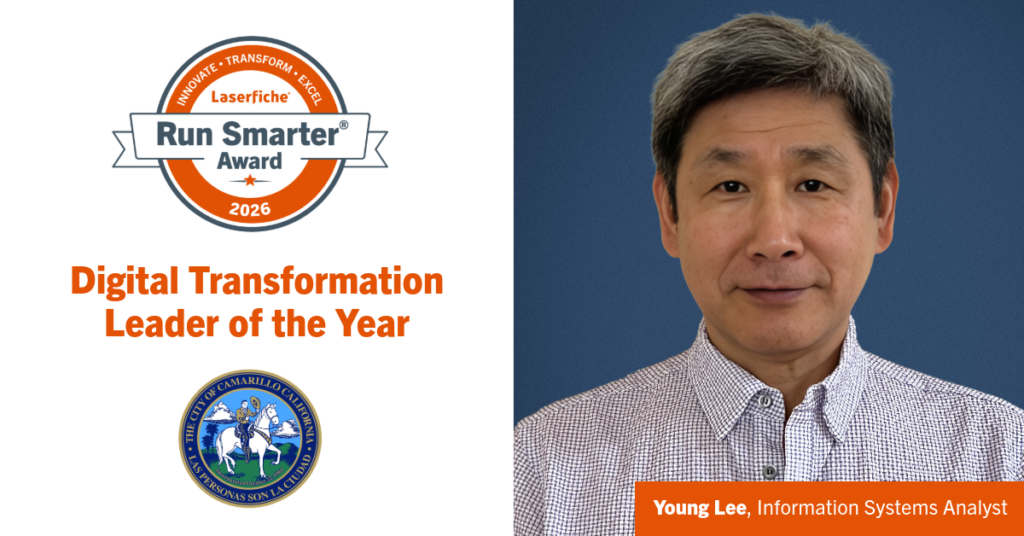
  • Young Lee,Information Systems Analyst, City of Camarillo, California:Digital Transformation Leader of the Year
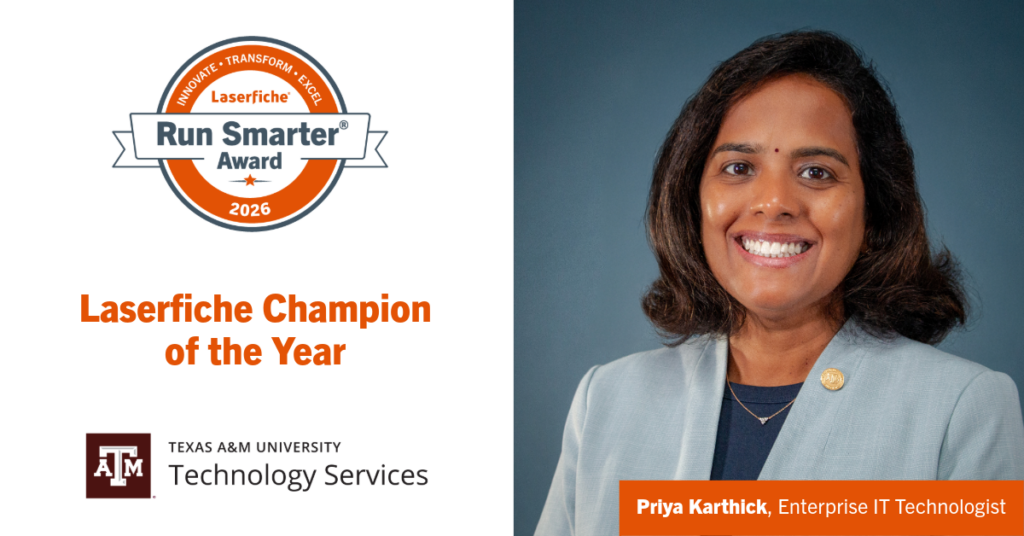
  • Priya Karthick, Enterprise IT Technologist, Texas A&M Technology Services:Laserfiche Champion of the Year
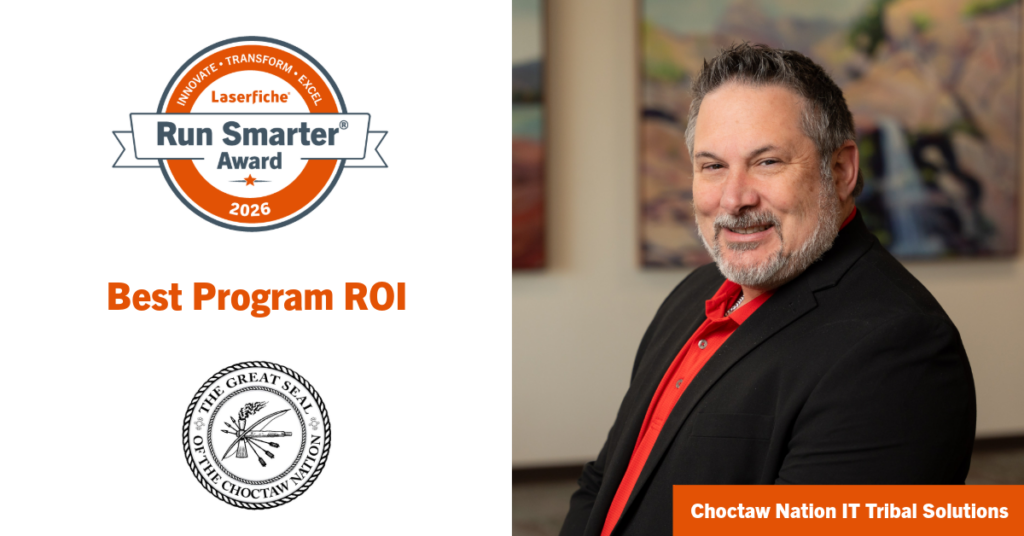
  • Choctaw Nation IT Tribal Solutions: Best Program ROI
  • Palo Alto Unified School District Information Services:Change Maker of the Year
  • Kansas State University: Laserfiche Program of the Year, U.S./Canada
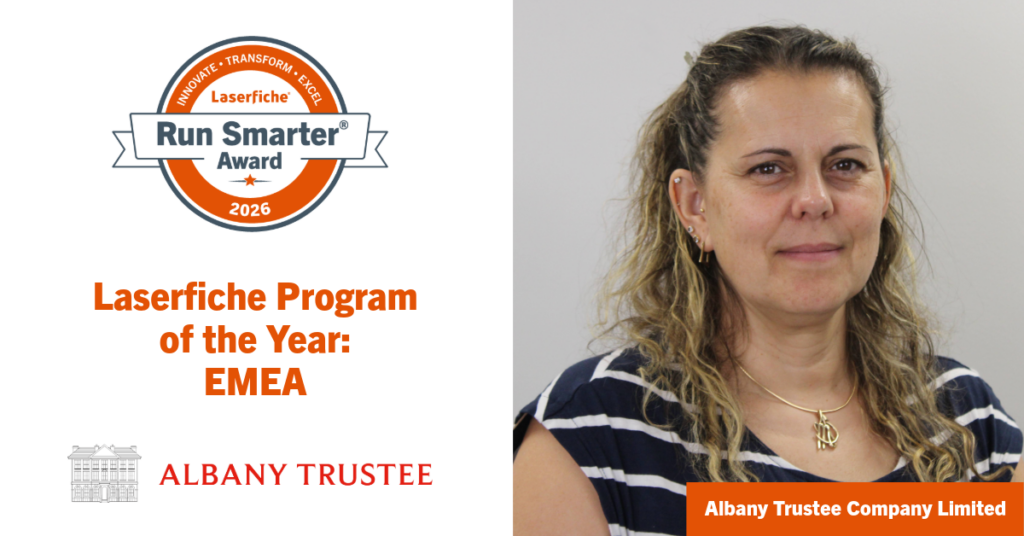
  • Albany Trustee Company Limited: Laserfiche Program of the Year, EMEA
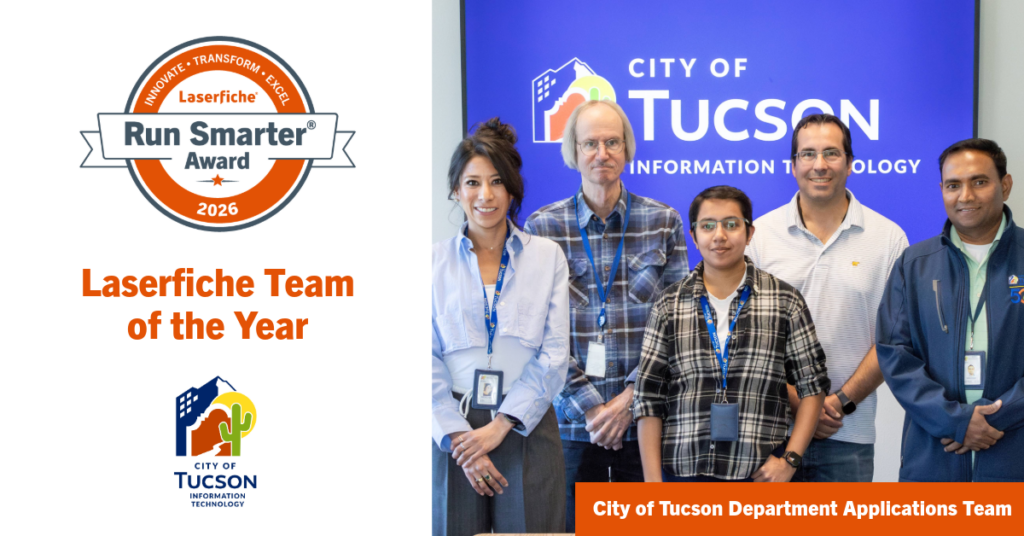
  • City of Tucson Department Applications Team:Laserfiche Team of the Year

Learn more about the Laserfiche Run Smarter Award winners here.

Laserfiche will celebrate the winners during the 2026 Empower conference. Click here to register for the conference.

About Laserfiche 

Laserfiche is the leading enterprise platform that helps organizations digitally transform operations and manage their content with AI-powered solutions. Through scalable workflows, customizable forms, no-code templates and AI-enabled capabilities, the Laserfiche® document management platform accelerates how business gets done. Trusted by organizations of all sizes — from startups to Fortune 500 enterprises — Laserfiche empowers teams to boost productivity, foster collaboration, and deliver a superior customer experience at scale. Headquartered in Long Beach, California, Laserfiche operates globally, with offices across North America, Europe, and Asia. 

Congratulations to the Laserfiche Run Smarter® Award Winners

The Laserfiche Run Smarter® Awards celebrate the visionaries and trailblazers who are redefining the possible, using Laserfiche to dismantle operational silos and catalyze a new era of enterprise-wide productivity. These winners are enhancing productivity, reimagining processes and improving lives with Laserfiche technology.  

From municipal governments slashing process times by 92% to retail giants unlocking data from millions of invoices, the 2026 winners represent the gold standard of operational excellence. These organizations are reimagining what’s possible when technology and human ingenuity collide. Here is how this year’s elite class of innovators is redefining the way the world works: 

Nien-Ling Wacker Visionary of the Year: 

Doug Haubert, City Prosecutor

Doug Haubert, City Prosecutor, Long Beach City Prosecutor’s Office

Doug Haubert has provided visionary leadership for the Long Beach City Prosecutor’s Office through championing the GUIDES program (Government User Integrated Diversion Enhancement System). By using Laserfiche to turn siloed records into real-time, actionable intelligence, Haubert supports Long Beach officers in addressing complex social issues — from gang violence to mental health — with unprecedented precision and empathy. This digital ecosystem fosters seamless collaboration between law enforcement and service providers, shifting the focus from arrests to high-impact intervention. The result has been a measurable reduction in crime, faster access to critical social services, and a strengthened foundation of community trust. 

Digital Transformation Leader of the Year: 

Young Lee, Information Systems Analyst

Young Lee, Information Systems Analyst, City of Camarillo, California

Under Young Lee’s leadership, the City of Camarillo transformed a daunting year-end HR and payroll marathon into a sprint. By fostering cross-departmental collaboration and launching a citywide workflow initiative, Lee’s upgraded automated workflow slashed processing time from 50 hours to just four — a staggering 92% increase in efficiency. This digital overhaul didn’t just eliminate administrative bottlenecks; it created higher accuracy and empowered staff to trade manual data entry for community impact. Lee proves that with the right workflow, administrative burdens vanish, delivering a clear ROI and better citizen service. 

Laserfiche Champion of the Year: 

Priya Karthick

Priya Karthick, Enterprise IT Technologist, Texas A&M Technology Services

As a dedicated Laserfiche Champion, Priya Karthick has moved beyond simple implementation to true advocacy, mentoring peers and spearheading enterprise-wide Laserfiche initiatives that redefine the higher education experience. From automating complex onboarding processes to founding vibrant user groups, Karthick’s work ensures that hiring managers and new employees alike benefit from a seamless, digital-first environment. Her commitment to knowledge-sharing and community building has turned Texas A&M into a beacon of efficiency, proving that digital transformation is most powerful when it’s collaborative. 

Best Program ROI:

Choctaw Nation IT Tribal Solutions

Choctaw Nation IT Tribal Solutions

The Choctaw Nation is redefining how a tribal government serves its people. Since 2017, the organization has automated 111 distinct programs, turning what was once a months-long application process for tuition and emergency aid into a streamlined experience taking under two weeks. The impact is staggering: an 87% drop in incomplete submissions and over 107,000 staff hours reclaimed in a single year — a productivity boost valued at $3.76 million. By eliminating manual bottlenecks and saving $250,000 annually in administrative costs, the Choctaw Nation is proving that digital maturity isn’t just about efficiency; it’s about providing faster, more reliable support to every tribal member. 

Watch the full interview with the Choctaw Nation’s Todd Hughes

Change Maker of the Year:

Palo Alto Unified School District

Palo Alto Unified School District Information Services

The Palo Alto Unified School District (PAUSD) turned a cloud migration into a complete operational rebirth. Through “Implementation 2.0,” the district upgrated to Laserfiche Cloud, choosing to rebuild critical business processes from the ground up rather than simply digitizing old habits. 

By mastering APIs and modern data connectors, PAUSD successfully integrated Laserfiche with its student information system, automating everything from substitute teacher provisioning to enrollment. This shift has transitioned the IT team from “infrastructure maintenance” to strategic innovation partners. Through this effort, the team has affected profound cultural change where departments across fiscal, HR, and student services now collaborate to eliminate manual data entry and prioritize student success. 

See how PAUSD focuses on student success with tech-driven solutions. 

Laserfiche Program of the Year, U.S./Canada:

Kansas State University

Kansas State University

The team at Kansas State University aims to set the standard for inspiring learning and engagement for their over 21,000 students. Laserfiche has supported that mission by transforming student services through intelligent automation. By automating a process for academic program changes, the university now processes 85% of requests in under a day, and has reclaimed over 49,000 staff hours. This transformation not only enhances student experience but also strengthens operational efficiency and responsiveness. 

Get the details on KSU’s award-winning program

Laserfiche Program of the Year, EMEA:

Albany Trustee Company Limited

Albany Trustee Company Limited

Guernsey-based Albany Trustee turned its “Project Paperless” into a blueprint for modern fiduciary services. By embedding Laserfiche into the heart of operations, the firm transitioned from static spreadsheets to real-time visibility, ensuring that data integrity and compliance are built directly into their daily workflows. The results go beyond simple time savings; the organization has achieved structured AI adoption, driving higher accuracy in document creation and process analytics. By automating repetitive filing, Albany Trustee has empowered its team to focus on high-value client service. This transformation goes beyond streamlined operations and has sparked a culture of innovation where staff are digitally confident and actively seeking the next technological frontier. 

Laserfiche Team of the Year:

City of Tuscon Department Applications Team

City of Tucson Department Applications Team

The City of Tucson transformed digital compliance into a community asset. Facing upcoming federal requirements, the city’s Laserfiche team proactively overhauled 335 public-facing production forms to support full accessibility and ADA compliance, bridging a critical gap in resident services. Through rigorous research and a structured deployment strategy, the city eliminated screen reader errors and improved usability for all residents — all without additional software investments or vendor intervention. This initiative set a new standard for inclusive governance. By prioritizing dignity and access, Tucson has ensured that every citizen can navigate city services with ease and confidence. 

To hear more Laserfiche success stories, register for Empower today. 

Read more Laserfiche case studies.    

Laserfiche Earns 5-Star Rating in the 2026 CRN® Partner Program Guide

LONG BEACH, CALIFORNIA, March 11, 2026 — Laserfiche — the leading SaaS provider of intelligent content management — has been honored by CRN®, a brand of The Channel Company, with a 5-Star Award in the 2026 CRN Partner Program Guide. This annual guide is an essential resource for partners seeking vendor partner programs that match their business goals and deliver high partner value.  

As organizations navigate growing pressure to increase productivity and respond to regulatory change, Laserfiche’s AI-powered document management solutions enable users to transform operations and achieve meaningful business results at scale.

Partners that innovate with Laserfiche solutions have the opportunity to grow profits through the Laserfiche Partner Program, which equips them with the tools and resources needed to deliver customer success. Laserfiche’s partner ecosystem drives sustainable growth, delivers differentiated solutions and maximizes opportunities for both partners and their customers. Laserfiche provides comprehensive AI and cloud-deployment training resources that empower partners to identify opportunities, secure deals and deliver effective solutions with confidence. 

“We are committed to equipping our partners with the comprehensive educational and marketing resources that enable them to secure profitable deals and provide transformative solutions,” said Josep Domingot, vice president of sales at Laserfiche. “A 5-star rating in the CRN Partner Program Guide certifies the work Laserfiche has done to create an expansive and profitable channel ecosystem.”

For the 2026 Partner Program Guide, the CRN research team assessed technology vendors based on the strength and breadth of their partner program offerings, including partner training and enablement, pre‑ and post‑sales support, marketing resources, technical assistance and ongoing communication. The resulting guide provides partners with meaningful insight into partner programs designed to support sustained success in a rapidly evolving channel landscape.

“Being included in the 2026 CRN Partner Program Guide reflects how today’s technology vendors are rethinking their partner programs to keep pace with a rapidly evolving channel,” said Jennifer Follett, VP, U.S. Content, Executive Editor, CRN, at The Channel Company. “As solution providers navigate new customer demands, business models and technologies, this annual guide serves as a critical resource for identifying vendors that are investing in programs designed to drive long‑term growth and shared success. The guide delivers meaningful insight into what sets each partner program apart, helping solution providers make confident, strategic partnership decisions.”

See the 2026 Partner Program Guide at www.CRN.com/PPG. To learn more about the Laserfiche Partner Program, visit the Laserfiche website.

About Laserfiche

Laserfiche is a leading enterprise platform that helps organizations digitally transform operations and manage their content with AI-powered solutions. Through scalable workflows, customizable forms, no-code templates and AI-enabled capabilities, the Laserfiche® document management platform accelerates how business gets done. Trusted by organizations of all sizes — from startups to Fortune 500 enterprises — Laserfiche empowers teams to boost productivity, foster collaboration, and deliver a superior customer experience at scale. Headquartered in Long Beach, California, Laserfiche operates globally, with offices across North America, Europe, and Asia.

Navigating the Agentic Era: Laserfiche 2026 Leadership Predictions

John Merrill speaking during the general session at the 2025 Empower conference.

As we move through 2026, the conversation around artificial intelligence has shifted from “what if” to “how fast.” For business leaders, this means the challenge is no longer just adopting AI, but orchestrating a landscape where AI agents, human expertise and rigorous data governance intersect. 

Below are strategic considerations for navigating the technological and operational shifts that are defining 2026. 

1. From tools to agents: The new standard of content management 

By 2026, AI features — document summarization, automated metadata extraction and conversational search — are no longer differentiators; they are table stakes for a document management platform. The real frontier is the AI agent. Organizations are moving past experimental chatbots toward autonomous agents capable of executing workflows. 

Meanwhile, automation isn’t replacing knowledge workers; it’s liberating them. As AI handles repetitive administrative tasks, the workforce is refocusing on high-impact, creative strategy. Leaders should encourage low-stakes AI experimentation now. Familiarizing teams with AI agents in a safe environment will help prepare the organization for when these tools move into mission-critical operations. 

2. The rise of the agentic workforce and technical bottlenecks 

This year will also mark a significant shift in how software and solutions are built. While AI can now write the majority of application code, this creates new challenges for IT strategy. While entry-level coding is being automated, the demand for experienced developers remains high. Their role has evolved into “agent orchestrators” — experts who know how to direct sophisticated AI to achieve enterprise-grade results. 

The single most important skill for 2026 is adaptability: The ability to learn and unlearn skills rapidly is now more valuable than any specific legacy programming language. 

3. Security in the age of perfect impersonation 

The cybersecurity landscape in 2026 is defined by “AI vs. AI.” This new era includes supercharged social engineering; AI can now almost perfectly impersonate individuals, making traditional phishing defenses obsolete. Organizations must move toward robust, hardware-based authentication like Fast Identity Online two-factor authentication (FIDO 2FA). Forward-thinking CIOs are now requiring vendors to adopt additional security controls, certifications and compliance frameworks.  

4. Infrastructure reality check: Budgets and supply chains 

Despite the software-centric nature of AI, the physical reality of hardware is a major constraint. Anticipated AI demand has created significant supply chain volatility. With technology budgets capped at roughly 9-10% growth and vendor subscription costs rising, leaders must find “AI offsets.”  Funding for AI innovation in 2026 is largely coming from efficiency gains and spending decreases in other areas of the IT budget rather than massive new capital injections. This is evidenced by Gartner’s 2026 forecast, which shows that while total IT spending is growing by only 10.8%, investment in AI is surging by 80.8% 

2026: The year of responsible acceleration 

The organizations winning in 2026 are those that treat AI not as a bolt-on product, but as a fundamental shift in how human talent is deployed. Trust — in your data, your vendors and your governance — remains the only currency that allows for rapid adoption. 

See how you compare to peers in your AI adoption now by reading more in The State of Document Management & AI. 

The State of Document Management and AI

From Records to Intelligence: What the 2026 InfoGov Summit Made Clear About AI in Government

Dr Moya Hill smiling while speaking at a podium
Dr. Moya Hill on stage speaking at the 2026 Public Sector InfoGov Summit

At the Public Sector InfoGov Summit 2026, focused on “Advancing Information Governance Across the Public Sector,” one message came through consistently: AI in government is not just a technology question but actually an information governance conversation. From the White House Office of Records Management and the National Archives to the Department of the Interior and Veterans Affairs, the focus was not on hype but instead on readiness, responsibility and results. 

Government runs on records. And before AI can deliver value, those records must be structured, managed and trusted. Philip Droege, director of the White House Office of Records, gave a keynote on managing White House records that was a powerful reminder that governance at the highest levels of government is built on discipline, documentation and defensibility. Whether under the Presidential Records Act or federal records mandates, accountability depends on clarity: what a record is, where it lives, who owns it and how it transitions. 

That same principle applies to AI. 

John Montel, associate CIO from the Department of the Interior, reinforced this directly: Before introducing AI, agencies must prepare their information environment. Physical records, electronic content and data must be organized. 

Ownership must be clear. Retention must be consistent. Metadata must be reliable.  

Records Management Lays AI Groundwork in Government 

Without that groundwork, AI amplifies inconsistency rather than value. This is where AI-powered content management becomes meaningful. AI can automatically classify documents, extract metadata, identify sensitive information and summarize complex files. But those capabilities only create impact when they operate inside a governance framework with retention schedules, access controls, audit trails and human oversight built in. 

The National Archives provided a compelling example. Acting Chief Innovation Officer Jill Reilly described how NARA is leveraging AI to enhance metadata, improve semantic search and expand access to historic collections including the 1950 Census and Revolutionary War Pension files. But the key to success was not the algorithm. It was the “ground truth” datasets and strong metadata foundation beneath it. AI was layered on top of trusted records, not substituted for them. 

That is the model government leaders should follow. 

Dr. Moya Hill, chief FOIA/privacy/records officer with the Office of Acquisition, Logistics, and Construction, led a discussion on FOIA at the Department of Veterans Affairs which further underscored the point. Transparency is not optional. AI can assist in identifying responsive records, standardizing redactions and accelerating response times. But defensibility remains paramount with explainable outputs and auditable decisions. Governance programs must align FOIA, privacy and records management rather than treating them as separate disciplines. The conversation also turned toward agentic AI, systems capable of coordinating actions within defined rules. 

AMTRAK Senior Director of Data, AI and Automation John Chiofee’s closing keynote on the “governance fabric” tied information, data and AI together. Governance cannot sit in a silo. It must travel with the information across systems, departments and workflows. AI will increasingly monitor compliance thresholds, surface anomalies and recommend actions—but within guardrails defined by policy. 

That evolution mirrors what we see in AI-empowered content management today. 

  • Phase one is intelligent extraction structuring information automatically as it enters the system. 
  • Phase two is human-plus-AI collaboration accelerating review, classification and routing while preserving oversight. 
  • Phase three moves toward intelligent orchestration where AI agents help coordinate workflows, identify risk and support decisions under defined governance policies. 

This evolution is built into Laserfiche, a platform grounded in decades of public sector experience. Records management capabilities support full lifecycle tracking, granular security, automated retention and audit readiness aligned with standards like DoD 5015.2. AI capabilities such as Smart Fields, intelligent classification and workflow automation operate within that governance framework. 

The takeaway from the summit was clear: AI is not replacing records management. It is elevating it. 

Government leaders should not ask, “How do we deploy AI?” The better question is, “Is our information environment ready?” Agencies that invest now in structured metadata, lifecycle governance and cross-functional collaboration between IT, records and business leaders will be positioned to move from managing records to activating intelligence. 

Shaping Tomorrow’s Enterprise: The Power of Intelligent Workflow Automation

Kansas State University Modernizes Student Services with Cloud Automation

Every semester brings a surge of activity at Kansas State University (K-State). Students submit requests that shape their academic paths, from changing majors to updating personal records. Behind the scenes, staff work quickly to keep those processes moving. But for years, the tools supporting that work struggled to keep pace with the university’s scale and complexity.

K-State serves nearly 24,000 students from across the U.S. and around the world. It depends on administrative processes that are accurate, resilient and easy to manage. Instead, many workflows relied on paper forms, emailed PDFs and disconnected systems that slowed work and increased errors.

Over time, uneven access to the university’s enterprise document management system compounded the problem. “Not every department could afford to buy into our old system,” said Maleah Lundeen, assistant director of financial and digital solutions. “That led to a lot of shadow IT across the university.”

This patchwork of decentralized systems slowed work and increased errors. It also introduced security concerns, compliance gaps and duplicate data. Manual processes placed an additional burden on staff during peak academic periods, such as term starts and add/drop periods.

No area felt that pressure more than the Office of the Registrar. The department’s processes touch nearly every student at some point in their academic journey. Staff used paper forms, shared inboxes and conducted manual follow-ups via email. Incomplete submissions and illegible handwriting further slowed progress and extended student wait times.

A Cloud-Based Shift in Strategy

University leaders recognized that incremental fixes were no longer enough. They began looking for an enterprise platform that could scale across campus. Equally important was how that platform would be deployed. K-State wanted to reduce infrastructure risk, operational overhead and long-term technical debt.

Managing servers, upgrades and security internally was increasingly unsustainable, especially following previous disruptions. A vendor-hosted deployment model delivered stronger resilience while reducing the operational burden on IT teams.

“We wanted everything under one umbrella,” Lundeen said, referring to forms, workflows and document management working together in a single platform. Laserfiche supported that vision while aligning with the university’s cloud-first direction, delivering integrated capabilities without heavy customization or complex development.

“Laserfiche supports our cloud-first strategy by providing a scalable, agile platform that reduces silos and enables faster innovation,” said Bud Tillman, assistant vice president/deputy CIO for enterprise systems. “It has strengthened operational excellence by streamlining processes, improving cross-unit collaboration, and helping teams deliver on our mission more efficiently.”

Kansas State University

Lundeen and her team could see the difference immediately during hands-on testing. “In about a day with Laserfiche, we built what took more than a week in another system,” she said. “Some competing workflows never worked successfully at all, which proved that Laserfiche really was as intuitive as promised.”

Modernizing Registrar Workflows

The Office of the Registrar became the first department to implement Laserfiche. The focus was on modernizing high-volume, long-standing processes that had changed little over time. The team identified 32 registrar workflows for automation.

Today, many of those processes are live, each using electronic forms, automated workflows and centralized document storage. They include:

  • Academic program change, enabling faster approvals for major, minor and certificate updates
  • Student data information change, supporting secure updates to names, gender, birthdates and Social Security numbers
  • Armed forces residency benefit, streamlining a formerly 10-plus-page paper form for military-affiliated students
  • Automated student notifications, confirming submissions and completion without manual follow-up
  • College and athletics notifications, ensuring stakeholders receive timely alerts when changes impact eligibility

Because the platform is hosted by Laserfiche, the registrar’s office also avoids downtime risks during critical periods. Staff can rely on continuous availability during peak enrollment cycles, without worrying about infrastructure failures or deferred upgrades.

Kansas State University

Together, these workflows reduce manual effort, improve data accuracy and deliver faster, more predictable service for students and staff.

Measurable Impact in Months, Not Years

One of the earliest and most impactful workflows was the academic program change process. Previously, staff processed paper or PDF forms manually, routing approvals through email and shared inboxes. Processing typically took three to seven days, with delays common during busy times of the year.

After Laserfiche, the average processing time dropped from an average of five days to just 11 hours, representing a 91% efficiency gain. Within the first three months, staff processed 453 requests digitally, saving approximately 109 hours per form.

Kansas State University

In total, that translates to more than 49,000 staff hours — nearly eight years of reclaimed work capacity — enabling K-State to respond to student needs faster and deliver more timely, reliable services.

Accuracy, Resilience and Governance Built In

Laserfiche integrates directly with the student information system, allowing staff to retrieve verified student data automatically rather than entering details by hand. Previously, manual data entry for each new request led to frequent errors and rework. “Now the data comes straight from our system, improving accuracy and reducing follow-up work,” Lundeen said.

Centralized document storage also eliminated duplication across departments. This makes records easier to find, manage and govern. Search is faster, metadata is consistent and documents remain securely accessible throughout their lifecycle.

Momentum That Scales

Success in the registrar’s office quickly built momentum across campus, with additional departments expressing interest in adopting the platform. “We’ve seen a strong response from teams eager to modernize their own processes,” said Lundeen.

Financial operations are next on the roadmap, alongside efforts to retire legacy content systems. Laserfiche will support this large-scale data migration and information governance. The cloud deployment will simplify transitions and reduce long-term risk.

“With Laserfiche, we empower departments to manage their own processes without relying on IT for every change,” said Lundeen. “That’s helping us reclaim time, reduce risk and prepare the university for the future.”