How OXXO Transformed Millions of Invoices into Actionable Asset Data

Extracting Data at Enterprise Volume

Imagine being asked to build a database from more than 100,000 PDF invoices, each one formatted differently and containing dozens of line items, serial numbers and fiscal details.

Now imagine doing that without pulling teams out of daily operations and without compromising regulatory accuracy.

For OXXO, this was not a hypothetical exercise. It was the next logical step in managing fixed assets on a national scale.

“Manually, it simply wasn’t possible,” said Patricia Fabila, transformation, administration and finance manager at OXXO. “There was no practical way to extract that information without automation.”

When Scale Demands Structure

As part of FEMSA (Fomento Económico Mexicano), a multinational conglomerate and the world’s largest Coca-Cola bottler, OXXO operates more than 25,000 convenience stores across Mexico. Each store opening and equipment update generates fixed assets such as refrigeration units, shelving and point-of-sale equipment. Every asset is backed by an invoice that must be retained for accounting, regulatory and insurance purposes.

Over time, OXXO used Laserfiche to digitize and centrally manage all of its fixed-asset invoices, establishing a trusted system of record. Today, that system contains more than 1 million documents and continues to grow by approximately 1,500 invoices each month. While this foundation supported audits, insurance claims and regulatory requirements, OXXO saw an opportunity to unlock even more value from the information.

“We had all the invoices digitized in Laserfiche,” Fabila said. “What we needed next was the ability to work with the information inside those documents.”

That need became more pressing as OXXO worked to reconcile internal asset records with information reported to Mexico’s tax authority, SAT. While SAT maintains its own record of issued invoices, OXXO needed to confirm that those records aligned with its internal data across years of historical documentation. At that scale, searching PDFs one by one was no longer viable.

Turning Invoices into a Database with Smart Fields

OXXO partnered with Expert Data to extend its existing Laserfiche environment using Smart Fields, an AI-powered data extraction tool. The objective was to extract structured data from invoices at scale and convert historical documents into a dataset that could be queried, validated and analyzed.

“OXXO had a clear vision for how it wanted to use its data,” said Gasi Fayad, director at Laserfiche solution provider Expert Data. “Smart Fields made it possible to extract and structure information on a level that would not be feasible manually. The result is a database that continues to deliver value over time.”

Smart Fields uses AI to automatically capture and apply metadata from documents, even when layouts vary. This flexibility was critical, as OXXO receives invoices from a wide range of suppliers using different formats.

Rather than stopping at invoice-level metadata, OXXO designed the solution to capture detail at the line-item level. Many invoices contained dozens or even hundreds of individual assets, each of which needed to be represented as a distinct data record.

Using Smart Fields, OXXO extracted structured data from more than 100,000 historical invoices. Because each invoice could generate multiple line items, the initiative produced millions of individual data rows. Each one represents a specific asset with its own serial number, value and reference back to the original invoice. OXXO organized this data into a fully queryable database with defined rows and columns.

Smart Fields captures and structures data including:

  • Invoice numbers and SAT fiscal UUIDs (universally unique identifiers)
  • Supplier and fiscal information
  • Invoice totals and accounting values
  • Individual asset descriptions and serial numbers
  • Line-item values tied back to each invoice

Once structured, OXXO could search, filter and compare this information across years of historical data.

“With Smart Fields, we moved from having invoices in a repository to having a real database,” Fabila said. “Now we can see exactly what was purchased, item by item, with data we can validate and analyze.”

Proactive Insight Across a Nationwide Operation

With Smart Fields in place, OXXO shifted from document searches to data queries. Teams can now locate assets by store, serial number or fiscal identifier across millions of structured data rows, rather than manually reviewing large sets of invoices. When regulatory authorities request information, OXXO can respond using a centralized dataset that reflects both historical and current operations.

The database also supports internal validation. Teams can compare accounting entries against invoice data, and verify asset records using detailed, line-item information.

While the project was not designed to generate direct cost savings, its value lies in preparedness and risk reduction. “Laserfiche helps us respond faster and with more confidence to regulatory requirements,” Fabila said. “That peace of mind is extremely valuable for an organization of our size.”

Expanding the Historical Record

OXXO, together with Expert Data, designed the Smart Fields initiative to grow over time. With a structured data model already in place, the team is now evaluating how far back to extend data extraction across its historical archive.

The organization can selectively process additional years of invoices as regulatory or operational needs evolve, continuing to strengthen the database with each expansion.

“Laserfiche plays a strategic role in how we manage information,” Fabila said. “It gives us confidence that we can support regulatory requirements, operate efficiently and make decisions based on reliable data.”

Laserfiche Announces 2026 Run Smarter® Award Winners

LONG BEACH, CALIFORNIA, March 18, 2026 — Laserfiche — the leading SaaS provider of intelligent content management — today announced the winners of the 2026 Laserfiche Run Smarter® Awards.

These awards celebrate the visionaries and trailblazers who are redefining the possible, using Laserfiche to dismantle operational silos and catalyze a new era of enterprise-wide productivity. From a large city reimagining criminal justice to a financial services firm’s innovative use of AI to enable smarter service delivery: The winners enhance productivity, reimagine processes and improve lives with Laserfiche technology.

“The true power of Laserfiche has always been in how it unlocks value — whether that is through delivering actionable intelligence, cost savings, or reclaimed time to put toward new innovation,” said Karl Chan, CEO of Laserfiche. “This year’s honorees are at the forefront of information management technology, with many of them leveraging cloud and AI technology to modernize processes and achieve business transformation.”

Congratulations to the 2026 Run Smarter Award winners:

  • Doug Haubert, City Prosecutor, Long Beach City Prosecutor’s Office: Nien-Ling Wacker Visionary of the Year
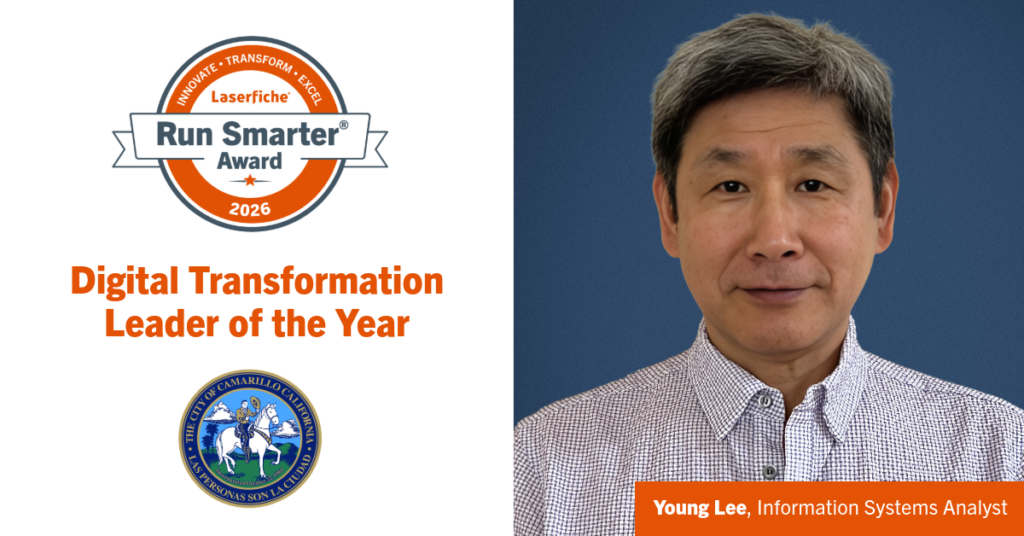
  • Young Lee,Information Systems Analyst, City of Camarillo, California:Digital Transformation Leader of the Year
  • Priya Karthick, Enterprise IT Technologist, Texas A&M Technology Services:Laserfiche Champion of the Year
  • Choctaw Nation IT Tribal Solutions: Best Program ROI
  • Palo Alto Unified School District Information Services:Change Maker of the Year
  • Kansas State University: Laserfiche Program of the Year, U.S./Canada
  • Albany Trustee Company Limited: Laserfiche Program of the Year, EMEA
  • City of Tucson Department Applications Team:Laserfiche Team of the Year

Learn more about the Laserfiche Run Smarter Award winners here.

Laserfiche will celebrate the winners during the 2026 Empower conference. Click here to register for the conference.

About Laserfiche 

Laserfiche is the leading enterprise platform that helps organizations digitally transform operations and manage their content with AI-powered solutions. Through scalable workflows, customizable forms, no-code templates and AI-enabled capabilities, the Laserfiche® document management platform accelerates how business gets done. Trusted by organizations of all sizes — from startups to Fortune 500 enterprises — Laserfiche empowers teams to boost productivity, foster collaboration, and deliver a superior customer experience at scale. Headquartered in Long Beach, California, Laserfiche operates globally, with offices across North America, Europe, and Asia. 

Congratulations to the Laserfiche Run Smarter® Award Winners

The Laserfiche Run Smarter® Awards celebrate the visionaries and trailblazers who are redefining the possible, using Laserfiche to dismantle operational silos and catalyze a new era of enterprise-wide productivity. These winners are enhancing productivity, reimagining processes and improving lives with Laserfiche technology.  

From municipal governments slashing process times by 92% to retail giants unlocking data from millions of invoices, the 2026 winners represent the gold standard of operational excellence. These organizations are reimagining what’s possible when technology and human ingenuity collide. Here is how this year’s elite class of innovators is redefining the way the world works: 

Nien-Ling Wacker Visionary of the Year: 

Doug Haubert, City Prosecutor

Doug Haubert, City Prosecutor, Long Beach City Prosecutor’s Office

Doug Haubert has provided visionary leadership for the Long Beach City Prosecutor’s Office through championing the GUIDES program (Government User Integrated Diversion and Enforcement System). By using Laserfiche to turn siloed records into real-time, actionable intelligence, Haubert supports Long Beach officers in addressing complex social issues — from gang violence to mental health — with unprecedented precision and empathy. This digital ecosystem fosters seamless collaboration between law enforcement and service providers, shifting the focus from arrests to high-impact intervention. The result has been a measurable reduction in crime, faster access to critical social services, and a strengthened foundation of community trust. 

Digital Transformation Leader of the Year: 

Young Lee, Information Systems Analyst

Young Lee, Information Systems Analyst, City of Camarillo, California

Under Young Lee’s leadership, the City of Camarillo transformed a daunting year-end HR and payroll marathon into a sprint. By fostering cross-departmental collaboration and launching a citywide workflow initiative, Lee’s upgraded automated workflow slashed processing time from 50 hours to just four — a staggering 92% increase in efficiency. This digital overhaul didn’t just eliminate administrative bottlenecks; it created higher accuracy and empowered staff to trade manual data entry for community impact. Lee proves that with the right workflow, administrative burdens vanish, delivering a clear ROI and better citizen service. 

Laserfiche Champion of the Year: 

Priya Karthick

Priya Karthick, Enterprise IT Technologist, Texas A&M Technology Services

As a dedicated Laserfiche Champion, Priya Karthick has moved beyond simple implementation to true advocacy, mentoring peers and spearheading enterprise-wide Laserfiche initiatives that redefine the higher education experience. From automating complex onboarding processes to founding vibrant user groups, Karthick’s work ensures that hiring managers and new employees alike benefit from a seamless, digital-first environment. Her commitment to knowledge-sharing and community building has turned Texas A&M into a beacon of efficiency, proving that digital transformation is most powerful when it’s collaborative. 

Best Program ROI:

Choctaw Nation IT Tribal Solutions

Choctaw Nation IT Tribal Solutions

The Choctaw Nation is redefining how a tribal government serves its people. Since 2017, the organization has automated 111 distinct programs, turning what was once a months-long application process for tuition and emergency aid into a streamlined experience taking under two weeks. The impact is staggering: an 87% drop in incomplete submissions and over 107,000 staff hours reclaimed in a single year — a productivity boost valued at $3.76 million. By eliminating manual bottlenecks and saving $250,000 annually in administrative costs, the Choctaw Nation is proving that digital maturity isn’t just about efficiency; it’s about providing faster, more reliable support to every tribal member. 

Watch the full interview with the Choctaw Nation’s Todd Hughes

Change Maker of the Year:

Palo Alto Unified School District

Palo Alto Unified School District Information Services

The Palo Alto Unified School District (PAUSD) turned a cloud migration into a complete operational rebirth. Through “Implementation 2.0,” the district upgrated to Laserfiche Cloud, choosing to rebuild critical business processes from the ground up rather than simply digitizing old habits. 

By mastering APIs and modern data connectors, PAUSD successfully integrated Laserfiche with its student information system, automating everything from substitute teacher provisioning to enrollment. This shift has transitioned the IT team from “infrastructure maintenance” to strategic innovation partners. Through this effort, the team has affected profound cultural change where departments across fiscal, HR, and student services now collaborate to eliminate manual data entry and prioritize student success. 

See how PAUSD focuses on student success with tech-driven solutions. 

Laserfiche Program of the Year, U.S./Canada:

Kansas State University

Kansas State University

The team at Kansas State University aims to set the standard for inspiring learning and engagement for their over 21,000 students. Laserfiche has supported that mission by transforming student services through intelligent automation. By automating a process for academic program changes, the university now processes 85% of requests in under a day, and has reclaimed over 49,000 staff hours. This transformation not only enhances student experience but also strengthens operational efficiency and responsiveness. 

Get the details on KSU’s award-winning program

Laserfiche Program of the Year, EMEA:

Albany Trustee Company Limited

Albany Trustee Company Limited

Guernsey-based Albany Trustee turned its “Project Paperless” into a blueprint for modern fiduciary services. By embedding Laserfiche into the heart of operations, the firm transitioned from static spreadsheets to real-time visibility, ensuring that data integrity and compliance are built directly into their daily workflows. The results go beyond simple time savings; the organization has achieved structured AI adoption, driving higher accuracy in document creation and process analytics. By automating repetitive filing, Albany Trustee has empowered its team to focus on high-value client service. This transformation goes beyond streamlined operations and has sparked a culture of innovation where staff are digitally confident and actively seeking the next technological frontier. 

Laserfiche Team of the Year:

City of Tuscon Department Applications Team

City of Tucson Department Applications Team

The City of Tucson transformed digital compliance into a community asset. Facing upcoming federal requirements, the city’s Laserfiche team proactively overhauled 335 public-facing production forms to support full accessibility and ADA compliance, bridging a critical gap in resident services. Through rigorous research and a structured deployment strategy, the city eliminated screen reader errors and improved usability for all residents — all without additional software investments or vendor intervention. This initiative set a new standard for inclusive governance. By prioritizing dignity and access, Tucson has ensured that every citizen can navigate city services with ease and confidence. 

To hear more Laserfiche success stories, register for Empower today. 

Read more Laserfiche case studies.   

Laserfiche Cloud Essentials – For End Users

Laserfiche Cloud Essentials – For Administrators

Laserfiche Earns 5-Star Rating in the 2026 CRN® Partner Program Guide

LONG BEACH, CALIFORNIA, March 11, 2026 Laserfiche — the leading SaaS provider of intelligent content management — has been honored by CRN®, a brand of The Channel Company, with a 5-Star Award in the 2026 CRN Partner Program Guide. This annual guide is an essential resource for partners seeking vendor partner programs that match their business goals and deliver high partner value.  

As organizations navigate growing pressure to increase productivity and respond to regulatory change, Laserfiche’s AI-powered document management solutions enable users to transform operations and achieve meaningful business results at scale.

Partners that innovate with Laserfiche solutions have the opportunity to grow profits through the Laserfiche Partner Program, which equips them with the tools and resources needed to deliver customer success. Laserfiche’s partner ecosystem drives sustainable growth, delivers differentiated solutions and maximizes opportunities for both partners and their customers. Laserfiche provides comprehensive AI and cloud-deployment training resources that empower partners to identify opportunities, secure deals and deliver effective solutions with confidence. 

“We are committed to equipping our partners with the comprehensive educational and marketing resources that enable them to secure profitable deals and provide transformative solutions,” said Josep Domingot, vice president of sales at Laserfiche. “A 5-star rating in the CRN Partner Program Guide certifies the work Laserfiche has done to create an expansive and profitable channel ecosystem.”

For the 2026 Partner Program Guide, the CRN research team assessed technology vendors based on the strength and breadth of their partner program offerings, including partner training and enablement, pre‑ and post‑sales support, marketing resources, technical assistance and ongoing communication. The resulting guide provides partners with meaningful insight into partner programs designed to support sustained success in a rapidly evolving channel landscape.

“Being included in the 2026 CRN Partner Program Guide reflects how today’s technology vendors are rethinking their partner programs to keep pace with a rapidly evolving channel,” said Jennifer Follett, VP, U.S. Content, Executive Editor, CRN, at The Channel Company. “As solution providers navigate new customer demands, business models and technologies, this annual guide serves as a critical resource for identifying vendors that are investing in programs designed to drive long‑term growth and shared success. The guide delivers meaningful insight into what sets each partner program apart, helping solution providers make confident, strategic partnership decisions.”

See the 2026 Partner Program Guide at www.CRN.com/PPG. To learn more about the Laserfiche Partner Program, visit the Laserfiche website.

About Laserfiche

Laserfiche is a leading enterprise platform that helps organizations digitally transform operations and manage their content with AI-powered solutions. Through scalable workflows, customizable forms, no-code templates and AI-enabled capabilities, the Laserfiche® document management platform accelerates how business gets done. Trusted by organizations of all sizes — from startups to Fortune 500 enterprises — Laserfiche empowers teams to boost productivity, foster collaboration, and deliver a superior customer experience at scale. Headquartered in Long Beach, California, Laserfiche operates globally, with offices across North America, Europe, and Asia.

Navigating the Agentic Era: Laserfiche 2026 Leadership Predictions

John Merrill speaking during the general session at the 2025 Empower conference.

As we move through 2026, the conversation around artificial intelligence has shifted from “what if” to “how fast.” For business leaders, this means the challenge is no longer just adopting AI, but orchestrating a landscape where AI agents, human expertise and rigorous data governance intersect. 

Below are strategic considerations for navigating the technological and operational shifts that are defining 2026. 

1. From tools to agents: The new standard of content management 

By 2026, AI features — document summarization, automated metadata extraction and conversational search — are no longer differentiators; they are table stakes for a document management platform. The real frontier is the AI agent. Organizations are moving past experimental chatbots toward autonomous agents capable of executing workflows. 

Meanwhile, automation isn’t replacing knowledge workers; it’s liberating them. As AI handles repetitive administrative tasks, the workforce is refocusing on high-impact, creative strategy. Leaders should encourage low-stakes AI experimentation now. Familiarizing teams with AI agents in a safe environment will help prepare the organization for when these tools move into mission-critical operations. 

2. The rise of the agentic workforce and technical bottlenecks 

This year will also mark a significant shift in how software and solutions are built. While AI can now write the majority of application code, this creates new challenges for IT strategy. While entry-level coding is being automated, the demand for experienced developers remains high. Their role has evolved into “agent orchestrators” — experts who know how to direct sophisticated AI to achieve enterprise-grade results. 

The single most important skill for 2026 is adaptability: The ability to learn and unlearn skills rapidly is now more valuable than any specific legacy programming language. 

3. Security in the age of perfect impersonation 

The cybersecurity landscape in 2026 is defined by “AI vs. AI.” This new era includes supercharged social engineering; AI can now almost perfectly impersonate individuals, making traditional phishing defenses obsolete. Organizations must move toward robust, hardware-based authentication like Fast Identity Online two-factor authentication (FIDO 2FA). Forward-thinking CIOs are now requiring vendors to adopt additional security controls, certifications and compliance frameworks.  

4. Infrastructure reality check: Budgets and supply chains 

Despite the software-centric nature of AI, the physical reality of hardware is a major constraint. Anticipated AI demand has created significant supply chain volatility. With technology budgets capped at roughly 9-10% growth and vendor subscription costs rising, leaders must find “AI offsets.”  Funding for AI innovation in 2026 is largely coming from efficiency gains and spending decreases in other areas of the IT budget rather than massive new capital injections. This is evidenced by Gartner’s 2026 forecast, which shows that while total IT spending is growing by only 10.8%, investment in AI is surging by 80.8% 

2026: The year of responsible acceleration 

The organizations winning in 2026 are those that treat AI not as a bolt-on product, but as a fundamental shift in how human talent is deployed. Trust — in your data, your vendors and your governance — remains the only currency that allows for rapid adoption. 

See how you compare to peers in your AI adoption now by reading more in The State of Document Management & AI

The State of Document Management and AI

From Records to Intelligence: What the 2026 InfoGov Summit Made Clear About AI in Government

Dr Moya Hill smiling while speaking at a podium
Dr. Moya Hill on stage speaking at the 2026 Public Sector InfoGov Summit

At the Public Sector InfoGov Summit 2026, focused on “Advancing Information Governance Across the Public Sector,” one message came through consistently: AI in government is not just a technology question but actually an information governance conversation. From the White House Office of Records Management and the National Archives to the Department of the Interior and Veterans Affairs, the focus was not on hype but instead on readiness, responsibility and results. 

Government runs on records. And before AI can deliver value, those records must be structured, managed and trusted. Philip Droege, director of the White House Office of Records, gave a keynote on managing White House records that was a powerful reminder that governance at the highest levels of government is built on discipline, documentation and defensibility. Whether under the Presidential Records Act or federal records mandates, accountability depends on clarity: what a record is, where it lives, who owns it and how it transitions. 

That same principle applies to AI. 

John Montel, associate CIO from the Department of the Interior, reinforced this directly: Before introducing AI, agencies must prepare their information environment. Physical records, electronic content and data must be organized. 

Ownership must be clear. Retention must be consistent. Metadata must be reliable.  

Records Management Lays AI Groundwork in Government 

Without that groundwork, AI amplifies inconsistency rather than value. This is where AI-powered content management becomes meaningful. AI can automatically classify documents, extract metadata, identify sensitive information and summarize complex files. But those capabilities only create impact when they operate inside a governance framework with retention schedules, access controls, audit trails and human oversight built in. 

The National Archives provided a compelling example. Acting Chief Innovation Officer Jill Reilly described how NARA is leveraging AI to enhance metadata, improve semantic search and expand access to historic collections including the 1950 Census and Revolutionary War Pension files. But the key to success was not the algorithm. It was the “ground truth” datasets and strong metadata foundation beneath it. AI was layered on top of trusted records, not substituted for them. 

That is the model government leaders should follow. 

Dr. Moya Hill, chief FOIA/privacy/records officer with the Office of Acquisition, Logistics, and Construction, led a discussion on FOIA at the Department of Veterans Affairs which further underscored the point. Transparency is not optional. AI can assist in identifying responsive records, standardizing redactions and accelerating response times. But defensibility remains paramount with explainable outputs and auditable decisions. Governance programs must align FOIA, privacy and records management rather than treating them as separate disciplines. The conversation also turned toward agentic AI, systems capable of coordinating actions within defined rules. 

AMTRAK Senior Director of Data, AI and Automation John Chiofee’s closing keynote on the “governance fabric” tied information, data and AI together. Governance cannot sit in a silo. It must travel with the information across systems, departments and workflows. AI will increasingly monitor compliance thresholds, surface anomalies and recommend actions—but within guardrails defined by policy. 

That evolution mirrors what we see in AI-empowered content management today. 

  • Phase one is intelligent extraction structuring information automatically as it enters the system. 
  • Phase two is human-plus-AI collaboration accelerating review, classification and routing while preserving oversight. 
  • Phase three moves toward intelligent orchestration where AI agents help coordinate workflows, identify risk and support decisions under defined governance policies. 

This evolution is built into Laserfiche, a platform grounded in decades of public sector experience. Records management capabilities support full lifecycle tracking, granular security, automated retention and audit readiness aligned with standards like DoD 5015.2. AI capabilities such as Smart Fields, intelligent classification and workflow automation operate within that governance framework. 

The takeaway from the summit was clear: AI is not replacing records management. It is elevating it. 

Government leaders should not ask, “How do we deploy AI?” The better question is, “Is our information environment ready?” Agencies that invest now in structured metadata, lifecycle governance and cross-functional collaboration between IT, records and business leaders will be positioned to move from managing records to activating intelligence. 

Shaping Tomorrow’s Enterprise: The Power of Intelligent Workflow Automation

Laserfiche Virtual Training – New Laserfiche Administrator Bootcamp

Designed for new users to get caught up on Laserfiche administration basics, this lab-style instructor-led training will provide the foundations necessary to successfully manage, administer, and troubleshoot your Laserfiche system.

Topics covered include repository design, metadata administration, repository security and records management, along with repository and task automation.