Preparing for AI Governance: Hong Kong’s Compliance Landscape in 2026 

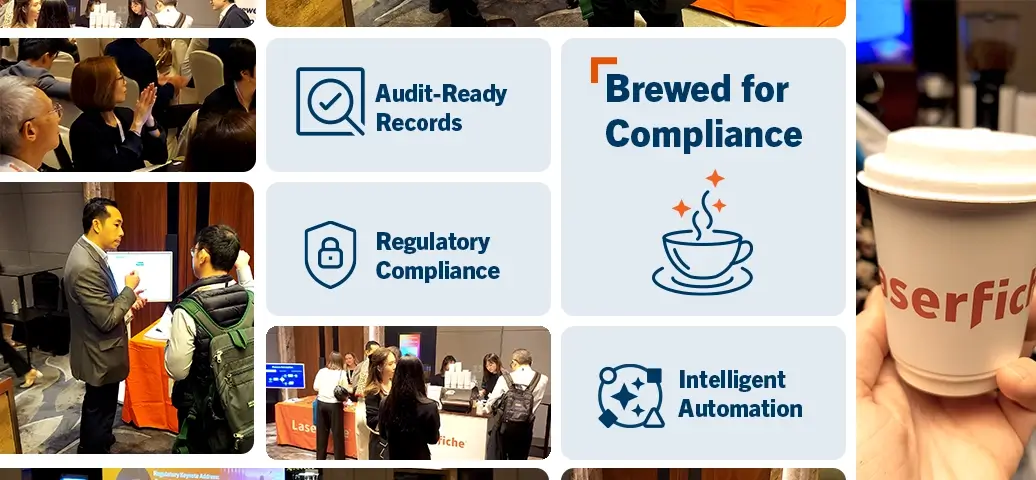
Laserfiche is Brewed for Compliance

Hong Kong’s status as a premier international financial hub is anchored by a foundation of transparency and a robust regulatory framework. However, in the ever-evolving digital landscape of 2026, that foundation is being tested. According to the recent ALB Hong Kong Regulatory & Compliance Summit, rising  global geopolitical tensions and a surge in AI-enabled fraud are creating a new breed of cross-border compliance challenges. 

At the summit this March, financial experts and cybersecurity leaders gathered to analyze how shifting sanctions and digital crimes are straining institutional protocols. Their consensus was clear: traditional compliance is no longer enough. 

The Governance Imperative  

With the commencement of the Protection of Critical Infrastructure Ordinance in January 2026, Hong Kong has entered a new era of active enforcement. Compliance is no longer a compliance-by-mandate; it is a critical boardroom priority. With data from the Hong Kong Police Force showing a steady rise in deception cases, regulators are increasingly focused on how AI can be both a weapon for financial crime and a shield for defense. 

For businesses in this dynamic digital hub, the conversation has shifted from whether to adopt AI to how to build the tech-driven defenses necessary to withstand this complex regulatory environment. To ensure long-term stability, organizations must transcend traditional advisory roles and embed AI governance as a fundamental pillar of security.  

Securing Your Organization 

While the advent of AI has led to the rapid sophistication of cybercrime and fraud, organizations can take definitive steps to secure themselves. Following the insights from the 2026 Summit, the priority is to move beyond passive monitoring toward an active defense model. 

Key Defense Strategies 

1. Combating AI-Enabled Fraud and Financial Crime 

As criminals leverage AI for money laundering and cyberattacks, taking the following measures can significantly mitigate your risk: 

  • Establish Smart Policing and Cybersecurity Centers: Move beyond basic IT support by embedding dedicated security hubs within your corporate infrastructure to centralize threat intelligence. 
  • Deploy “AI-to-Catch-AI”: Your compliance framework must utilize machine learning for real-time monitoring of transnational telecom and internet fraud, identifying patterns that are invisible to the human eye. 
  • Prioritize Digital Forensics: Invest in advanced forensic tools to ensure that if a breach occurs, your team can rapidly trace the source and mitigate the imp 

2. Privacy by Design: The PDPO and Beyond 

While the Personal Data (Privacy) Ordinance (PDPO) —Hong Kong’s primary legal statute for safeguarding individual privacy— remains the bedrock of data protection, the Office of the Privacy Commissioner for Personal Data (PCPD) now emphasizes Ethics-by-Design. This approach mandates embedding ethical considerations and privacy protections into the earliest stages of technological development. Key pillars of this strategy include:  

  • Transparency and Explainability: Organizations are urged to move toward “Explainable AI” (XAI). In sectors like banking and insurance, being able to explain why an algorithm made a specific decision is now a regulatory expectation, not a luxury. 
  • Data Mapping and the GBA: As cross-border data transfers within the Greater Bay Area (GBA)—linking Hong Kong with mainland China—become more frequent, businesses must conduct rigorous data mapping. This creates a detailed inventory of where data originates and how it flows across different legal jurisdictions. 
  • Supplier Due Diligence: Compliance must extend to your partners. Organizations must perform supplier data protection due diligence to ensure that third-party vendors adhere to the same rigorous security standards required by the PDPO. 

3. Bridging the Governance Gap: The Evolving Role of the GC 

 In recent years, the role of the General Counsel (GC) has transitioned from a purely legal function to that of a strategic partner. GCs are now tasked with aligning AI operations with rapidly changing business requirements. To bridge the gap between innovation and oversight, organizations should implement: 

  • Cross-Functional Committees: Establish an AI ethics committee that includes legal, compliance, and technology innovators. 
  • Human Checkpoints: Even the most advanced AI requires “human oversight.” Ensure that high-stakes decisions—especially those involving credit scoring, employment, or legal outcomes—are reviewed by qualified professionals. 

4. Navigating Risk and Sustainability Directives 

AI does not operate in a vacuum. The 2026 Summit leaders noted that intricate sanctions regimes and trade tensions —particularly between the U.S. and China— are impacting how technology is deployed. Interestingly, AI compliance in 2026 is becoming inextricably linked to ESG (Environmental, Social, and Governance) mandates specifically in these areas: 

  • Algorithmic Fairness: Preventing bias in AI is no longer just a technical goal; it is a social responsibility. Ensuring algorithms do not discriminate is now a key metric in corporate social performance.  
  • Corporate Governance: Boards are expected to translate “responsible AI” from a theory into clear governance standards, ensuring that technological research and development support long-term organizational sustainability. 
  • Resilient Operations: Compliance programs must be recalibrated to handle global volatility. This requires sector fluency—the ability to understand local regulatory nuances while navigating geopolitical shifts.  

Beyond Compliance: Shaping the Future of 2026  

As Hong Kong accelerates its digital economy ambitions, the winners will be those who view compliance as a “proactive risk management system.” By pioneering legal tech adoption and redesigning service delivery models, firms can turn regulatory hurdles into competitive advantages. 

In the words of the industry leaders at the ALB Summit, staying ahead of the curve requires a “comprehensive understanding of both technological advancements and the methods utilized by financial criminals.” By embedding these best practices into your organizational DNA, you do more than adapt to the changes of 2026—you will actively shape it. 

For more information on governed-AI, download the eBook now:

Optimize Your Processes with an Upgraded Operational Dashboard

Our June updates deliver smarter tools to help you manage workloads and connect your systems with ease. Discover what’s new in Laserfiche Cloud this month, including a comprehensive upgrade to the Operational Dashboard, plus new capabilities and modern updates for your daily workflows and line-of-business integrations.

New Tools for Monitoring and Managing Processes in the Operational Dashboard

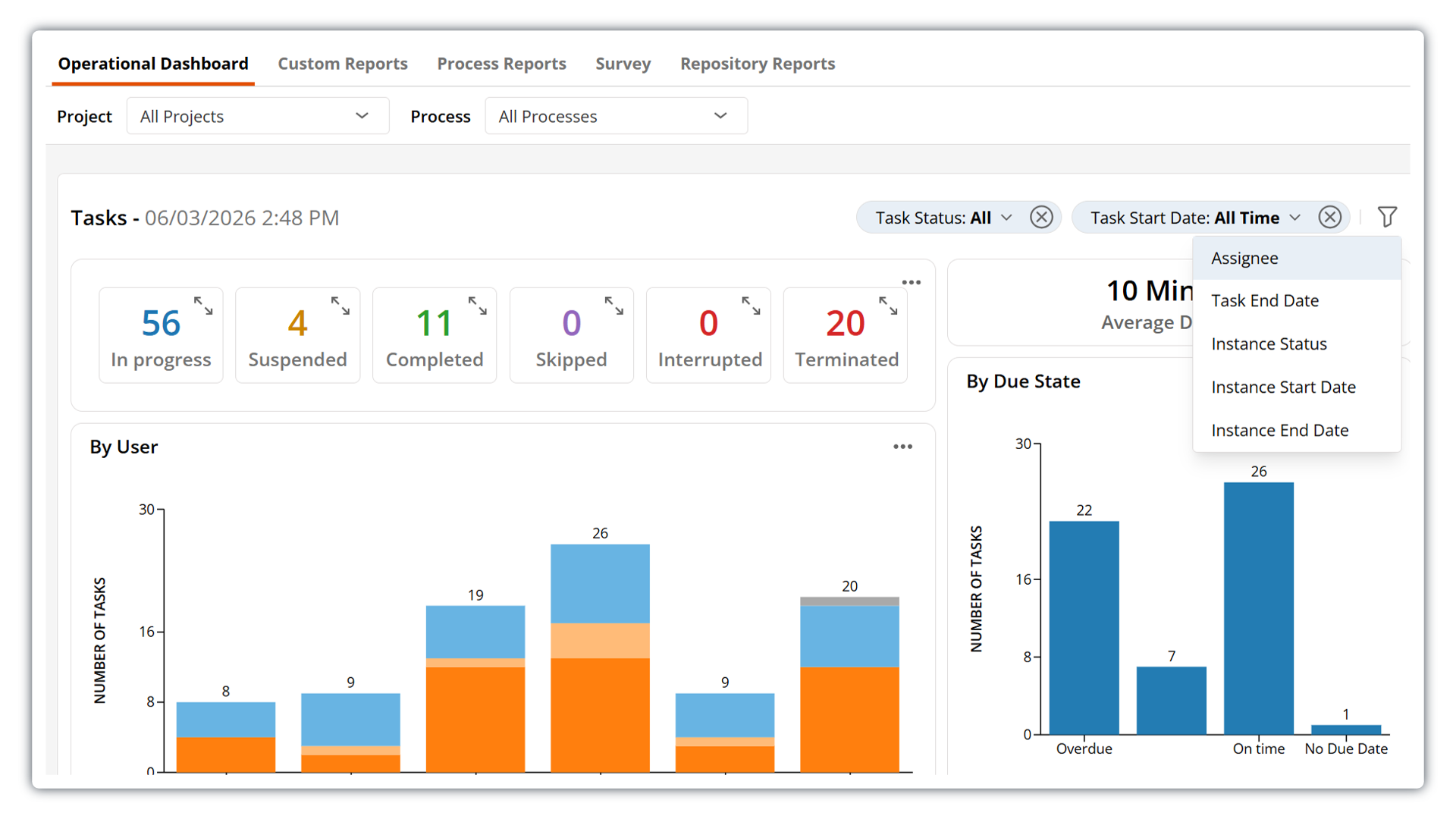
New enhancements to the Operational Dashboard make it easier for teams to monitor work, understand process and task status, and take action faster.

With new bulk task reassignment, managers can quickly rebalance workloads when priorities shift, team availability changes or work starts to pile up. Rather than reassigning tasks one at a time, you can now select multiple tasks and reassign them in a single action directly from the Operational Dashboard – less manual effort and fewer repetitive steps.

This update also introduces the ability to perform bulk actions on process instances from within the dashboard, so you can move from spotting issues to resolving them all in one place. Retry, skip, interrupt, or stop multiple instances that need attention at once – so you can address exceptions more efficiently and keep processes on track without switching between views.

Modernized filtering interface in Laserfiche Operational Dashboard

The dashboard also features a modernized, more intuitive filtering experience that makes it easier to focus on the data that matters to you. Quickly apply available filters from a streamlined new drop-down menu. Applied filters now appear in a horizontal filter bar, giving you clear visibility into which filters are currently active and allowing you to easily modify or remove them as needed.

This update also introduces a new option to filter by assignee, giving you more control when refining dashboard views and making it easier to understand workload distribution across your team.


Save and Organize Emails Faster with the Updated Outlook Add-In

The Laserfiche Outlook Add-In for Microsoft 365 includes new capabilities that make it even easier to save and organize emails from Outlook directly into your Laserfiche repository. With the new save-on-send functionality, you can automatically file emails and attachments upon sending them. This update also adds support for assigning metadata tags and generating pages or text on import — all directly from Outlook.


Other updates:  

Customize sender display name for emails sent from Workflow: Get more control and more personalization when using Workflow to automatically send out emails. You can now select from the same list of custom email display names available across Process Automation.

Repository API V2 update: This update brings new capabilities to the Laserfiche API, including the ability to generate and update pages, lock and unlock entries, and check documents in and out. See the full changelog for more details.

Salesforce External Client Apps Support: Laserfiche Application Connection now supports Salesforce External Client Apps for new Salesforce integrations. This update aligns with Salesforce’s latest authentication approach for connection setup. Existing Salesforce connections using Connected Apps remain supported and functional.

Laserfiche Launches on AWS Marketplace, Bringing Intelligent Content Management to the Enterprise

Organizations can now seamlessly procure Laserfiche document management to support and scale information governance and workflow automation.

LONG BEACH, CALIFORNIA, June 2, 2026 — Laserfiche — the leading SaaS provider of intelligent content management — has partnered with AWS to make Laserfiche available through AWS Marketplace. This collaboration enables AWS customers to seamlessly procure Laserfiche’s document management platform to manage content, automate workflows and implement agentic AI capabilities.

“We’re excited about this evolution of our long-standing partnership with AWS,” said Thomas Phelps, Laserfiche senior vice president of corporate strategy and CIO. “AWS Marketplace provides a near-frictionless experience for Laserfiche direct customers who want to accept negotiated private offers, manage billing and payment history, and apply eligible purchases toward their AWS Enterprise Discount Program (EDP) commitments — all through their centralized AWS account.”

Laserfiche provides document lifecycle management, information governance and workflow automation tools on a platform that earned multiple Champion awards from Info-Tech Research Group. Laserfiche AI features include automatic metadata extraction, document summarization, chat and agentic capabilities.

“Within two weeks of requesting the ability to procure Laserfiche Cloud through AWS Marketplace, Laserfiche confirmed its availability on the marketplace,” said Bianca Lochner, Ph.D., City of Scottsdale CIO. “We appreciate Laserfiche’s swift execution and anticipation of our needs as our business partner.”

“We are thrilled to welcome Laserfiche to AWS Marketplace,” said Carol Potts, AWS General Manager of US ISV Sales. “Organizations in highly regulated industries can now adopt Laserfiche’s intelligent content management and agentic AI capabilities to quickly automate how they organize, govern, and act on critical information at scale. Enabling access to these innovations is how we help customers transform the way they work.”

To learn more, explore AWS Marketplace.

About Laserfiche 
Laserfiche is a leading enterprise platform for document management and content-centric workflow automation. Through scalable workflows, forms, no-code templates and AI-enabled capture, the Laserfiche® platform accelerates how business gets done.  

Laserfiche pioneered the paperless office with enterprise content management. Today, Laserfiche’s cloud-first development approach incorporates innovations in machine learning and AI to enable organizations globally to transform into digital businesses. Customers in every industry — including government, education, financial services, healthcare and manufacturing — use Laserfiche to boost productivity, scale their business and deliver digital-first customer experiences.  

Laserfiche employees are committed to the company’s vision of empowering customers and inspiring people to reimagine how technology can transform lives.  

Navigating the Future in K-12 Education Leadership Council: Governance Protects Public Trust

Teacher at desk talking to student and parent

Artificial intelligence has increasingly become a topic of everyday conversation. From film to finance, every industry is contemplating the practical advantages of utilizing AI. For those in K-12 AI leadership, the conversation isn’t just about AI adoption—it’s about digital integrity.

Government agencies, schools, banks and businesses are all beginning to use AI to process information and assist with decision making. At the same time, bad actors are also using these tools to create highly convincing scams, impersonations and misinformation.

That shift raises an important question for public sector leaders. If AI can create such a powerful illusion of reality, how do institutions protect the integrity of their data, processes and reputations?

The answer is governance. 

The $5 Million Wake-up Call

Technology discussions often focus on algorithms, models or computing power. Yet the most important factor in responsible AI adoption is not the algorithm itself. It is the framework that governs how information is created, verified and used. Without strong governance, even the most advanced technology introduces risk.

I was reminded of this during a recent conversation with a group of K-12 leaders focused on navigating the future in K-12 education. They were discussing a case in which a school district lost nearly five million dollars in funding due to a sophisticated scam. Artificial intelligence was used to generate convincing communications that appeared legitimate. At first glance it seemed like a cybersecurity failure.

Why It Wasn’t a Cybersecurity Failure

However, the investigation revealed something different. The district’s systems were not breached through a technical vulnerability. The breakdown occurred in the verification process that should have governed how financial requests were approved. The attackers relied on the assumption that the message would move through the system without proper validation. In other words, the technology enabled the deception, but the absence of governance allowed it to succeed. 

K-12 AI Leadership: Beyond the Algorithm

This distinction matters because it reframes how government and education leaders should think about AI adoption. Artificial intelligence is not inherently a threat. In fact, it offers enormous potential to help agencies and institutions work more effectively. AI can assist with document classification, automate routine workflows and surface insights hidden inside large volumes of information. These capabilities can free public servants to focus on higher value work that directly benefits citizens and students. But those benefits only materialize when AI operates within a defined governance structure.

“The value of AI in education is quickly undermined when governance is not considered, not taken seriously, or left incomplete. Without clear oversight and accountability, institutions risk poor decisions, unreliable outcomes, and a loss of trust that is far harder to rebuild than the technology itself,” said Council lead Brian Cohen, Vice President of the Center for Digital Government and Center Digital Education.

The Blueprint for Responsible K-12 AI Governance

From a content and information management perspective, that structure begins with documented processes. Information should have clear ownership. Data sources must be trusted and traceable. Retention and access policies need to be consistently applied. Most importantly, human oversight must remain part of the process. AI can assist with interpretation and automation, but accountability cannot be delegated to an algorithm.

When those principles are in place, AI becomes a force multiplier rather than a liability. Agencies can move faster because information flows through repeatable processes. Leaders can trust the outputs because they understand where the data originated and how it was handled. Citizens gain confidence that technology is supporting transparency rather than undermining it.

This is why governance has become the central conversation in responsible AI adoption. Public institutions do not have the luxury of experimentation without safeguards. Their credibility rests on trust, and trust is built through disciplined management of information.

Artificial intelligence will continue to evolve rapidly. New capabilities will emerge that reshape how governments operate and how schools support students. Ultimately, effective K-12 AI leadership isn’t defined by how fast you adopt new tools, but by how firmly you establish the governance that protects your students and your staff. In the end, protecting data, processes and institutional reputation does not start with algorithms. It starts with the rules and responsibilities that guide how information is managed. AI may be the catalyst for change, but governance is what ensures that change strengthens, rather than weakens, public trust.

Learn more about secure AI- powered K-12 document management

Best Practices in Process Automation

Workshop: You Design It; We Build It!

Level Up! Implementing Laserfiche AI in your Processes

Law Enforcement Strengthens Connections to Community Resources

Turning First Contact Into a Turning Point

Across America, many public safety systems have generally operated in a reactive mode, responding to incidents after they occur. In Long Beach, California, city leaders saw an opportunity to take a different, proactive approach.

“We’re focused on intervention and prevention,” said Long Beach City Prosecutor Doug Haubert. “If we can get people into services directly from that first contact with law enforcement, it’s more effective for that individual and better for the community as a whole.”

Long Beach police officers were often the first point of contact for persons experiencing homelessness, mental health crises or substance use disorders. In many cases, these interactions required immediate action, especially when someone was ready to accept help. But without real-time access to information about the individual, or what services were available, officers had limited options in the moment. They relied on memory, phone calls or paper-based resources to try to connect individuals with support.

“We would contact someone, offer services and try to connect them to the right resources,” said Officer Alejandro Cazares of the Long Beach Police Department. “But if we didn’t have an outreach worker with us or immediate access to those resources, we’d have to give them a phone number or an address, or try to call around ourselves.”

Long Beach Police Department and Long Beach City Prosecutor’s Office

Service providers faced a similar challenge. Even when help was available, it was difficult to connect with individuals at the point in time when they were ready to accept it.

“One minute they’re in; one minute they’re out,” said Michael Rubio of the Los Angeles Centers for Alcohol and Drug Abuse (LACADA). “If someone is ready right now, we have to meet them right now.”

Building a Connected Public Safety Solution

To bridge these gaps, the Long Beach City Prosecutor’s Office partnered with Laserfiche to develop GUIDES (Government User Integrated Diversion Enhancement System), a mobile application that connects law enforcement, prosecutors and service providers.

With GUIDES, officers now have immediate access to shelter, mental health and substance use resources directly from their phones. From the field, officers can quickly connect individuals to support through a streamlined process:

  • Officers submit a referral in seconds through the GUIDES app while in the field.
  • Referrals are routed to the social worker at the City Prosecutor’s Office.
  • Individuals are then referred to service providers based on their specific needs.
  • Outreach teams from the service providers follow up to connect the individual to their services.

“At its core, GUIDES is a secure data-sharing platform,” said Haubert. “We can now connect people to services as soon as officers encounter them.”

Long Beach Police Department and Long Beach City Prosecutor’s Office

Prior to GUIDES, the Long Beach Police Department was already a long-time user of Laserfiche to improve access to information about court orders. Laserfiche enabled the department to centrally store critical information such as court documents, images and PDFs, apply metadata for organization, and securely retrieve content while meeting regulatory, security and privacy requirements.

“Laserfiche already had a strong presence within the city and the police department,” said Byron Bolton, the city prosecutor’s chief technology officer. “There was a level of trust there, which made it much easier for us to build on that foundation.”

The GUIDES app represents a significant advancement in the city’s approach to public safety. It extends secure information access beyond records management into real-time decision-making in the field. With Laserfiche as the backbone, GUIDES enables officers to access resources, submit referrals and share information across agencies directly from their mobile devices.

Behind the scenes, Laserfiche supports secure data sharing, audit tracking and compliance with criminal justice standards, ensuring that information is accessible, trusted and protected.

“Security is built into every layer of GUIDES,” said Bolton. “The Laserfiche platform allows us to meet CJIS requirements and city cybersecurity standards while still giving officers fast, reliable access to the information they need in the field.”

From Referral to Coordinated Care

Through the Law Enforcement Assisted Diversion (LEAD) program, which gives officers an alternative way to connect individuals with services, referrals move quickly from first contact to coordinated care.

Long Beach Police Department and Long Beach City Prosecutor’s Office

“Even if it’s overnight, officers can submit a referral, and we can follow up the next morning and make sure the individual gets connected to the service they need,” said Gigi Zanganeh, LEAD program coordinator for the city prosecutor’s office. 

For service providers like L.A. CADA, that speed and visibility enable them to respond quickly. In many cases, outreach teams connect with individuals the same day or by the next day, a significant improvement over previous manual processes.

This approach also expands the city’s capacity to serve more individuals by streamlining the process for officers, social workers and service providers to work together.

“Laserfiche allows us to capture referrals, share them across agencies and act on them without delay,” said Bolton. “That level of coordination is what makes this work.”

Real Stories, Real Impact

The impact of GUIDES is best understood through the people it helps:

  • After years of repeated interactions, one individual who previously declined assistance was finally connected to substance abuse services through GUIDES. Today, they are substance-free and housed.
  • In another case, an individual experiencing homelessness was referred by an officer and connected to services within a day. They were placed into a residential program and they continue to make progress months later.
  • For individuals facing complex barriers, coordinated support makes the difference. In one instance, someone was ready to enter treatment but could not leave their pet behind. Through collaboration between city staff, service providers and community partners, a foster solution was arranged, allowing them to begin recovery.

Strengthening Trust and Public Safety

As outcomes improve, so does trust.

“The app definitely helped us build trust with the community because they see the results,” said Cazares.

It’s also changing how residents view law enforcement. “People understand that officers aren’t just there for enforcement,” said Haubert. “They’re there to help people and connect them to the services they need.”

For community partners, the impact is just as meaningful. “When you get everyone at the table — police, prosecutors and providers — all working toward the same goal, it changes everything,” said Rubio.

Together, this alignment is redefining public safety in Long Beach. Officers can act in the moment, service providers can respond quickly, and individuals are connected to support when it matters most.

As the City Prosecutor’s Office continues to expand GUIDES and explore new capabilities, Laserfiche provides the foundation to scale these efforts while maintaining security, visibility and control over information. “Technology like the GUIDES app powered by Laserfiche can save time and money,” said Haubert. “But in Long Beach, we’re using it to save lives.”

Introduction to Laserfiche Forms and Business Processes

Create your first electronic form and process in this hands-on lab!

Perfect for anyone new to Laserfiche and automation, this session will show how you can use Laserfiche to increase efficiency and streamline work with electronic forms and automated processes. With Laserfiche Forms and Business Processes you can reimagine and automate tedious, time-consuming processes to regain time for your organization. This course will teach you how to:

Build an easy-to-use electronic form to standardize information

Route form information to the correct reviewer

Automate tedious tasks like sending emails and saving attachments

User Management (Laserfiche Cloud)

Create and manage users in Laserfiche with this hands-on lab!

Perfect for anyone getting started with administering their Laserfiche Cloud system, this course provides an overview of foundational user management concepts while highlighting best practices. Get familiar with the interfaces for managing users and groups while learning about common use cases and best practices to apply for your organization. This course will teach you how to:

Create users and groups within Laserfiche

Leverage groups to simplify user management

Administer user licensing and access to Laserfiche applications

Configure account-wide default settings