In today’s fast-paced digital landscape, data plays a crucial role in every business operation. From customer information to financial records, organizations deal with massive amounts of data on a daily basis. Extracting meaningful insights and automating processes requires efficient tools, and one such tool that was developed nearly 50 years ago and has stood the test of time is regular expressions (regex) for searching, finding, replacing, or validating text. However, a regex is notoriously difficult to work with, mostly due to the complex memorization of rules needed to create expressions and challenging nature in reading and troubleshooting them.
Laserfiche Introduces Regular Expression (RegEx) Builder

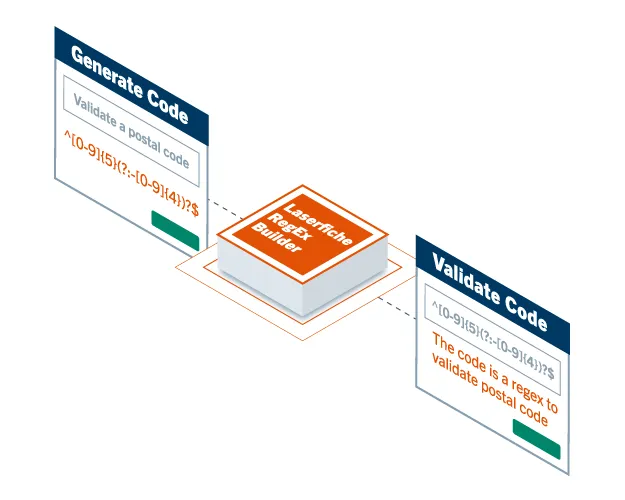
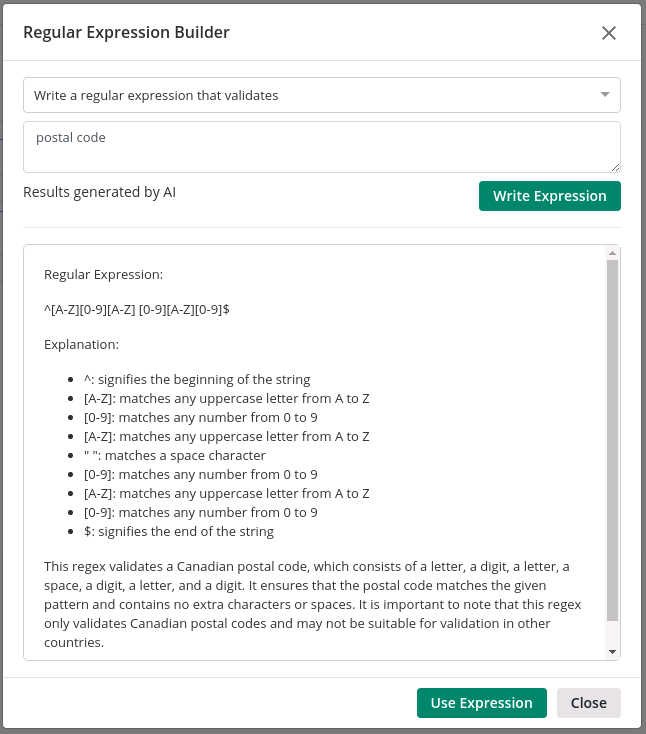
The Laserfiche RegEx Builder utilizes Generative AI to help users natively build and update regular expressions with much less coding. Instead of building solutions from scratch, the Laserfiche RegEx Builder can be used to accelerate the process of turning ideas into a usable piece of code that can be integrated into a Laserfiche Form, dramatically shortening the time from idea to delivery.
The Power of Regular Expressions
Regular expressions are powerful tools used for pattern matching and data manipulation. They provide a concise and flexible way to search, validate, and extract information from text strings. With regex, developers and data scientists can perform complex data operations with ease, saving time and effort. Whether it’s parsing log files, extracting email addresses, or validating user input, regex offer a versatile solution for handling various data processing tasks.

The Challenges of Regex
While a regex is a valuable asset, expressions can be daunting for those unfamiliar with their syntax and intricacies. Constructing complex regex patterns often requires a deep understanding of the language, and mistakes lead to inaccurate results. Moreover, regex patterns become convoluted and challenging to maintain as requirements evolve and expressions grow larger. These challenges hinder productivity and limit the potential benefits of regex.
AI Empowers Regex Users
Artificial intelligence, with its ability to analyze patterns, learn from data, and make intelligent predictions, significantly enhances the productivity of regex builders. By leveraging AI, regex users can now automate various aspects of regex pattern creation and optimization, empowering users with enhanced efficiency and accuracy.
Smart Pattern Recommendations
AI-powered regex builders using large language models (LLMs) process large datasets and offer intelligent pattern recommendations. These models identify common patterns and suggest suitable regex expressions, reducing the time spent on trial and error. By learning from existing data, AI provides regex users with insights and suggestions that improve the quality of their patterns.
Error Detection and Correction
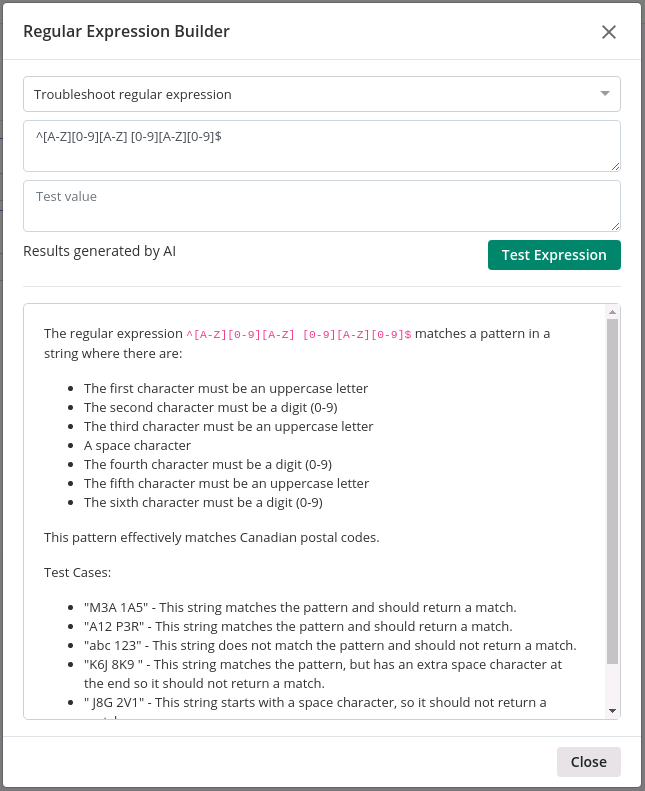
AI can assist regex users by detecting and correcting errors in their expressions. By analyzing the syntax and semantics of the regex, AI algorithms can identify potential issues and provide suggestions for improvement. This helps prevent runtime errors and ensures the accuracy of the regex patterns.
Automated Testing and Validation
Validating regex patterns against sample data can be time-consuming, particularly when dealing with complex expressions. AI can automate this process by generating relevant test cases and validating the regex patterns against them. This ensures that the expressions work as intended, saving developers the effort of manual testing.

Integration with Automated Business Processes
AI-powered regex builders seamlessly integrate with existing workflows, streamlining the creation and deployment of regex patterns. They can be integrated into programming languages, data processing pipelines, or text editors, allowing users to harness the power of regex within their preferred environments.
Leveraging the Capabilities of AI
Regular expressions have long been a valuable tool for data manipulation and analysis. With the assistance of the Laserfiche RegEx Builder, enterprises can unlock new levels of productivity by automating the creation, optimization, and validation of regex patterns. The Laserfiche RegEx Builder is just one example of deploying AI at scale ā or using AI to streamline operations across the enterprise. By harnessing the power of AI to accelerate the creation of a powerful tool for process automation, organizations can achieve their goals of enterprise-wide digital transformation.
The Future of AI and Laserfiche
Laserfiche is embracing a new era of computing and productivity ā and this is just the beginning of it. Weāre excited to explore AI and introduce you to new AI-powered capabilities and innovations with Laserfiche in the coming months.
This Certification Series is designed for users who want to capture content into Laserfiche more efficiently. Learners explore different capture methods, automation options, and ways to reduce manual effort when filing documents and extracting metadata.
Users who need to bring content into Laserfiche and automate filing or metadata extraction.
You’ll be assessed on: choosing the right capture method, creating capture profiles, and automating document filing.
You need a score of 80% or more to successfully pass. There is no time limit to complete the assessment and you have unlimited attempts.
SITUATION
⢠Capturing, routing and storing member information was manual and lacked consistency
⢠Operations needed to scale at a pace that aligned with the credit unionās growth trajectory
⢠The credit union sought a platform for automation that would integrate with existing tech stack
RESULTS
⢠All staff now use Laserfiche regularly in a variety of key processes
⢠Saved hundreds of hours each month
⢠Alleviated the burden of mergers as the credit union grows
āWe address peopleās needs and solve problems ā itās what credit unions do,ā said Matthew Tingey, senior applications specialist at American United Federal Credit Union (FCU).
The philosophy has powered American United FCU since 1952, driving the organizationās growth to serve more than 26,000 people today. And along with that growth has come transformation, to create a single source of truth for records, integrate core technology systems and enable easier self-service for members.
āI was originally asking questions like, āCan I automate this? Can I batch process these things? Where can I take the annoying parts out of this process?āā said Tingey. āBut itās never good enough to solve my own problem. I need to solve problems for everyone in the organization. Thatās where Laserfiche came in.ā

The credit union now uses Laserfiche as its repository for member information, and the main workflow engine for automated processes across the organization, including finance, member relations, money movement and more, saving hundreds of hours each month and alleviating the burden of mergers as the organization continues to grow.
Like many growing organizations, American United FCU had information ā including member documents, HR employee records, financial records and more ā incoming from a multitude of channels, being handled in a variety of ways. Tingey, a dedicated credit union professional who has worked in every department across the organization, recognized a need to standardize archival of documents. At the same time, he saw an opportunity to automate information capture.
The credit union began using Laserfiche process automation to automate records management activities, routing documents to where they needed to be stored within the repository, with the needed metadata, no matter the source.
āWeāve processed multiple millions of documents through there,ā said Tingey. āEmployees just need to click, and it gets to where it needs to go.ā
American United FCU, supported by Laserfiche solution provider Millennial Vision (MVi), has built out a Laserfiche program that also supports the organizationās total quality management initiative, which aims to improve processes with an eye toward growth and profitability.
āThese tools help us do things more efficiently, bridge the gap between some of our other software tools, and let our teams work in better collaboration. They really solve a lot of problems.ā
With the initial solution in place, it was time to connect other systems to eliminate human error and make the repetitive tasks around document capture and storage even easier.
āFrom there, I wanted Laserfiche to talk back to our core [account system] to verify the information being captured,ā Tingey said. āNow, itās not just member documents that weāre processing through the system but applications, loan documents, and other daily work. The process has expanded and grown. Itās the single source of truth, and really the backbone of our process automation.ā
In addition to having Laserfiche verify information from the organizationās core, CUProdigy, the credit union has a number of integrations that support a more seamless everyday work experience for employees.

āWeāve also built a large database of information that we want to track and report on in Microsoft Power BI, and Laserfiche plays a big role in that,ā Tingey said, adding that he keeps track of data issues ā caused by activities like an employee leaving the organization, for example ā through daily reports. āLaserfiche is a big part of managing the data that is used to create those Power BI reports.ā
Similarly, Tingey has transformed the way that the organization validates data, identifying potential issues through Forms processes (started by Laserfiche Workflow) that trigger when an issue occurs. These items were previously actively tracked by an employee on a continual basis; today, no one needs to remember to review the reports since processes are triggered in Forms when issues occur ā plus, instructions are integrated into the form so that less training and individual knowledge is required to address them.
āMore recently, weāve added some API integrations with the core to this process,ā Tingey explained. āWe pull information out of CUProdigy to use in Laserfiche Workflow and Forms via database queries. Notes can be pushed back to accounts with a click of a button in a form. A couple of the items that instructed the user to fix an issue can now be resolved automatically via the API without human intervention. These data validations and the automation around them have allowed our QA to be more efficient, effective and consistent.ā
One game-changing integration for the credit union was between Laserfiche and DocuSign, which allowed Tingey to automate a common activity for credit unions: member information changes. The legacy process was manually driven and admittedly not very employee- or member-friendly.
The organization has enhanced the overall experience for employees and members by embedding the entire process into Laserfiche Forms:
Similarly, the credit unionās wire transfer process has benefited from Laserfiche Forms and an integration with DocuSign.
āIn terms of solutions, I borrow from myself,ā Tingey said, explaining that heās often able to build on successes by taking a process and repurposing it by making tweaks to forms or steps.
The legacy wire transfer process, which involved many manual activities performed by employees, left members and auditors with little visibility into the required steps. The new Laserfiche process, however, gives the credit union the ability to provide helpful context to the member about what they are signing and the wire disclosure via the DocuSign integration.
āOnce complete, employees only need to click a button to attach it to the form, and processing of the wire in our core is done via API, with minimal tasks required by the employee,ā Tingey said. The form is automatically routed to the necessary employees for review and processing, and all supporting documentation is archived in the Laserfiche repository with standard naming conventions and metadata.

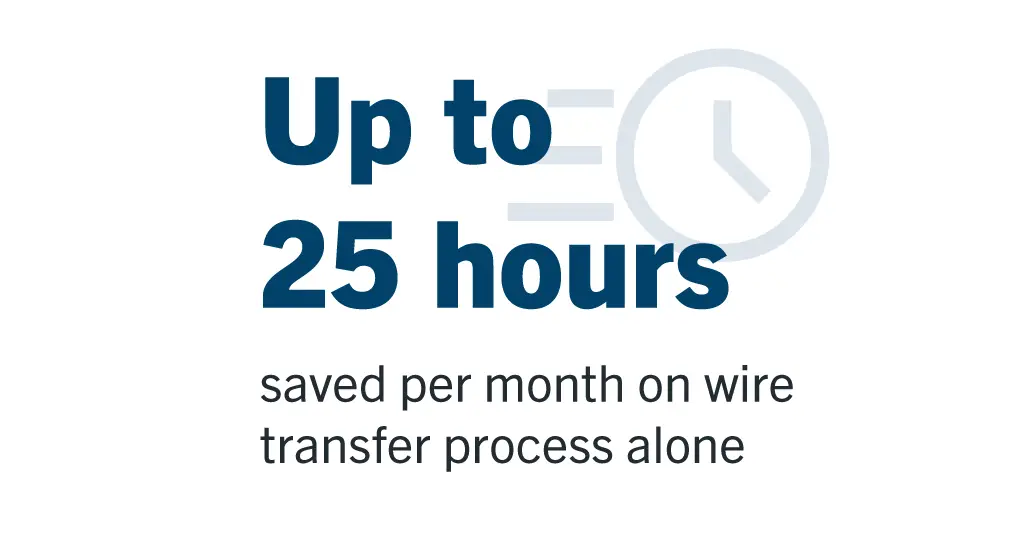
The new wire transfer process saves up to 25 hours of staff processing time per month, while also reducing opportunities for human error and increasing staff satisfaction.
āWeāve taken all the annoying little parts out of the process, like downloading a PDF, uploading it to DocuSign, marking fields on it, manually sending it to the member, downloading it again, etc.ā said Tingey. āAnother benefit is that when the member is prompted for signature, information will pop up to tell them exactly what theyāre doing. It will let them know weāre doing a change of information process and hereās that weāre changing, or a wire transfer and hereās our wire disclosure. So instead of just signing something because theyāre being asked to sign something, members feel more informed and taken care of.ā
Since the initial implementation of Laserfiche for process automation, American United FCU has had a lot of success automating back-office activities as well as some member processes that employees handle. Going beyond the back office to positively impact the member experience has always been the ultimate goal, however.
āThese automated processes are all increasing member satisfaction,ā Tingey said. āWhether our members are in-branch or doing things remotely, they are saving time and donāt have to wait for a teller to manually find all the documents they need to get things done.ā
Today, Tingey is focused on transforming the member experience with the launch of a new website, which will feature enhanced self-service features powered by Laserfiche Forms. One such feature is the rewards claim request, which enables members to claim an end-of-year dividend that the credit union offers as a perk for members based on the products and services theyāve used throughout the year. The claim form lists all of the possible products and services that qualify for a reward amount, and the member enters a few details to verify themselves. The form verifies this information against the database to qualify the submission, and a Laserfiche workflow sends an email confirmation, recording all activities into a database so that rewards can be paid out at the end of the year.
Laserfiche digitization and automation projects have supported increased focus on the member experience, even through significant periods of growth for the credit union. Since 2007, the organization has completed 10 mergers, enabling asset growth from about $39 million to just over $370 million (as of April 27, 2023).
While mergers are always a huge undertaking, the process was made less painful with standardized and automated processes in place. āMergers are very, very large projects ā everything gets dumped into a central location, and thereās cleanup and moving things around,ā said Tingey. āIf it werenāt for the structure from Laserfiche and the tools like Workflows, they would be nearly impossible.ā
Laserfiche has become such a vital part of American United FCUās infrastructure that many employees arenāt able to imagine life without it today.

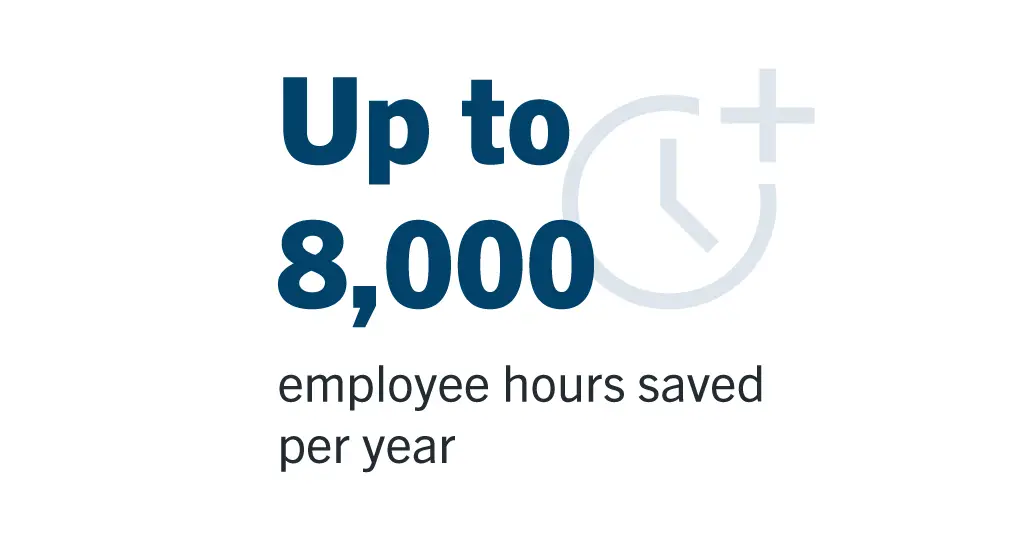
āLaserfiche is a cornerstone of our environment.Ā The automation functionalities alone save us thousands of hours annually, but on top of that it helps us in so many ways to gather, process, and document nearly every piece of information that passes through our organization.Ā There isnāt a single member of our team that doesnāt interact with Laserfiche, and most of them are working with the system throughout the day, every day.ā
Advancements in machine learning and artificial intelligence (AI) have led to the emergence of revolutionary technologies, such as generative AI. At Laserfiche, we believe that generative AI has the potential to fundamentally alter how people use technology and to change our lives ā in our homes, in our classrooms and especially in our workplaces.
Laserficheās vision for how AI will transform the workplace focuses on empowering individuals to transform their work, take control of their processes, and supercharge their productivity ā all without losing sight of increasingly important and ever-evolving data privacy and security standards.
Use cases for AI are diverse and ever-expanding, however, to achieve enterprise-wide transformation, organizations will need to deploy AI at scale.
What is AI at Scale?

Implementing AI at scale will require the use of AI across the enterprise to streamline operations, improve decision-making, and react faster to changes. Here are a few examples of business-critical processes that can be made more efficient and agile using AI technology:
Some of the challenges of deploying AI at scale include the creation of sophisticated data management frameworks that cover all components of a data lifecycle, and efficiently deploying AI solutions across platforms.
A content services platform is already foundational to an organizationās business-critical content and processes, managing data lifecycles including capture, storage, integration and disposition. These platforms are also often integrated with other core technologies to support the flow of information enterprise-wide, making it the ideal context in which to use AI and deploy it at scale.
Using AI within content services has the potential to uncover new ways to deliver business value, by accelerating the speed of business; improving monitoring and analysis of process data; creating new business capabilities and innovations; reducing error; and enabling the organization to keep up with rapidly evolving markets.
Considerations for Using AI at Scale
Doing anything at an enterprise scale comes with a set of considerations that should be thoughtfully evaluated, but AI tools pose some new and unique challenges. AI technology processes vast amounts of data, creating increased risk of the intentional or unintentional exposure of sensitive and proprietary enterprise data. AI tools can also produce biased or incorrect responses to prompts, potentially leading to biased or unethical decision making. Therefore with AI, security, privacy and ethical considerations come first and foremost.
Data Transparency: At Laserfiche, data transparency is a cornerstone of our development and operational approach. We are approaching AI in the same way we have always approached Laserfiche features and tools, which are trusted by organizations in the most highly regulated industries, such as government, healthcare, financial services and manufacturing. To facilitate the responsible deployment of AI, Laserfiche is employing a risk-and-benefits framework rooted in leading industry practices for assessing risk and protecting sensitive information to assess the benefits and risks of AI. In conjunction with Laserficheās existing data privacy and security initiatives and code of ethics, this framework will guide Laserficheās development and use of AI technologies in its products in a responsible manner.
Security: Laserfiche believes that enterprises and technology vendors must implement multiple technical safeguards to minimize the risk that inappropriate use of AI may pose to sensitive data. Additionally, centralized security policies that limit access to data as privacy and security policies permit will be essential to giving administrators fine-grained control over their data.
Adoption: Another important consideration ā and possibly the most challenging ā is how teams will adopt AI across the organization. AI at scale will require organizations to break down the silos that are currently separating data as well as people and processes to adopt new ways of working and create a company culture that embraces change and innovation. Using AI to transform the enterprise will require new skills, restructured business processes and new ways of communicating so that everyone knows what is changing, why it is changing, and what expectations are across teams and departments.
The Future of AI and Laserfiche
Laserfiche is embracing a new era of computing and productivity ā and this is just the beginning of it. Weāre excited to explore AI and introduce you to new AI-powered capabilities and innovations with Laserfiche in the coming months. Be sure to stay tuned for more news here on laserfiche.com.
SITUATION
⢠Needed a way to centralize information
⢠Reliance on manual processes such as order management and accounts payable
⢠Lack of standardization and automation in processes
RESULTS
⢠Automated manual processes and created a digital-first, streamlined employee experience
⢠Increased productivity, transparency, and accountability
4Front Engineered Solutions has nine facilities in North America, and designs, manufactures and installs loading dock equipment solutions that are aimed at supplying the critical needs of customers across warehousing, manufacturing, retail, and distribution centers. As a result, productivity is a high priority. Commanding that accounts payable processes conform to the demands of todayās digital world is imperative. Like the modern and efficient approach taken with its products/solutions, 4Front wants to ensure it complies with industry regulations and more importantly, that customer needs are met with speed and accuracy.
āWe initially wanted a quick way to process and access files ranging from order records, invoices and credit memos across different offices,ā said Amy Skoug, director of IT ā Applications at 4Front. āBy developing a system that employees can use to manage core business documents from across the country, we have been able to use Laserfiche to improve efficiency and transparency for our customer service teams and other departments.ā

4Front has been able to centralize information across departments in multiple locations, including accounting, customer service, engineering, and distribution, using Laserfiche repositories that enable standardized records management practices and simultaneous collaboration on documents. Employees use Laserfiche to digitally capture, manage and process order documents from purchase orders through invoicing, boosting accuracy and accountability. These initiatives have also enabled employees to work remotely during the pandemic, contributing to the companyās long-term business continuity and resiliency. Additionally, 4Front has leveraged Laserfiche to gain greater insight on how to continually improve efficiency, using to the process data from Laserfiche to rapidly identify and address process bottlenecks and opportunities for optimization.
4Front initially implemented Laserfiche in 2016, driven by a need for a digital document management system that could provide long-term access and easy retrieval for manufacturing order information. With a previously paper- and manual task-driven order process, the organization scanned existing files and input new orders into a centralized Laserfiche repository for office locations in the U.S. and Canada. 4Front used the Laserfiche platform to build a digital customer and order information system, enabling staff to search for files with metadata and monitor real-time status for orders. This digital system has improved responsiveness to customers in need of service, as well as enabled departments such as accounting and customer service to digitally update and approve amendments to orders. Through an automated Laserfiche workflow, documents in need of review are routed to the relevant team, who can then cross-reference submissions across multiple locations and approve of changes within the system. Staff can work off one master copy of the document, which minimizes errors associated with managing multiple document versions.
āWe gained a lot of interest from many departments after implementing Laserfiche Forms, including customer service to distribution, accounts payable and accounting,ā said Skoug. āIt provided us with a new way to do approvals for many of our existing processes.ā
Implementing Laserfiche has also supported global expansion at 4Front. The company used the solution to digitize the check filing process within its Canada office. Using this system, staff can now process large batches of checks, which are digitally paired with corresponding invoices and filed within the repository by vendor name.
The company also integrated Laserfiche with 4Frontās enterprise resource planning (ERP) system to process invoices and work orders more easily. Files are automatically sorted and populated with the relevant sales order metadata, allowing interdepartmental collaboration, digital search and retrieval by leveraging metadata for order information. Using Laserfiche, 4Front also automated the three-way match between invoices, receipts and order forms. Laserfiche generates reports and checklists throughout the approval processes to help staff stay on track, identify areas of improvement, and minimize manual errors. Starting as a manual, paper-intensive process, the new invoice and work order processes have enabled more transparent customer and order information and opened up new opportunities for digital transformation.
After implementing its automated invoice and order management system, 4Front has achieved substantial savings in time originally dedicated to manual, paper-based tasks. This has been especially crucial during periods of expansion, as well as during pandemic-related operational disruptions.
Digital, centralized information has supported business continuity at 4Front as well, providing employees with a means to access and share files during the pandemic when staff needed to work remotely.

Solution-driven metrics are another component contributing to 4Frontās digital transformation initiatives, utilizing monthly reports that provide insights on overall productivity, staff performance and trends on reason codes. Additionally, the company is actively identifying other departments and processes where Laserfiche could be deployed, including the HR department to centralize employee files, facilitate the onboarding process and track trainings and safety reporting. 4Front is also looking to digitize common manufacturing industry processes such as generating and managing bills of lading (BoL), as well as new product information documentation. To continue driving change, plans are in place to deploy Laserfiche in departments handling input and feedback from external stakeholders, such as the warranty team and in-records retention processes, as well as engineering change processes.
āThe manufacturing sector is becoming increasingly data driven. Our digital transformation initiatives have enabled us to provide a better experience for our customers and staff members. We can respond to customers more quickly, retrieving relevant documents in seconds while speaking to them.ā
Amy Skoug, director of IT ā Applications, 4Front
SITUATION
⢠Complex processes surrounding procurement, service requests and other business needs lacked consistency and oversight.
⢠The organization sought a solution to automate business processes and streamline them for staff.
RESULTS
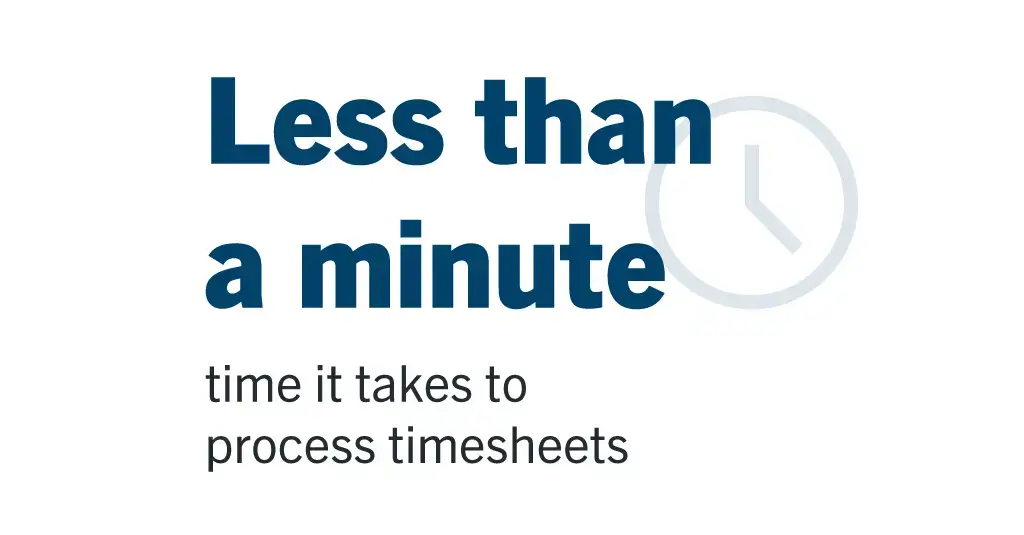
⢠Automated solutions accelerated key workflows including the timesheet process, which was reduced from one week to less than a minute.
⢠Digitization and automation initiatives supported staff satisfaction, new hybrid work models, interoperability and compliance across the organization.
SIU Medicine is a publicly assisted medical school and clinical practice with more than 2,000 providers, researchers and staff members across the state of Illinois. Additionally, SIU is home to a world-class scientific research facility. The facilityās more than 100 active projects complement the institutionās mission of optimizing the health of the people of central and southern Illinois through education, patient care, research and community service.
SIUās multi-pronged approach requires complex business processes for procurement, service requests and other everyday activities. The organization has been using Laserfiche for digitizing records for the past 10 years, partnering with Laserfiche solution provider TKB Associates. Recently, SIU found a need to modernize processes and expand use of Laserfiche to include Laserfiche Forms and workflow.

ā[We saw] an opportunity to get executive buy-in and automate processes like online timesheets,ā said Jennifer Washburn, IT manager at SIU Medicine. āAnd since then, weāve had people lining up and really wanting us to tackle their projects.ā
Today, the organization has embraced process automation across departments, leveraging Laserfiche as a capture, decision-making and workflow engine. With streamlined processes and automated records management that reclaims time for employees to focus on more value-added work, Laserfiche supports the organizationās goals, enabling SIU to sustain high employee and patient satisfaction.
Like healthcare IT teams across the country, SIU Medicineās Process Automation Team has navigated three significant challenges in recent years:
The Process Automation Teamās commitment to continuous improvement has been a boon to the organizationās ability to respond in innovative ways.
āLaserfiche allowed us to tackle problems and solve them in ways that I donāt think would have been possible otherwise,ā said Jennifer Washburn, IT manager at SIU Medicine.
To support hybrid and remote staff, the organization started by automating the timesheet process with Laserfiche Forms.
āLaserfiche Forms allowed us to help our staff continue to do their jobs from wherever they were,ā said Washburn. The team created electronic forms and associated workflows for different types of timesheets in various employee categories.
“SIUās timesheet process was reduced from 1 week to less than a minute.” align=”left”>The difference in the automated process was significant. āPreviously, the manual processes could take a week or longer,ā Washburn said. āToday, it takes less than a minute.ā
This initial automation project also sparked a shift in which many departments began to see real value in digital transformation.
The selection of timesheets for a pilot was also strategically successful for the Process Automation Team. āNot only was it a huge efficiency gain for us, but it also introduced every single member of our workforce to Laserfiche Forms,ā Washburn explained.
The Process Automation Team has continued to take on new projects with the goal of enhancing the employee experience and empowering users to do the work and research that supports the organizationās mission. Meanwhile, Laserfiche tools like electronic forms, automated workflows and electronic records management also support compliance with internal and external requirements, as well as usersā ability to access data across different systems.
SIU Medicine has automated both simple processes such as animal requests ā enabling researchers to request animals for research projects, with streamlined approvals and documentationā and more complex workflows that are used organization-wide.
For example, purchase orders are now on Laserfiche Forms. What was once a manual process that involved PDFs being emailed or paper forms being passed from desk to desk is now completely digital and automated.
āWe created a Laserfiche form that pulls budget purpose numbers and auto-populates the necessary information from another system, which then brings in the fiscal officer thatās responsible for that budget number,ā said Mike Overmeyer, data architect at SIU Medicine. The automated system also helps employees by auto-routing POs that may need to go to multiple officers, or that are rejected by one or more officers. āWe also give purchasing the ability to run POs by IT or an administrator, if they need to. Itās conditional, and weāre not putting the onus on the employee to make those decisions or execute those manual tasks that can end up causing delays.ā
Washburn said that budget purpose numbers are housed in a separate, legacy accounting system that can be leveraged via lookups from Laserfiche Forms. āUsers enter a number and it all pre-populates. They click submit and itās near instantaneous getting to the next person. The end users are amazed that they can do all of this in one place.ā
Feedback has been so positive that the project was expanded to include purchases that are made through state procurement cards. āThe intent is now to use it for everything that gets purchased for the school, from paper towels and office supplies to computer or laboratory equipment,ā Washburn added.

SIU also used Laserfiche to expedite the collection of patient information when a local healthcare provider retired. āThere was a local practice where the provider retired, and all of their patients were transitioned into our practice,ā Washburn explained. āWe had to collect release of information notices, so we quickly deployed a Laserfiche form to streamline that process. Our clinical staff just had to enter the patientās health record number. Our system integrates with our practice management system to pull everything automatically, which significantly reduced the time it would have taken manually.ā
SIU Medicineās IT department also stood up its own Laserfiche-powered system for entering requests. Employees fill out an electronic form to request a variety of IT services, including reports, software installation, or even new processes through Laserfiche Forms. āPrior to using the forms, we would get requests that were very unstructured, and there might be a lot of follow-up questions to find out, for instance, what reports someone needed, or what we could to do provide support,ā said Jeff Wilson, IT director at SIU Medicine.
Other processes that the organization has transformed using Laserfiche include:
SIU leverages Laserficheās robust records management capabilities on a daily basis for compliance with industry and state requirements. All forms and information generated from Laserfiche processes are saved and managed in the Laserfiche repository, supporting information governance practices at SIU.

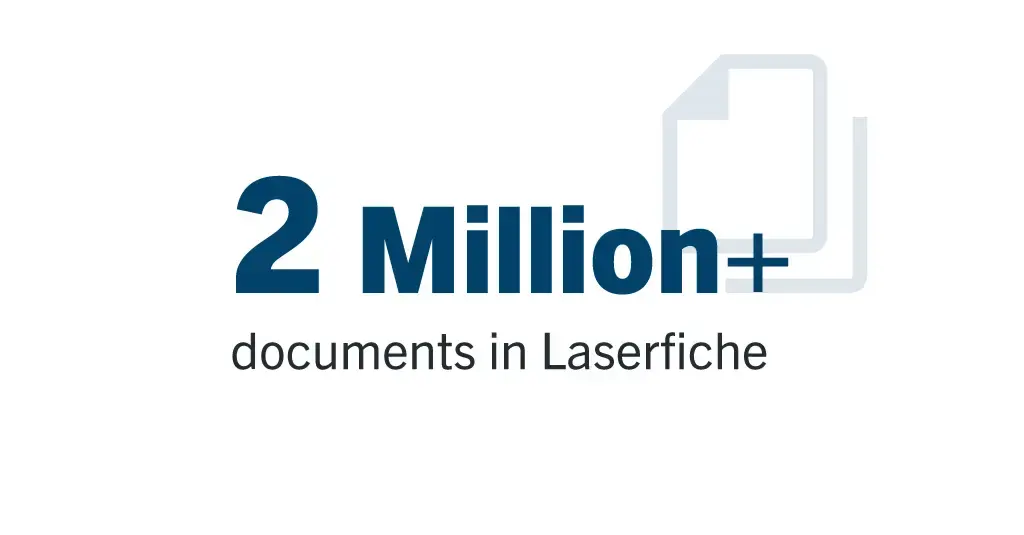
āWe have well over 2 million documents in our repository,ā said Washburn. āIf thereās not an existing folder structure for the area that weāre working in, Laserfiche Forms can create it dynamically. We make sure that everything lands in Laserfiche at the end of the day.ā
Finally, the organizationās digital efforts have extended beyond process, productivity and compliance improvements, into staff resilience and satisfaction ā which has been invaluable in the current healthcare climate. āWorking in healthcare, thereās a lot of pressure and demand, so we are constantly thinking about how our staff is doing and what we can do to make the experience better,ā Washburn said. āSIUās executive leadership has emphasized that staff are more contented in their roles when they feel supported and know what they can expect from their leaders. In the most recent employee satisfaction survey, we were rated highest in staff understanding of their roles and responsibilities, and we ranked steady in satisfaction.ā
SITUATION
⢠Company expansion led to a need to optimize paper-based accounts payable processes.
⢠NWFM sought a means to manage invoices digitally and increase transparency between back office and field operations.
RESULTS
⢠Achieved hundreds of thousands of dollars in savings
⢠Increased accuracy in invoice processing
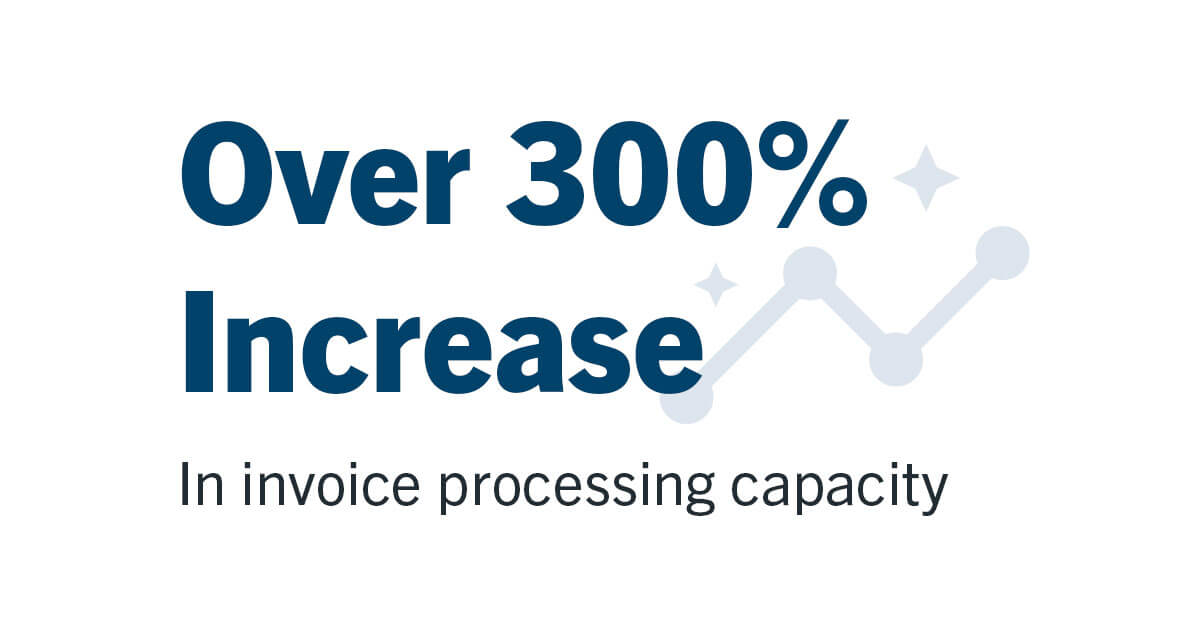
⢠Over 300% increase in invoice capacity
⢠Increased investor confidence in the company
NWFM is a locally owned, full-service farm investment and property management company based in Yakima, Washington. Established in 2018, the company had initially processed all its vendor invoices manually. However, as NWFM expanded, the amount of paper invoices increased proportionally with its growing operations and client base.
āOriginally, we manually processed about 250 invoices a month,ā recalled Tim Hull, administrative manager at NWFM. āAs a few hundred acres of new land came under our management, I could see a paperwork tsunami coming.ā
Recognizing an opportunity to optimize paper-based accounts payable processes and improve back office and field operations, NWFM searched for a digital capture and workflow solution. Due to its reputation as a robust cloud content services platform, Laserfiche was chosen, and NWFM worked with solution provider FreeDoc of Lynnwood, Washington, to design a dedicated, customized accounts payable workflow.
Since implementing Laserfiche to keep up with a rapid growth trajectory, NWFM has achieved substantial cost and operational savings, as well as gained the ability to leverage data and metrics built into Laserfiche to improve transparency and accuracy throughout its operations.

Managing hundreds of acres of farmland across Central Washington, NWFM recognizes the value of automation and technology in its operations for the sake of efficiency and accuracy. Assessing its original invoice processing system, the company identified significant challenges:
āAs we took on more farmland to manage, I wasnāt sure how I was going to handle such a big influx of invoices every month,ā said Hull. āLaserfiche helped us to create a solution to connect our employees located almost 100 miles away to our central office and resolve many of our major challenges.ā
The digital accounts payable system at NWFM routes all electronically imported invoices into a dedicated folder within the companyās Laserfiche repository. Each invoice can be reviewed for accuracy before sending it for final approval and payment processing. Throughout the process, the administrative team can make changes to expense category codes and make notes to the bookkeeper.
NWFMās Laserfiche system is integrated with FastField purchase order software, which allows area managers to upload pictures of invoices directly to Laserfiche from remote locations. The integration extracts vendor names, ranch names, individual blocks, numerical codes and other relevant information needed for processing and approvals; facilitating the management of clear, categorized information while processing invoices.

This has significantly increased the efficiency of invoice review and finalization. NWFM has gone from processing 250 invoices a month to more than 1,000, with the potential to scale up as the company continues to grow.
āLaserfiche has really proven to be the backbone of many of our processes,ā said Hull. āIts cloud-hosted infrastructure and the ability to search for specific words within documents has helped us to form a solid connection between our central office and the ranches we manage ā we are able to understand each other more clearly in terms of orders and financial documents.ā
In addition to the need to establish a revamped AP system, the NWFM team wanted to give investors located out-of-state the ability to review invoices and financial documents digitally. Rather than continue with the legacy process of storing invoices in filing cabinets, NWFM now has a standardized digital repository and has been able to increase its financial transparency when working with investors, giving them access to invoices in real-time. Built with email import functionality, purchase order integrations and granular access rights, the new AP management system has supported NWFMās efforts to modernize its operations and position the company for growth.
Hull explains that NWFM initially tracked cost savings from the AP automation initiative for the first several months after implementation.

āWe happily stopped counting savings after it exceeded $1,000 per month,ā he said. āThe savings was used to hire a chemical inventory specialist who now tracks inventory movement and returns unused stock. This allowed us to already return $72,000 in unused chemicals this year alone.ā
NWFMās new AP system also enables employees to process invoices while checking the price of products against bid sheets. In addition to the time savings from managing invoices, this process has additionally saved NWFM thousands of additional dollars by enabling the company to catch vendor billing errors, identifying $14,000 in billing errors per year. Leveraging data extracted from its invoice repository, the company is now making more accurate and productive purchasing decisions, and identifying savings opportunities.
Following the success of its AP system, NWFM has plans to establish satellite offices to further localize invoice processing in a more distributed strategy. This puts invoice processing closer to the ranch managers who make the purchases and generate the purchase orders. As the company continues to expand, Laserfiche has proven its effectiveness as a scalable solution.
āOrganizing invoice and purchase order information by project or by ranch and block for review would have taken me weeks,ā stated Hull. āNow I have it all at my fingertips.ā
SITUATION
In 2020, the Town of Prosper created a continuous process improvement program based on lean practices. As a part of this effort, the town aimed to eliminate paper-driven processes and manual tasks across various departments in order to meet the demands of the townās growing population.
SOLUTION
The IT department began by replacing the paper applications for the townās boards and commissions with a Laserfiche form. After experiencing Laserficheās ease of use, the department expanded with more electronic forms for the municipal court and the public works departments.
RESULTS
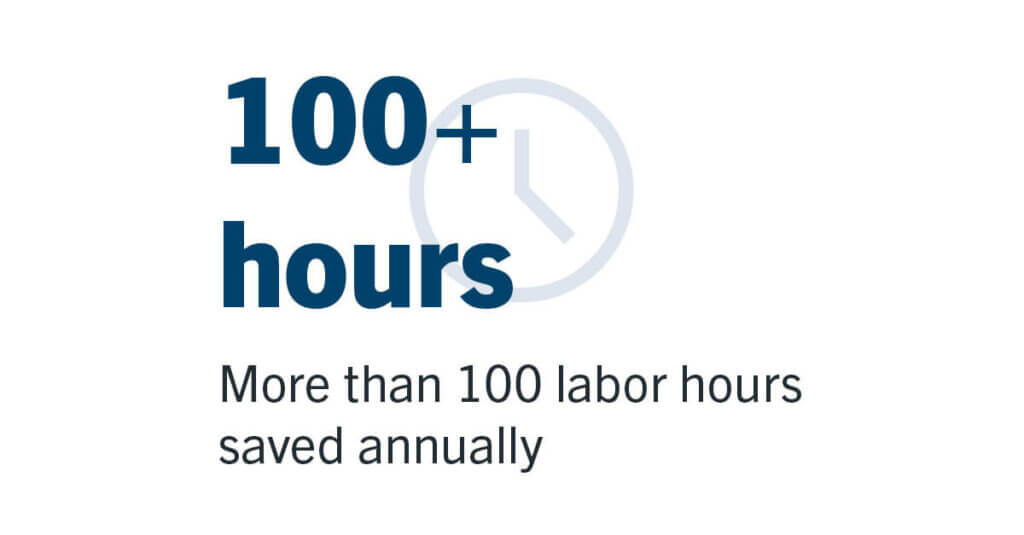
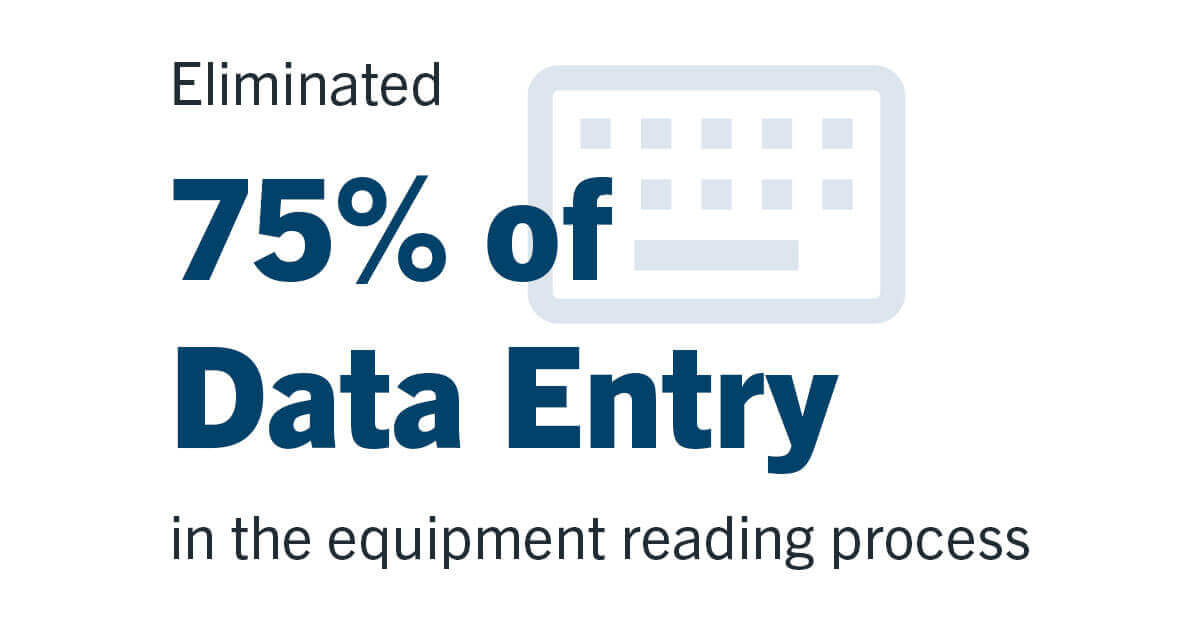
In addition to reduced opportunity for error and a streamlined staff experience, the time the public works department spends on the water equipment readings process has been cut by 75% or more. The department estimates it has saved more than 100 hours annually by re-engineering the process.
The Town of Prosper is a fast-growing suburb with small-town charm, located 30 miles north of Dallas at the crossroads of U.S. 380, Preston Road and the Dallas North Tollway in Collin and Denton Counties. Prosper sits on 27 square miles and is home to more than 35,430 people. A home-rule municipality, governed by a council-manager form of government, the town has full-time fire and police departments, including its own dispatch service. As the Town grows to its projected build-out population of 70,000 residents, Prosperās vision is to remain a āPlace Where Everyone Matters.ā
Prosper is a town within Texasās Dallas-Fort Worth-Arlington metropolitan area that has experienced tremendous growth in recent years. With a projected build-out population of 70,000 ā double its current population ā the townās IT department has had the foresight to prioritize increased efficiency, implementing processes and solutions that will help the town scale with growth and continue delivering high quality public services.
As a part of this effort, IT has leveraged Laserfiche enterprise content management (ECM) in various departments as a channel for process modernization and efficiency. The town started by replacing the paper applications for the municipalityās boards and commissions with a Laserfiche form. After experiencing Laserficheās ease of use, the department expanded with more electronic forms for the municipal court and the public works departments.
āWeāre utilizing Laserfiche for what itās good at, which is routing information, filing it into a system that makes it easy to search, easy to retrieve and easy to maintain with retention guidelines,ā said Leigh Johnson, director of information technology at the Town of Prosper. āAnywhere that we can get a department to start using it more weāre trying to do so.ā
Johnsonās vision puts digitization and centralization at the forefront, reducing opportunity for human error while providing a streamlined staff and citizen experience when interacting with the townās information. Laserfiche supports this vision, as the town continues to explore new ways to leverage Laserficheās robust records management, electronic forms and integration capabilities.
The Town of Prosper recently implemented a continuous improvement program with the ultimate goal of maintaining a high quality of service to the townās growing population. This initiative led the IT department to explore opportunities for new efficiencies within existing technologies and processes.
āFrom the moment I started digging into Laserfiche, I thought āThis is really slick,āā Johnson said. āI learned about forms and workflow, and we decided at some point that we needed to be utilizing it more and get some training on it.ā
The IT department tapped the townās Laserfiche solution provider, MCCi, for support and training on the platform, which inspired new ideas and opened doors to more advanced solutions.
One of the first Laserfiche-driven process improvements was done in collaboration with the town secretary, who wanted to modernize the way people applied to be on one of the townās boards or commissions. Like in many municipalities, Prosperās application was previously done on paper and the process was entirely manual.
āAny place we can eliminate inefficient processes, whether they are paper or otherwise, is going to benefit us,ā Johnson explained.

The new process allows applicants to fill out a digital Laserfiche form on the townās website. Applicants attach their resumes; information is filed in Laserfiche and assigned a retention schedule, lessening the burden of managing paper records hidden in a filing cabinet.
When COVID-19 arrived, the IT department saw an increased need for digital forms to help decrease foot traffic to Town Hall. Building on their knowledge of Laserfiche forms, the team built several new forms, including:
āLaserfiche became our go-to, because it was existing platform and we knew how easy it was to build a form with minimal training,ā Johnson added.
After their experience with creating some helpful Laserfiche forms for the town secretary and municipal courts, the IT department was ready to take on a more complex challenge. The team identified a legacy process that the public works department used daily to collect readings from equipment (such as water meters) at public works facilities throughout the town.
Previously done using a stack of paper comprising a sheet for each facility, the process involves field workers who drive out to each site to take readings from the equipment and note the relevant numbers by hand.
āEmployees would then go back to the office and transcribe the information into what I called a ādirty log,ā which is basically another piece of paper where numbers could be erased and redone, mustard or coffee could be spilled on it,ā Johnson said. Numbers were then transferred into a āclean log,ā which could be kept as record and shown to the Texas Commission on Environmental Quality (TCEQ) during audits. āThere were so many opportunities for numbers to be input incorrectly, and it was very time consuming.ā
With support from MCCi, the Town of Prosper IT team reimagined the process using Laserfiche, which made the readings available to supervisors back in the office in real time. The new process involves equipping field workers with tablets and enabling them to enter readings digitally into a Laserfiche form. The forms presented a list of facilities and, depending on which facility the field worker selected, the form would dynamically change fields for different types of readings. Field workers electronically sign the form, which would also automatically be geotagged with the location of the facility.
āThe public works department wanted another way to verify that a person was at the facility, so that if there was ever any question about it, we would have that signature and geotag,ā Johnson said.
Field workers then move onto the next facility and repeat the process. If a supervisor in the office notices an anomaly with any of the information entered, they can immediately notify the field worker to take another reading.
āBefore, they have even gotten back to the office before a supervisor could notify them that something looked off, so weāre saving more time and fuel as well,ā Johnson added. āAs they submit the numbers, they are written to an SQL database. We also file the forms in Laserfiche by month. When TCEQ comes out to do the audit now, instead of having to look through a file folder, weāve got all the forms filled out, timestamped, geo-tagged, signed, and we know we went out there and did readings as weāre required to do. Itās much more efficient, and itās updated in real-time.ā

In addition to supporting the auditing process, the new equipment readings form has reduced the opportunity for error by eliminating 75% of the legacy processās manual data entry. Johnson also estimates that the new process saves at least two hours per week in manual transcription, all of which results in huge efficiency gains for the public works department.
Today, the IT department is working on integrations to create even more connectivity and efficiencies. An integration between Laserfiche and the townās enterprise permitting and licensing system, for example, will enable the planning department to streamline records management by auto-filing paperwork related to permitting and licensing into Laserfiche. The human resources department, too, has embraced a digital approach to managing content and exploring new solutions.
āWe went from having just one form for the boards and commissions application to creating dozens,ā Johnson said. āWe are growing so fast ā we have lots of new employees starting, which has been the trend in recent years. So weāre not slowing down; we canāt slow down. Thereās so much growth. Residents are very engaged and they demand a lot. Laserfiche is an example of one of the ways we can use technology to scale our services.ā
CATIC migrated content from a legacy document management system into Laserfiche, resulting in over $325,000 annual cost savings and creating up to…
MPI was able to continue serving its members through one of the longest writers and actors strikes in entertainment industry history.
Featured Resource
Over 50% of insurers cite data fragmentation as their top operational challenge. Find out how to transform data from an obstacle into your competitive edge.
Whether you have product questions, support needs or want to partner with us, we’re here to help you on your digital transformation journey. Fill out the form and a Laserfiche team member will be in touch as soon as possible.