Learn how to secure your documents in Laserfiche! Within the repository, you have robust security options to ensure appropriate roles in your organization can access the content and actions they need while limiting access to those they do not. In this hands-on lab, you’ll familiarize yourself with the interfaces to set security while learning how to configure repository security to meet common use cases. Starting with foundational concepts, such as inheritance and scope, you’ll see how to apply best practices to create scalable and easy-to-maintain security for your organization.
In this course, you’ll learn how to:
Set security on repository folders to grant access to content and actions
Define administrative and end user actions available in the repository for your users
Recreated and revitalized with new examples, this brand new lab will walk you through the basics of JavaScript in the form designer! JavaScript can be used to enhance the functionality of Laserfiche Forms and Business Processes, and it’s easier than you might think! In this hands-on introductory course, you’ll get started with using the LFForm object in the new form designer and building your own customized forms using JavaScript. Whether you’ve never coded before or you’re familiar with JavaScript in the classic designer, this course will help you enhance the user-friendliness and functionality of your forms with JavaScript.
In this course, you’ll learn how to:
Identify common uses for JavaScript within the form designer
Leverage resources to build custom JavaScript functionality using the LFForm object in the new form designer
Configure common JavaScript functionality like changing form and field settings dynamically; setting, copying, and modifying field values; validating input with custom constraints; creating clickable hyperlinks and buttons based on field values; and more!
Join over 4,000 IT professionals to explore how exponential technologies are transforming organizations. Mark your calendar for June 9 – 11, 2026, at The Bellagio, Las Vegas.
California’s Digital Future: Smart, Inclusive, and Citizen-Centric!
The Public Sector Network’s Government Innovation California 2026 event is designed to showcase practical strategies and proven applications that help state and local agencies deliver measurable impact.
As the largest pension fund in Tanzania, the Public Service Social Security Fund (PSSSF) serves a vast membership base of nearly 700,000 individuals across the nation, supported by a staff of 1,000 and numerous financial partners. Formed from the merger of four distinct funds over the past seven years, the organization embarked on an ambitious mission: to become the country’s best provider of public sector pension services. This goal required a significant business reengineering effort, particularly to harmonize disparate systems and automate critical processes. PSSSF’s strategic investment in Laserfiche has proven to be a cornerstone of this transformation, fundamentally reshaping how they manage documents and deliver services.
Overcoming Legacy Hurdles and Manual Benefits Processing
Before adopting Laserfiche, PSSSF faced significant operational challenges stemming from its historical mergers and a reliance on manual, paper-based processes. Managing an immense volume of member documents was a constant struggle. “We had the challenges of searching documents during our processes, and storage occupied quite a big space. Security of the documents was also a challenge,” explained Erick Kato, director of information communication technology at PSSSF. This led to inefficiencies, delays, and a less-than-ideal experience for both staff and members.
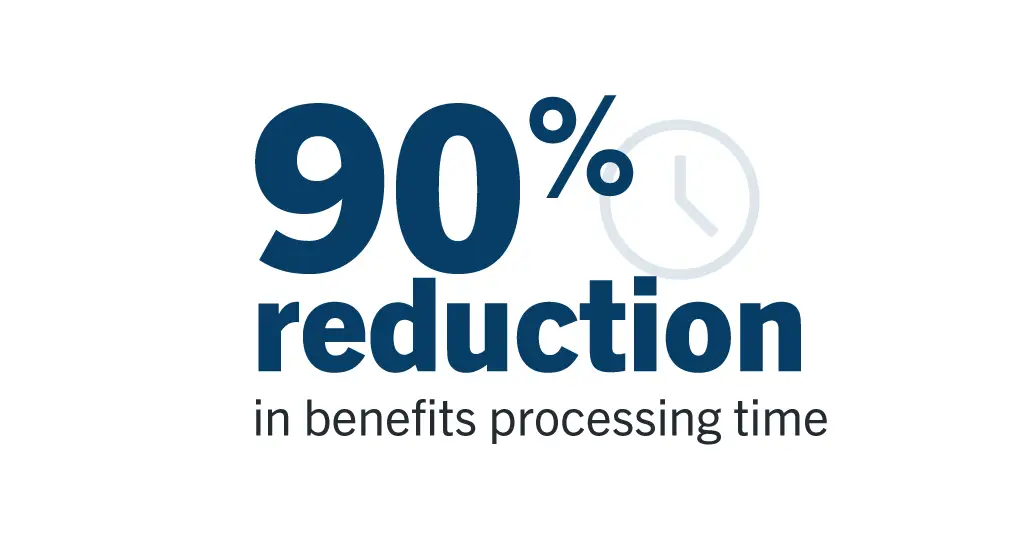
The manual nature of operations meant that processing member benefits could be a lengthy ordeal. “Processing benefits could take up to 60 days in some cases,” Kato said. For members, this led to inconvenience and cost. “Some people used to travel more than 900 kilometers to visit our offices to submit documents or inquire about their benefits.” The organization recognized the need for a solution that could centralize records, streamline workflows and enhance accessibility.
Laserfiche as a Digital Core: Automating Benefits Processes and Integrating Systems
The pension fund undertook a thorough evaluation of various systems before selecting Laserfiche. Their decision was driven by Laserfiche’s proven capabilities in enterprise content management, its user-friendly interface, and its robust capacity for document storage and rapid retrieval. “We found Laserfiche was quite easy to use,” Kato explained. “Laserfiche can also store quite a large number of documents and the searching capabilities, when compared with other systems, are very fast.”
Laserfiche was strategically implemented to become the digital backbone of their operations, with a primary focus on membership and benefit processing and payment. The solution enabled the fund to securely store, classify and easily access member records, which is paramount for a pension fund. “With Laserfiche, we can store members’ records in the way that we want them to be stored — we can classify the information and make it easier for our staff to process payments,” said Neema Kuwite, PSSSF director of finance.
Another key aspect of the solution was seamless integration. “We have integrated [Laserfiche] with our system which processes benefits to create an easy experience and eliminate the need for switching applications,” Kato said. Laserfiche integration extends to other critical business areas, including contract management and procurement, creating a unified digital environment. “These integrations have streamlined processes because you don’t have to move from one system to another. For example, from within our benefit processing system, an employee can access member documents from Laserfiche, which can be checked, processed and routed. Processing becomes very fast and easy.”
Furthermore, Laserfiche supports the fund’s broader automation agenda. “We’re looking forward to having Laserfiche support us in other administrative chains,” said PSSSF CEO Abdul-Razaq Badru. “It will help us implement the full automation program that we are embarking on, which includes connecting internal systems and integrating with larger databases to boost overall efficiency.”
Unprecedented Efficiency and Member Satisfaction
The adoption of Laserfiche has delivered transformative results across the organization, validating PSSF’s investment. These include:
Dramatic time savings: The most significant impact has been on benefit processing times. “Processing benefits used to take up to 60 days, but now it takes about 3 to 5,” said Kato. This 90%-plus reduction in processing time has fundamentally improved service delivery.
Cost savings: Both the organization and its members have realized substantial cost benefits. “We save time and we save people the headache of having to be in the records office looking for documents,” said Kuwite. The shift from paper to digital has also freed up valuable physical space. “Laserfiche has helped us to reduce the space we used to keep those records on paper. We can now use the space to hire more people or rent out to others who need office space. It’s really given us a return on investment.” For members, the ability to apply for benefits online means they don’t have to travel, saving them time and money.
Enhanced customer satisfaction: The ability to process payments quickly and provide online access to records has significantly boosted member satisfaction. “With our members, Laserfiche provides increased customer satisfaction by shortening the time it takes to process benefits,” added Kuwite. A customer survey confirmed this, with results showing members are “so comfortable and happy with our services, and the fact that we can pay them in a timely manner. Laserfiche has played a big role in that.”
Strategic and cultural transformation: Laserfiche has become one of PSSSF’s two core systems, alongside the organization’s ERP. “Laserfiche is going to help us achieve our aim of becoming a fully automated enterprise,” Badru explained. The platform is also fostering a culture of technology-driven, evidence-based decision-making. “It is actually pushing us also to think of how we can take advantage of our existing database and use the data for decision making in the future.”
Future Outlook: More Automation and AI
By strategically implementing Laserfiche, this leading pension fund has successfully navigated the complexities of merging legacy systems and transforming into a highly efficient, member-centric organization. The dramatic reduction in benefit processing times, coupled with significant cost savings and enhanced member satisfaction, underscores Laserfiche’s pivotal role. “Laserfiche solves all your problems in processing, especially if you have significant amounts of manual processes or you’re a semi-automated organization,” said Badru. “Laserfiche takes care of all those manual troubles you have.” Looking ahead, the organization is excited about further integration with AI tools, anticipating an even brighter, more automated future.
As one of Mexico’s leading insurance companies specializing in property, casualty and civil liability insurance, GMX Seguros has prioritized operational excellence and customer experience. Facing the perennial challenges of paper-intensive processes, escalating compliance demands, and the critical need for rapid claims resolution, the insurer sought to replace a legacy document management system with a more robust solution.
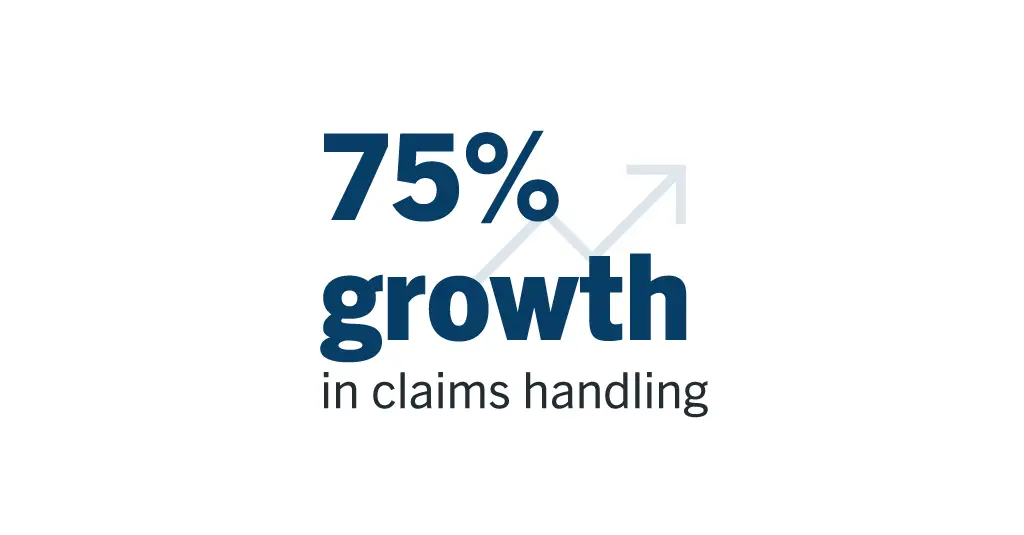
The insurer found a solution in Laserfiche, embarking on a journey that has dramatically streamlined operations, cut processing times, and fortified GMX’s position as a market leader. Through the organization’s automation initiatives, the insurer achieved an impressive 75% growth in claims handling capacity and a 20-30% increase in other business areas.
Reimagining Manual Processes and Costly Bottlenecks
Before adopting Laserfiche, the GMX grappled with a complex web of manual processes and physical documentation. Policy issuance, regulatory compliance and claims handling were bottlenecks that hindered efficiency and customer satisfaction.
“We were generating a lot of paper in different ways,” said Oscar Salgado, CIO at GMX Seguros, describing the sheer volume of paper as about the size of a two-bedroom apartment. This physical footprint wasn’t just about space; it translated into slow, laborious workflows. The claims process, a cornerstone of customer trust, was particularly impacted.
“Claims processing used to take more than 15 days,” Salgado said. Longer timelines in claims processing, however, test customer patience in their time of need.
Beyond operational inefficiencies, the company faced stringent regulatory requirements, such as those from the Comision de Seguros, demanding meticulous collection and secure storage of sensitive customer documents (IDs, proofs of address, financial statements) to comply with anti-money laundering regulations. Managing these crucial personal documents across disparate systems was a significant hurdle.
Laserfiche as a Digital Backbone
The insurer began implementing Laserfiche with a focus on policy management, digitally archiving all issued policies and integrating them with a customer portal for easy download. This initial success paved the way for more expansive applications.
A key area of transformation was regulatory compliance. “We need to collect IDs, address, proofs of address, statements — all these documents are personal and sensitive data,” Salgado said. “We store them in Laserfiche, and this helps us organize all the documents within our customer folders.” The centralized, secure repository became indispensable for managing sensitive data and demonstrating compliance.
The most significant impact, however, was felt in claims. The company developed a digital claims solution, which collects all necessary documents from customer and automatically builds a digital file. The GMX team built an integration between Laserfiche and the company’s claims system via Laserfiche API which links every claim document to its corresponding policy and customer file, creating a comprehensive digital record.
The insurer’s use of Laserfiche extends to other departments and critical processes including:
Legal: Manages contracts with providers and agents, from initial petition through revisions and final signatures.
Policy services: Supports legal compliance by digitally capturing customer signatures on policies, verifying their awareness of terms and conditions, and securely storing these signed documents.
Human resources: Streamlines the collection, review and storage of numerous legal and personal documents required for new agents.
Finance: Connects with the ERP system for processes like purchase orders, further unifying the digital ecosystem.
Dramatic Time Savings and Efficiency Gains
The implementation of Laserfiche yielded immediate and profound benefits, most notably in time savings and operational efficiency.
“The time that we are saving is tremendous,” Salgado explained. The most striking improvement was in claims processing: “Claims that used to take more than 15 days now less than five. In some cases, we can process a claim within the same day.”
This strategic advantage became especially evident during a crisis, when GMX experienced an influx of claims in a short period of time. In 2023, Hurricane Otis made landfall near Acapulco and became the costliest tropical cyclone to strike Mexico on record.
“We had the best turnaround time for claims related to Hurricane Otis,” Salgado said. While competitors struggled to process claims for months, the GMX Seguros’ Laserfiche-powered processes allowed the insurer to pay customers in less than a month. “With this efficiency, we can process more claims in less time.” This increased capacity, he added, amounts to 75% growth in claims handling.
Handling 50,000 – 60,000 claims per year and issuing more than 300 policies per day, GMX employees use Laserfiche on a daily basis to support critical service delivery. Beyond claims, the insurer has experienced 20% – 30% growth in other business areas.
GMX has also implemented Laserfiche to increase efficiency in:
Purchase orders
Travel expense reports
Contract management
Invoices
Supplier management
Compliance related to Article 492 of the National Insurance and Bonding Commission
The importance of the company’s standardized document management and automated processes is further magnified by audits, which are done internally as well as by regulatory entities. “We use Laserfiche to review and compile all documentation needed for audits, which used to be a very time consuming process,” Salgado said.
The paper reduction has also liberated valuable physical resources, freeing up office space and allowing for better utilization of facilities.
Building a Resilient Digital Future
GMX Seguros has not only automated critical processes like claims, compliance, and policy management but has also built a resilient, highly efficient digital ecosystem. The ability to dramatically reduce claims processing times has translated directly into enhanced customer satisfaction, particularly when responding to high-volume events like natural disasters.
“We have some of the best response times in Mexico,” Salgado said. “Laserfiche is not just a document storage system for us. It’s a competitive advantage.”
Nearly half of employees are entering company-related information into public AI tools to complete their tasks and hiding their AI use, out of fear of seeming lazy, risky, or non-compliant
1 in 10 employees describe AI adoption in their workplace as “the Wild West,” unregulated, unclear, and out of control
LONG BEACH, CALIFORNIA, August 13, 2025 — Laserfiche, the leading SaaS provider of intelligent content management and business process automation, today released new survey findings on AI adoption in the workplace, revealing that nearly half of Americans (49%) who use AI at work keep it to themselves, with 15% deliberately avoiding telling their manager.
As AI tools become more embedded in daily life, the survey reveals a workplace reality that is far less aligned. While many employees are eager to harness AI to boost productivity, inconsistent policies and cultural hesitation are fueling secrecy around AI adoption at work. Employees who are hiding their AI use worry it will be seen as lazy (16%), risky (15%), or out of step with company policy (16%).
A Mixed Workforce Mood
Employee sentiment around AI remains divided. While 21% are optimistic, and 22% say AI already helps them work faster or more efficiently, others are more cautious. Nineteen percent are skeptical, citing concerns about accuracy or misuse, and 13% are anxious or resistant, uneasy about the risks and consequences of incorporating AI into their workflows.
Younger generations are more optimistic about AI at work: 24% of Gen Z and 20% of Millennials say they see its potential but are still learning how to use it, compared to just 10% of Baby Boomers.
A New Frontier — with New Risk
Only one in three employees (36%) say their workplace has clear policies and approved AI tools in place. Meanwhile, 1 in 10 describe their organization’s AI environment as “the Wild West,” an unregulated space where people do what they want.
That lack of structure has consequences. Nearly half of employees (46%) admit to pasting company information into public AI tools, such as ChatGPT or Google Gemini, sometimes without knowing if the content is sensitive or confidential. Many turn to these tools in an attempt to gain a competitive edge (24%) or because their company’s own tools are too limited or hard to use (23%).
Older employees are significantly more cautious about using unofficial AI tools at work: 69% of Baby Boomers and the Silent Generation, and 35% of Gen X, avoid these tools, compared to just 21% of Millennials and 17% of Gen Z.
The Path Forward: Build Culture Before Crisis
These findings highlight a growing AI governance gap. Usage is outpacing policy, and fear is replacing transparency. To solve this, organizations must do more than roll out AI tools. They need to foster a culture where employees feel informed, supported, and aligned on how and when to use them.
“When employees feel like AI is their ‘dirty little secret,’ that’s not a tech problem, it’s a leadership one,” said Karl Chan, CEO of Laserfiche. “Many employees are eager to embrace AI to work but often resort to unofficial tools when company-approved options are too limited or difficult to use. Innovative organizations can meet employee needs and unlock new potential by implementing guidelines, and adopting IT-vetted, intuitive AI tools that help employees reach productivity goals.”
Methodology
The survey was conducted by Veridata Insights and commissioned by Laserfiche. It included 1,000 U.S.-based individuals aged 18 and over, census-balanced by age and gender.
About Laserfiche Laserfiche is a leading enterprise platform that helps organizations digitally transform operations and manage their content with AI-powered solutions. Through scalable workflows, customizable forms, no-code templates and AI-enabled capabilities, the Laserfiche® document management platform accelerates how business gets done. Trusted by organizations of all sizes — from startups to Fortune 500 enterprises — Laserfiche empowers teams to boost productivity, foster collaboration, and deliver a superior customer experience at scale. Headquartered in Long Beach, California, Laserfiche operates globally, with offices across North America, Europe, and Asia.
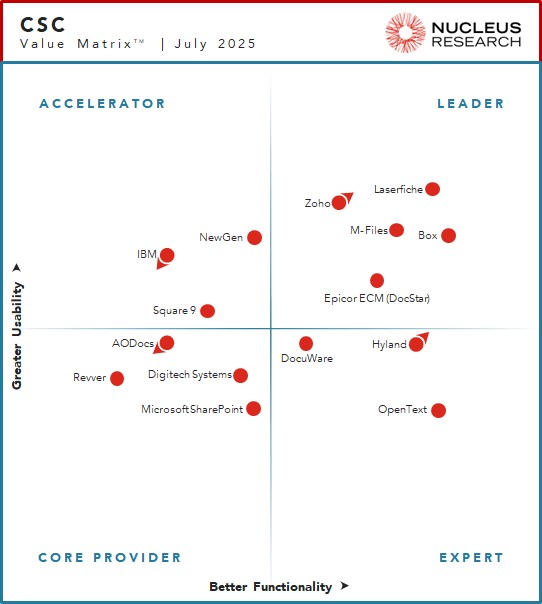
“As a leader in this year’s Value Matrix, Laserfiche was rated highest in usability for its AI productivity tools, new administration hub, process automation and integration capabilities,” said Evelyn McMullen, research manager at Nucleus Research and author of the report.
CSC as a Strategic Advantage: AI-powered Information Management
Recently released Laserfiche AI-powered features are aimed at boosting productivity even further and enabling automation at scale. Smart Fields, an out-of-the-box intelligent capture tool, allows customers to extract data automatically using natural language instructions, no matter the source or format. Smart Chat provides an intuitive chat interface that enables users to quickly gain insights from their repository content.
“As AI matures at an accelerated pace, vendors in the CSC market have the unique advantage of managing both structured and unstructured data from across the entirety of an organization,” the report’s Market Overview states.
Laserfiche AI features alongside powerful workflow automation, information governance and records management tools create new opportunities for organizational efficiency. Customers across industries use Laserfiche to increase productivity, create competitive advantage and drive growth.
“Laserfiche gives us the forms and workflow processes as well as data integration that enable efficiency at scale,” said Airline Hydraulics Chief Technology Officer Todd Schnirel. “Our Laserfiche-powered process improvements have supported us in achieving a significant increase in net revenue while adding very little operating expense.”
“Being ranked a leader for 10 consecutive years is a testament to our product innovation,” said Thomas Phelps, senior vice president of corporate strategy and CIO at Laserfiche. “Our top ranking in usability reflects our core value of putting people first and our commitment to delivering intuitive solutions that empower users.”
To learn more about Laserfiche’s position in the Content Services and Collaboration market, download the report here.
About Laserfiche
Laserfiche is a leading enterprise platform that helps organizations digitally transform operations and manage their content with AI-powered solutions. Through scalable workflows, customizable forms, no-code templates and AI-enabled capabilities, the Laserfiche® document management platform accelerates how business gets done. Trusted by organizations of all sizes — from startups to Fortune 500 enterprises — Laserfiche empowers teams to boost productivity, foster collaboration, and deliver a superior customer experience at scale. Headquartered in Long Beach, California, Laserfiche operates globally, with offices across North America, Europe, and Asia.