


This month, we’re rolling out new features and product enhancements that help you capture more information from your documents using Smart Fields, keep tasks moving with greater control over reassignment and routing, and do more with Smart Chat and Agents. Explore these updates and more from our latest Cloud release.
Smart Fields Expands Intelligent Capture to Marks, Images, and More
Documents often contain critical information that cannot be captured through text extraction alone. Checkmarks, shaded answer bubbles, signatures, images, and handwriting can all communicate important information. Until now, Smart Fields had limited ability to interpret these visual elements, leaving teams to review documents and enter information manually even when the rest of the document could be processed automatically.
This update adds enhanced visual understanding to Smart Fields and AI-assisted form fill, allowing Laserfiche AI to interpret text and visual information in a document together to populate metadata or fill form fields.
This includes support for optical mark recognition (OMR), enabling Laserfiche AI to interpret marked selections such as checkmarks, shaded bubbles and boxes.
Other new capabilities include interpreting and describing images within your document and capturing text from logos and watermarks.
Smart Fields and AI-assisted form fill also perform better in other scenarios that rely on visual understanding, including detecting the presence of signatures and extracting difficult-to-read handwriting such as cursive.
Together, these enhancements allow you to capture a more complete picture of the critical data and key details within your organization’s content using Laserfiche AI.
New Controls for Task Configuration and Management
New updates to task configuration and management give team managers more flexibility to redistribute work and process designers greater control over task reassignment and routing.
Team managers can now reassign tasks within their own teams without needing to manage the process that created them. When a team member is unavailable or workloads become uneven, managers can now redistribute work directly to another team member, without escalation to a process owner or administrator. This gives managers the operational flexibility they need to manage their team’s tasks, without granting broader access to process data or administrative control over process instances –keeping permissions aligned with their responsibilities.
Additionally, process designers can now control whether users can reassign tasks assigned directly to them. This helps prevent tasks that should remain a specific person’s responsibility, like manager approvals or performance reviews, from being handed off. Authorized team managers, process owners and administrators can still reassign these tasks when needed.
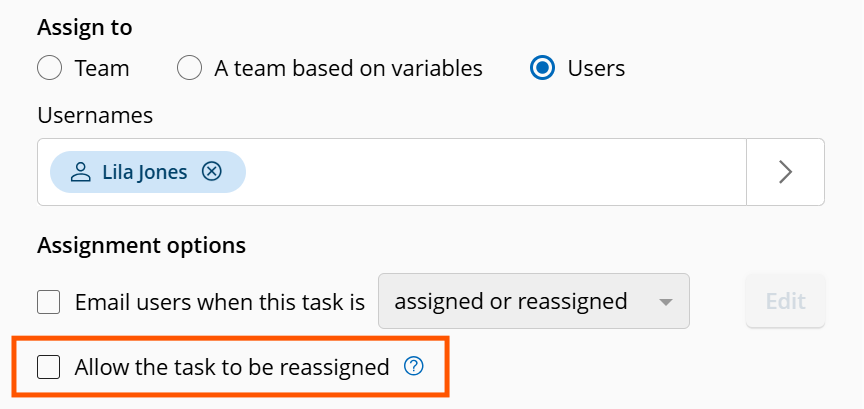
These updates also make task handoffs more predictable by preserving specialized routing when a task is released. When a team member releases a task they previously claimed, Laserfiche now reruns its assignment rules to determine who can claim it next, rather than making it available to the entire team. This helps ensure released tasks continue to follow the routing logic built into the process.
Together, these updates help keep work moving, simplifying task management and making reassignment and release more controlled and predictable.
To learn more about the latest task management updates and get a preview of what’s coming next, register for our upcoming webinar: Inbox Innovations: Simplifying Task Routing and Management.
Do More with Agents
You can now use directed agents to edit repository field values directly, further expanding their utility for metadata management.
To stay up to date on the latest in Laserfiche AI, join us for the New Laserfiche AI Innovations webinar series, with sessions in October, November, and December.
Ask Smart Chat About Your Workflows
Now, Smart Chat can help process designers understand their account’s workflows faster and with more confidence. Open Smart Chat in the workflow designer to ask questions about the specific workflow you’re viewing and get responses based on the actual design.
- Summarize Workflow Designs: Get grounded, plain-language summaries of what a workflow does, including its purpose, triggers, major branches and terminal paths.
- Explain Individual Activities & Logic: Ask about specific workflow activities to understand what they do, how they’re configured, and how they contribute to the overall automation. Follow how activities connect, how work moves through the design and why specific branches run.
- Troubleshoot and Onboard More Efficiently: Review complex, inherited or legacy workflows to identify issues and get up to speed faster.
Smart Chat Usability Improvements
New updates to the Smart Chat interface make it easier to read responses, customize your workspace and work across multiple tabs. You can now resize the chat window horizontally to best fit your content. Plus, switch between docked and floating views, follow responses more naturally as they’re generated and manage Smart Chat independently in each browser tab.
Dynamic Fields Improvements
Previously, a lookup rule could only take its input from a field filled by another lookup rule. Now, any field can serve as an input, allowing you to configure dynamic fields to display options based on free-form text entered by a user or a value generated by a field formula. This provides greater input flexibility while reducing the number of rules you need to build and maintain.
Lookup rules can also now populate multiple fields with dynamic data from a single data source. Instead of creating a separate rule for each field, you can use one rule to return multiple outputs and fill several fields in a template.
Additional interface improvements make it easier to configure dynamic fields and work with their values. A new label in the Properties pane of the template designer lets you quickly identify the field type, and improved error handling provides clearer feedback when an invalid input is selected. Additionally, users working with document metadata in the repository can now search within a dynamic field’s available options, making it easier to find the right value when a lookup returns a large number of results.
Import Agent Enhancements
Import Agent can now save email attachments as separate documents when importing email files from a local disk or directly from an email server. It can also ignore metadata assignment errors during import, applying valid values while logging invalid ones for administrators to review later, without stopping or rolling back the entire migration.
This month, we’re introducing new features and product enhancements that help you complete forms faster, do more with Laserfiche AI Agents, and get more visibility into AI usage. Explore these updates and more from our latest Cloud release.
AI-Assisted Form Fill
Filling out a form often means uploading a document and then reentering information from that document into the form. AI-assisted form fill uses Laserfiche AI to automatically populate relevant fields with information from the uploaded document, making form completion faster and easier.
How to Set It Up: When building a form, designers can enable this feature with a single setting on a file upload field.
Just select the file upload field of your choice and check the box next to “Extract and fill fields with AI” to tell Laserfiche AI which documents to analyze. Only files uploaded to a field with this setting enabled will trigger AI population.

With this setting enabled, Laserfiche AI handles both data extraction and field matching, so designers don’t need to configure any other form fields or define and maintain additional extraction rules or field-mapping logic.
How It Works: When someone uploads a file to an enabled field, Laserfiche AI reads the document, identifies the relevant data, and determines on its own which form fields the information belongs in. It then populates those fields automatically.
AI-assisted form fill never clears a field or overwrites information the submitter has already entered. If Laserfiche AI cannot find or confidently identify the information a field requires, that field remains blank.
The person completing the form can review the populated information, make corrections if needed, and complete any remaining fields before submitting the form.
AI-assisted form fill consumes AI units. Learn more about how usage is measured here.
By letting uploaded documents do more of the work, organizations can create a smoother submission experience and collect structured form data and supporting documents in one connected Laserfiche process.
Do More with Directed Agents
Laserfiche AI Agents can now take on more document management work with less back-and-forth.
Automate Complex Tasks with Fewer Interruptions: Complete complex tasks more efficiently. Now, for multi-step tasks, Agents will present their full plan upfront, giving you the option to review and confirm the proposed actions in one go instead of confirming each step one by one.
Create and Delete Collections: Agents can now create new personal Collections or delete existing ones on your behalf. Ask your Laserfiche AI Agent to find related documents, create and name a Collection, and add the documents to your new Collection in a single operation.
More Visibility into AI Usage
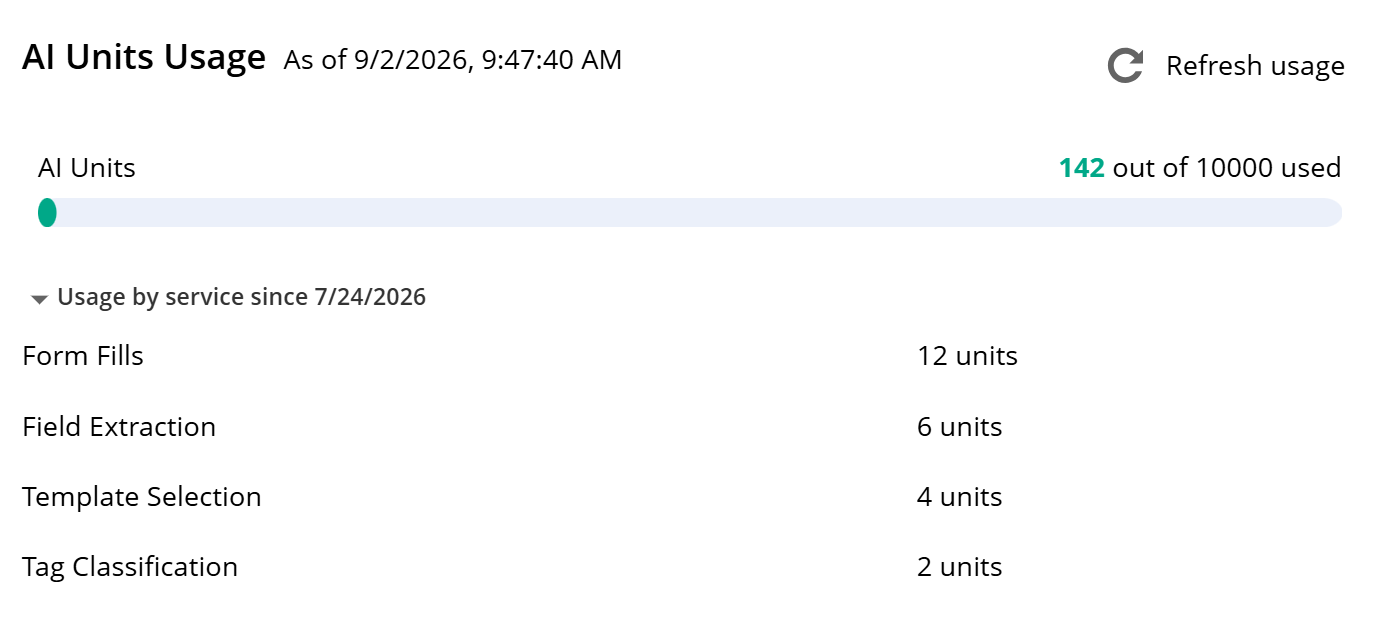
Admins can now get a clearer picture of how their account is using Laserfiche AI. The Plan page now includes a breakdown of AI units consumed by each feature, making it easier to understand which features are driving usage.
By providing more granular visibility into Laserfiche AI usage, this update helps admins more easily monitor where AI units are being used, spot inefficiencies that may be inflating usage, and manage AI resources more effectively.
Updated Software Development Kit
A new version of the Laserfiche Software Development Kit (SDK) is now available, providing a more current and secure foundation for building custom applications that interact with Laserfiche. The latest version, SDK 12, is now distributed through NuGet, making it easier for developers to install and deploy the components they need. SDK 12 also delivers upgraded versions of the Repository Access library and other supporting integration libraries, along with modernized interfaces and enhanced security. Additionally, documentation is newly available in the Laserfiche Developer Center.
Organizations using earlier SDK versions to connect to Laserfiche Cloud should begin planning to migrate to this latest SDK version, or to the Laserfiche API, as connections through earlier SDK versions will be discontinued in the future.
Additional Updates
Configure Audit Data Retention: You can now configure and enforce how long audit data is retained in Audit Trail for your account. This update gives administrators the control they need to meet compliance requirements and manage data growth.
Web Request Allotment Visibility: You can now view the number of web requests per day available for your account on the Plan page in Account Administration. Accounts that need an increased allotment have the option to purchase additional capacity as an add-on.
Government agencies have no shortage of information. Years of digital transformation have created vast repositories of content that employees rely on every day. The challenge now is turning that information into insight that helps employees make better decisions and serve their communities more effectively.
Across the public sector, valuable knowledge remains buried and scattered inside millions of documents. Expert estimates suggest more than 85% of data is “unstructured”, living within emails, physical files and chats. Employees know the answers they need are there but finding them often requires painstakingly digging through records one document at a time. Even agencies with mature content management practices continue to face the same issue. They have information but need a faster way to turn it into action.
Agentic AI has the potential to make that happen.
Initially, AI tools helped employees find information or summarize documents. Agentic AI goes much further. It can understand what information means, recommend the next step and carry out approved work on a user’s behalf. Instead of spending hours reviewing documents or completing routine administrative tasks, employees can focus on serving constituents.
From Managing Content to Unlocking Intelligence
Unlocking the full potential of agentic AI in government begins with trusted content. Too often, valuable knowledge remains locked inside documents that were written for people, not systems. Before AI can act on that information, it first has to understand what the documents contain.
Modern content management systems organize information in ways AI can understand. That makes content intelligence possible by giving AI the structure and context it needs to surface insights that employees can use to make faster, better-informed choices.
The opportunities span nearly every government department. For example, agencies can use Agents to:
- Analyze Freedom of Information (FOIA) Act requests and generate reports in minutes
- Locate documents containing personally identifiable information (PII) for review
- Identify employee certifications that are about to expire
- Monitor vendor contract expiration and renewal
The work varies, but the benefit is consistent. Employees spend less time searching for information and more time using it.
Success in every scenario depends on the same foundation. AI can only produce meaningful insights when it works with well-managed content. That foundation also reinforces the trust that government agencies work hard to earn every day.
Trust Begins with Governance
Maintaining trust requires clear governance. Government agencies are expected to protect sensitive information. They’re also accountable for every decision they make. As AI becomes part of daily work, those expectations extend to the technology itself.
AI Agents should work within the same permissions as the employee it supports, accessing only the information that employee is authorized to see. Every action is recorded, creating a clear audit trail, while employees remain responsible for making and approving important decisions.
These guardrails make AI easier to trust because they make its role easier to understand. People remain at the center of decision-making while AI handles repetitive administrative work such as analyzing documents, identifying records that require attention and monitoring routine deadlines. Human judgment stays in control, and AI helps employees work more efficiently.
With clear governance in place, AI becomes another trusted workplace tool instead of a black box. Employees understand how AI fits within established processes and policies, and where human oversight remains essential. That confidence makes adoption easier across the organization.
Making AI Accessible Across the Workforce
With clear governance in place, employees are far more likely to make AI part of their daily work. Natural language helps accelerate adoption by removing much of the technical complexity that once limited automation. Until recently, employees needed to build workflows or configure complex rules before tasks could be autonomously executed. Today, they can simply describe what they need.
People can ask questions about documents, request summaries or have AI Agents organize information before confirming the requested action. The interaction feels conversational, while the underlying governance remains unchanged.
As more employees begin using AI in their daily work, routine tasks require less of their attention. That leaves more time for judgment, problem-solving and public service.
Helping Governments Deliver Better Service with Agentic AI
Agentic AI helps people make better use of the knowledge already at their fingertips. Agencies that realize that value will build on the investments they’ve already made in content management and governance. Together, they provide the trusted foundation that intelligent systems depend on to operate responsibly and earn the confidence of employees and citizens alike.
Government has always depended on informed people exercising sound judgment. Agentic AI helps employees utilize their expertise more efficiently and put the vital information to work more quickly. When built on trusted content and clear governance, it becomes another tool that helps government teams serve their communities more effectively.
Watch our webinar to learn how AI Agents can help elevate your public service and empower your teams.
Dynamic Fields Now Support External Lookups
Dynamic fields are a useful tool for making your repository metadata cleaner, more consistent, and easier to manage, strengthening data integrity across Laserfiche. This month, we’ve introduced new updates that expand the capabilities of dynamic fields to make them even more powerful.
Previously, dynamic fields were limited to data sourced from static lookup tables. Now, you can configure dynamic fields using data query and web request rules, allowing you to pull live values from external applications directly into your metadata in real-time.
This update allows dynamic fields to display field value options that are based on live business data, reflecting the most current information instantly, no matter where it is stored.
In addition, dynamic field configuration is now available within the template designer, providing a more intuitive place to create and manage these connections.
Together, these updates offer new ways for teams to keep their repository metadata accurate, current and synchronized across their line-of-business systems.
Improve AI Data Capture with Dynamic Fields
Smart Fields can now use list options supplied by dynamic fields to guide metadata extraction. By checking extracted values against the currently available options, Smart Fields can produce more consistent metadata that aligns with an organization’s approved data. Organizations can continue managing these options in their existing source, without duplicating this information in each Smart Fields prompt.
Expanded Audit Trail Events
Laserfiche Cloud Audit Trail is expanding to provide broader visibility into security-sensitive and administrative activity across your cloud environment. Administrators can now better review privileged actions, identity-related changes and account administration activity from a centralized place.
This expansion includes team and project activities along with account-level security and user events. This allows organizations to extend audit visibility beyond the repository into process automation and account-level operations. With a clearer record of what happened and when, it’s now easier to monitor critical account activity and troubleshoot issues for faster investigation and clearer oversight.
Other updates:
Laserfiche Forms Mobile App Update: You can now sign into the Forms mobile app on your iOS or Android device using fingerprint or facial recognition. Biometric authentication now supports Single Sign-On (SSO) for Laserfiche Cloud, including SAML and AD FS authentication. This update also supports a deep linking feature that allows you to open the app directly to a specific form, making it easier to access the right form faster.
Repository API update: The Repository API now supports new capabilities for interacting with documents and metadata, including the ability to manage access rights, document annotations, records management and users’ Recent Documents, Starred documents and personal Collections. See the full changelog for more details.
Idle Session Termination: Administrators can now enable idle session timeout to automatically sign users out after a selected period of inactivity. This gives organizations greater control over session security and helps protect information when a signed-in device is left unattended.
New Toolkit for Developers: Explore the new LF Form Builder, which includes a toolkit of resources and examples to help you modernize how you build, test, and maintain Laserfiche Forms customizations. Learn more about the resource here.
New security suite extends Laserfiche’s proven security controls and adds near real-time data replication for governments, law enforcement and security-conscious enterprises.
LONG BEACH, CALIFORNIA, Aug. 6, 2026 — Laserfiche — the leading SaaS provider of intelligent content management — today announced the launch of Enterprise Security, an advanced suite of security enhancements designed for organizations navigating complex regulatory environments. Enterprise Security addresses GovRAMP and CJIS (Criminal Justice Information Services) security requirements based on the NIST SP 800-53 framework. For organizations handling privileged citizen, legal or corporate data, these built-in controls streamline audit preparation and fortify defenses.
With organizations placing a higher priority on data stewardship and corporate governance, enterprise IT leaders require a security architecture that protects data without slowing down operations. Laserfiche Enterprise Security extends Laserfiche Cloud’s highly resilient infrastructure with multi-region data replication, elevated security controls for privileged accounts, and built-in governance safeguards.
“Maintaining data integrity and compliance has always been at the heart of Laserfiche’s operations,” said Michael Allen, CTO at Laserfiche. “With Enterprise Security, Laserfiche provides enterprise IT users, especially those in government, law enforcement and highly regulated industries, with the complementary controls designed to meet stringent information security standards and protect their most sensitive assets.”
High-Security Controls and Regulatory Alignment
Laserfiche Enterprise Security introduces multi-region disaster recovery, enhanced oversight capabilities, and government-ready cloud security controls tailored for mission-critical data and sensitive operations.
Key capabilities included with Enterprise Security:
- GovRAMP and CJIS Readiness: Deploys advanced operational controls designed to meet strict government and criminal justice compliance mandates for sensitive data handling.
- Multi-region disaster recovery: Safeguards critical operations against large-scale infrastructure failures with near real-time, account-level repository data replication and multi-region failover.
- Advanced audit tracking and analytics: Provides complete visibility into user login activity, system changes, and security events
- Proactive threat augmentation: Bolsters existing security measures by adding specialized protections against unauthorized AI bot scraping and distributed denial of service (DDoS) attacks.
Laserfiche is listed on the GovRAMP Progressing Product List, with the Enterprise Security suite delivering the architectural controls required to support these standards.
Tailored for Mission-Critical Operations
Enterprise Security is built for organizations that safeguard heavily regulated and sensitive data, where seamless recovery and strict information control are vital to everyday operations:
- Government agencies and law enforcement: Safely manage records and criminal justice information while strictly adhering to CJIS and GovRAMP standards.
- Large enterprises and financial services: Protect proprietary corporate data and client financials with strong cryptographic modules and advanced visibility into user activity.
“Highly regulated sectors, from law enforcement to state and local governments, face a unique challenge: They must modernize content management while upholding non-negotiable security standards,” said Andrea Malick, principal advisory director at Info-Tech Research Group. “Solutions that offer built-in compliance frameworks like CJIS and GovRAMP give enterprise IT buyers the confidence to migrate sensitive workloads to the cloud without compromising control.”
Pricing and Availability
Enterprise Security is available starting today as a supplemental SKU for qualifying Laserfiche Cloud deployments.
Laserfiche is also introducing Business+, a new comprehensive subscription tier designed for organizations that want high-level security capabilities built directly into their standard platform deployment.
For More Information
- For a deep-dive into Laserfiche security and governance, visit laserfiche.com/products/trust-security.
Enterprise Security
We’re excited to introduce Laserfiche Enterprise Security, a suite of advanced compliance and data protection tools built directly into Laserfiche Cloud as an add-on for qualifying customers. The new add-on is designed to help organizations reduce risk, improve operational resilience and confidently manage their most essential information.
Laserfiche Cloud has always been built on a secure foundation, and Enterprise Security extends that for organizations who may have elevated security and compliance requirements.
For agencies handling Criminal Justice Information and state, local and tribal governments, along with other regulated public entities, Enterprise Security removes a major barrier to cloud adoption with a NIST 800-53–backed, CJIS-ready, GovRAMP-aligned environment.
Key Features:
Enhanced Disaster Recovery
Enterprise Security introduces cross-regional disaster recovery with four-hour snapshots, helping organizations recover faster from regional outages while maintaining data residency requirements. This reduces downtime, improves business continuity and gives IT teams greater confidence that critical services can keep running when they’re needed most.
CJIS and GovRAMP
Enterprise Security includes CJIS-ready operational controls and an environment built to GovRAMP standards. These frameworks align with U.S. NIST standards and are designed to help agencies modernize operations with Laserfiche Cloud while supporting key security controls that may be required for compliance.
See all that’s included with Enterprise Security on our Trust & Compliance Page, and register for our upcoming webinar to learn more.
NEW Business+ Tier
We have added a new enterprise tier that includes Enterprise Security along with expanded storage, additional API capacity, increased AI usage, more workflow resources and a dedicated sandbox environment for testing and validating changes before deployment. It’s built for organizations that need enterprise-scale performance, flexibility and security as they continue to grow.
Business+ includes Enterprise Security and:
- Expanded cloud storage
- Increased API capacity
- More AI usage
- Additional workflow resources
- A dedicated sandbox environment for testing and validating changes before deployment
Learn more about what’s included on our pricing page.

Security Certifications and Compliance Frameworks
GovRAMP
Pending
Laserfiche will achieve GovRAMP Verified status, demonstrating its implementation of security controls aligned with GovRAMP and NIST SP 800-53.
Contact us for more information.
CJIS Ready
Laserfiche Cloud supports CJIS-ready controls that help organizations securely manage Criminal Justice Information (CJI). Enterprise Security provides enhanced auditing, monitoring, encryption and administrative controls that address CJIS and other security requirements.
Contact us for more information.
SOC 2 Type 2 Plus
This report details the controls for Laserfiche Cloud related to the criteria for the security, availability and confidentiality principles set forth in TSP section 100, 2017 Trust Services Criteria for Security, Availability, Processing Integrity, Confidentiality, and Privacy (AICPA, Trust Services Criteria). To view a copy of this report, please contact us.
ISO/IEC 27001:2022
Laserfiche has obtained the ISO/IEC 27001:2022 certification for its information security management system (ISMS) within the scope defined by its Statement of Applicability, covering its suite of SaaS and self-hosted enterprise content management and process automation applications.
HIPAA
Laserfiche’s SOC Type 2 Plus covers the security requirements set forth in the Health Insurance Portability and Accountability Act of 1996 (HIPAA), provided within Title 45 Code of Federal Regulations Sections 164.308 – 312 (45 CFR Sections 164.308-312) (the Security Requirements).
Web Content Accessibility Guidelines 2.2 AA
Laserfiche has published VPATs and ACRs available for all Laserfiche Cloud and self-hosted products. Alignment to the WCAG 2.2 Level AA standard is the basis of our approach to compliance with Section 508 and EN 301 549 requirements. See accessibility details…
DoD 5015.2
DoD 5015.2 details the Department of Defense’s baseline requirements for Records Management Applications (RMA), that facilitate adequate and appropriate basis for addressing the basic challenges of managing records in the automated environment that increasingly characterizes the creation and use of records. Laserfiche Cloud records management controls are based on our self-hosted Department of Defense 5015.2 version 3-certified electronic records management capabilities.
SEC Rule 17a-4
Laserfiche features support non-alterable record archival requirements such as WORM (write once, read many) used to address SEC Rule 17a-4 for broker dealers. Beyond financial services, Laserfiche’s controls can also be applied to support records management practices for electronically stored information (ESI) requiring prevention of any unauthorized alternations or deletions of digital records.
HECVAT
Laserfiche has completed the Higher Education Community Vendor Assessment Toolkit (HECVAT) questionnaire. Contact us for more information.
NIST 800-53
Laserfiche security controls are aligned with NIST 800-53.
AI Security and Governance
Laserfiche AI services are provided using AI models and services from OpenAI. For information on AI services in regions where OpenAI is not available, please contact us.
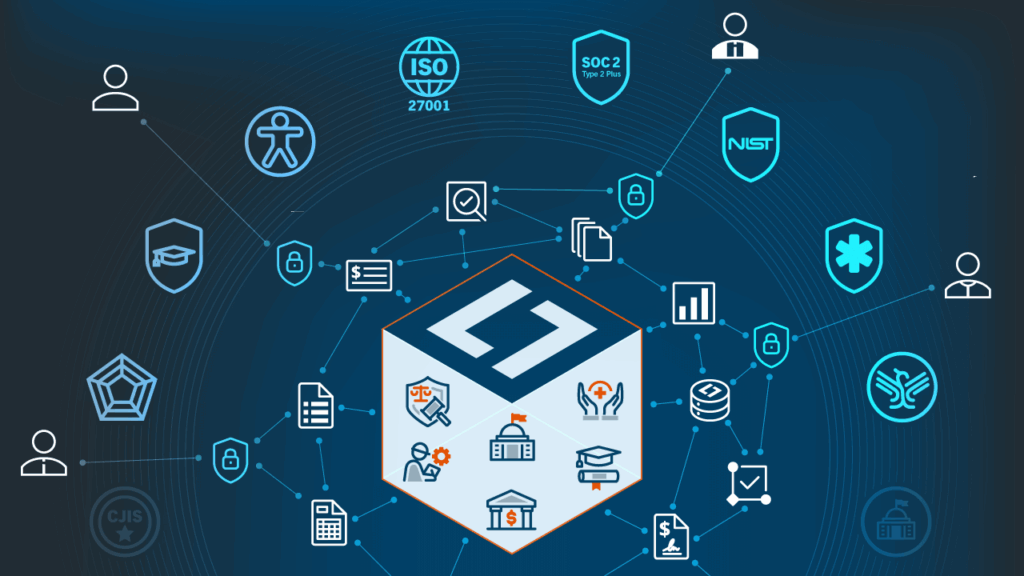
Regional data privacy requirements
Laserfiche AI addresses privacy and security standards of our current data center locations supporting GDPR (EU), CCPA/CPRA (USA), and PIPEDA (Canada) for low to moderate risk data. Our AI features are architected to support regional and industry-specific compliance needs, providing the same level of data sovereignty and protection you expect from Laserfiche Cloud.
For more information related to Laserfiche AI and data privacy, refer to the following:
- Laserfiche Privacy Notice
- OpenAI Security & Privacy
You own your data
- You retain ownership of inputs you provide. While Laserfiche owns the intellectual property rights to the outputs generated by our AI tools, we grant you a broad license to use those outputs for any of your organization’s internal business needs.
- Laserfiche does not use your organization’s data to train any internal or external AI models. Your data is used only as needed to deliver services and to meet our legal and regulatory obligations.
Laserfiche AI user prompts
Laserfiche designs its AI features with safety and security as core principles. We manage prompting risks through two layers of protection:
- Prompt-less by design: Many Laserfiche AI features, such as Document Summarization, do not use user prompts, reducing risks associated with accidental or malicious prompting.
- Enterprise-grade safeguards: For features that do accept user input, like Smart Fields and Smart Chat, we employ industry-standard protections against prompt injection. These include input filtering, validation, and other controls that keep prompts and responses within defined, limited boundaries.
Content confidentiality
Your confidential content is not accessible to other customers or unauthorized third parties. Laserfiche distinguishes between two types of data:
- Your confidential content: Laserfiche does not sell your data. Documents, files, and inputs you upload to Laserfiche are your own content.
- Usage and system data: Like most cloud providers, Laserfiche collects limited, high-level usage data (such as feature adoption and system performance metrics) to operate and improve the platform. This data is de-identified and does not include the contents of your documents or AI prompts.
Data retention
- OpenAI may store the prompts you enter or the responses you receive temporarily for up to 30 days to provide services and identify abuse. After 30 days, API inputs and outputs are removed from their systems, unless they are legally required to retain them. For more details, please refer to the OpenAI Services Agreement.

Security Controls
Below are some of the security controls Laserfiche software includes. If you have questions about a particular security solution or control, please contact us directly.
Single sign-on
Laserfiche Cloud supports single sign-on with Active Directory Federation Services (AD FS) and SAML authentication with identity providers such as Okta and Azure Active Directory.
Repository audit log
The Laserfiche Cloud repository audit log includes details of user actions, including viewing, modifying, creating and deleting documents, and similar operations on metadata and other repository objects.
Fine-grained access control
Administrators can use access rights to limit and control access to individual documents and objects. For example, security tags restrict access to documents on a document-by-document basis.
Intrusion detection
Laserfiche Cloud utilizes host-based intrusion detection systems to reduce the risk of data theft by individuals or organizations attempting to gain unauthorized access.
Access rights
Administrators can configure access rights and privileges to limit actions that users can perform across the repository based upon role assignments or group memberships.
AI governance
Laserfiche AI data is encrypted at rest (AES-256) and in transit (TLS 1.2+). Laserfiche does not utilize any of your data to train internal or external AI models.
Password policies
Laserfiche Cloud supports industry-standard password controls, such as password minimum length, complexity and history.
Penetration testing
Laserfiche engages third-party vendors to conduct external penetration testing of the Laserfiche Cloud system.
Vulnerability scanning
Laserfiche performs a vulnerability scan of backend servers that run in the Laserfiche Cloud hosting environment.
Firewalls
Laserfiche Cloud’s firewall configuration settings are regularly reviewed based on industry standards.
Repository application auditing
Laserfiche Cloud supports auditing of both access and modification of objects in repositories.
Enterprise Security
Securely modernize your business-critical work with Laserfiche Cloud.
Laserfiche Enterprise Security enhances security, resilience and governance capabilities for organizations managing sensitive, highly regulated data in Laserfiche Cloud.1 It provides FIPS 140-3 encryption2, privileged-user activity visibility, configurable session controls and multi-region disaster recovery with near real-time account-level replication.
Available to Laserfiche Cloud Business customers as an optional Add On, included with Business+ and offered for eligible Municipal Cloud packages.
Features
- Multi-region disaster recovery with near real-time repository replication
- Four-hour repository snapshots
- Enhanced user and privileged account monitoring
- Configurable security policies including inactivity session time out controls
- GovRAMP Verified and CJIS-ready
| Laserfiche Cloud Security Features | Professional Tier | Business Tier | Business+ Tier |
|---|---|---|---|
| AES‑256 Data Encryption | ✓ | ✓ | ✓ |
| Role‑Based Access Controls | ✓ | ✓ | ✓ |
| Single Sign‑On (SSO/SAML/AD FS) | ✓ | ✓ | ✓ |
| DDoS Protection | ✓ | ✓ | ✓ |
| Unauthorized AI Bot Prevention | ✓ | ✓ | ✓ |
| Administrative and Repository Auditing | ✓ | ✓ | ✓ |
| Configurable Inactivity Timeouts | ✓ | ✓ | ✓ |
| Advanced Audit Trail | Add On | ✓ | ✓ |
| FIPS 140-3 Cryptographic Modules | ✓ 3 | ✓ | |
| Four-Hour Repository Snapshots | ✓ | ✓ | |
| Multi-Region Disaster Recovery Support | ✓ | ✓ | |
| GovRAMP (Pending) | ✓ | ✓ |
- To ensure alignment with regulatory and operational needs, organizations should evaluate their use cases against the acceptable use restrictions in our Cloud Subscription Agreement before making a purchase. ↩︎
- Note: Enhanced encryption uses FIPS-compliant cryptographic algorithms (FIPS 140-3) that utilize up-to-date crypto routines approved by NIST and compiled to help prevent sophisticated attacks on underlying cryptographic algorithms. Enhanced encryption is available for the Laserfiche Cloud U.S. Region. ↩︎
- Items with an orange check-mark (“FIPS 140-3 Cryptographic Modules” and below) are available with the Enterprise Security Add On for Laserfiche Cloud Business customers, included with Business+ and offered for eligible Municipal Cloud packages. ↩︎

“Laserfiche’s compliance tools in the cloud, and knowing that Laserfiche takes security very seriously have been important factors in our decision making.”rn—Andrew McElrath, strategic project manager at Mille Lacs Corporate Ventures
Featured Success Story
Mille Lacs Corporate Ventures Transitions Corporate Operations to Laserfiche Cloud
Mille Lacs Corporate Ventures (MLCV), created by the tribal government of the Mille Lacs Band of Ojibwe, manages the business affairs of the Band.

Laserfiche is committed to privacy.
Our commitment
At Laserfiche, we have embraced a culture of privacy, which includes embedding privacy-by-design in our engineering efforts, and have implemented controls and policies throughout our organization. Laserfiche is a B2B company based in California. The State of California has passed strict, broad privacy regulation through the California Consumer Privacy Act (CCPA) and the California Privacy Rights Act (CPRA) while the General Data Protection Regulation (GDPR) leads the European Union’s privacy efforts. Many other countries, states and territories have implemented privacy regulations as well. Laserfiche endeavors to continually adapt and adhere to ever-evolving regulations that apply to its business.
Operational privacy
Operationally, we strive to keep our stakeholders’ data secure and retain only information we collect from you where we have an ongoing legitimate business need to do so, like providing you with a service you have requested, or to comply with applicable legal, tax or accounting requirements.
Privacy training
At Laserfiche, all employees are required to complete annual privacy training which covers applicable privacy regulations and data handling best practices.
Laserfiche documentation
In addition to what we communicate in our Privacy Notice, our Cloud Subscription Agreement with accompanying Data Processing Addendum specific to the Laserfiche Cloud platform addresses data privacy regulations including GDPR, CCPA and PIPEDA.
International transfers
For personal data transferred from the United Kingdom, the European Union and Switzerland, we provide appropriate safeguards per the Data Privacy Framework. To learn more, visit the “International Transfers” section of the Privacy Notice.
Information we collect
We collect information that you provide directly to us only for legitimate business purposes. For example, when you manage your user profile, participate in interactive features (such as the Contact Us page), request newsletters or other marketing communications, request customer support, enter login information, or otherwise communicate with us. To learn more visit the “Information We Collect” section of the Privacy Notice.
You have the right to opt-out of marketing communications we send you at any time. You can exercise this right by clicking on the “unsubscribe” or “opt-out” link in the marketing emails we send you. To learn more, visit the “How Laserfiche Uses and Shares the Information We Collect” section of the Privacy Notice.
To read our complete Privacy Notice, visit our Privacy Notice page.
Contact Us for Your ECM Needs
Whether you have product questions, support needs or want to partner with us, we’re here to help you on your digital transformation journey. Fill out the form and a Laserfiche team member will be in touch as soon as possible.