This summit brings together IT leaders looking to redefine what’s possible. From scaling AI, simplifying infrastructure to unlocking data-driven decisions and leading with empathy, you’ll explore how to drive meaningful change across people, platforms, and performance – while keeping your organization resilient, agile, and ready for what’s next.
The ALB Regulatory Summit event series is dedicated to providing a forum for regional and global regulatory bodies and policymakers across industries with an emphasis on the financial services industry across the Asia-Pacific region.
Over the past few years, government agencies, counties and municipalities have accelerated modernization efforts through digitization and, in 2026, that momentum will only grow. The year ahead will usher in an automation-first era, where AI and intelligent content management play a central role in advancing transformation efforts and strengthening public trust.
By unifying fragmented data, addressing ghost content and embedding compliance-by-design, agencies can shift from reactive recordkeeping to proactive, transparent and data-driven governance. Below are three key predictions for the year ahead.
1. Automation-first will become the new standard for state and local government
In 2026, government agencies will begin looking at digitization more holistically. they will become the standard operating model for content management, with AI continuously identifying and classifying ghost content across legacy and siloed systems.
Agencies will leverage AI-powered content management to continuously identify and classify ghost content buried across legacy or disconnected systems.
If the Department of Transportation were to find thousands of outdated project plans across multiple servers, the agency could use AI-led classification and low-code automation to instantly identify expired records, archive them based on retention policies and highlight pertinent data sets. By surfacing this ghost content and connecting once isolated systems, agencies will reclaim valuable storage, reduce compliance risks and accelerate modernization.
Automation can connect agencies beyond just IT departments, enabling processes that routinely classify, clean and govern data at scale. This enables leaders to make decisions based on the full scope of trusted, actionable information while illuminating any duplicate or hidden content.
2. Trust-centered AI will transform records from static archives into living intelligence
A recent survey found 50% of Americans felt “uncomfortable” with AI use in government services while 59% believed the technology would aid in efficiently serving residents. The public knows AI will streamline their experiences with government agencies but need transparency in these tactics to gain trust.
In 2026, I see AI shifting from a back-office productivity tool to a front-line intelligence partner providing both efficiency gains and transparency to cultivate trust with constituents. For example, agencies can use AI-driven content management to classify sensitive documents, respond to Freedom of Information Act (FOIA) requests faster and strengthen audit-ready compliance with greater transparency.
Instead of relying on AI as a black box, trust-by-default systems will combine human oversight with explainable AI to ensure decisions made from historical and real-time data are verifiable and equitable. AI tools used in allocating public resources will provide audit trails and reasoning to uphold public accountability. As a result, AI will become a force for accountability and clarity, turning decades of ghost content into a foundation for public confidence.
3. Interoperability and compliance-by-design will bridge the data divide
Inconsistent compliance and fragmented systems are some of the most significant barriers to seamless government services. In the year ahead, interoperability will be less centered around the movement of data between platforms and more about consistent governance.
AI-driven content management will aid in unifying information from multiple systems while automatically enforcing retention, security and compliance policies. As an example, a justice agency might manage records across law enforcement, courts and corrections. With embedded governance, sensitive data can be identified early, content will be consistently categorized and frameworks like those of the Criminal Justice Information Services (CJIS) and National Institute of Standards and Technology (NIST) can be applied in real time.
A compliance-by-design approach reduces risk without hindering work. Embedded controls and audit trails will make governance automatic, while open APIs give organizations the opportunity to connect aging systems with modern, cloud-secure platforms. All of this will enable more rapid service delivery and increased transparency while maintaining the level of governance expected by the public.
Building a Smarter, More Resilient Government
Agencies that align automation, AI and governance will move beyond record management, to governing intelligence, enabling better decisions, stronger accountability and greater public trust. This shift is already underway, and the next chapter of government modernization will be defined by how well agencies turn information into insights.
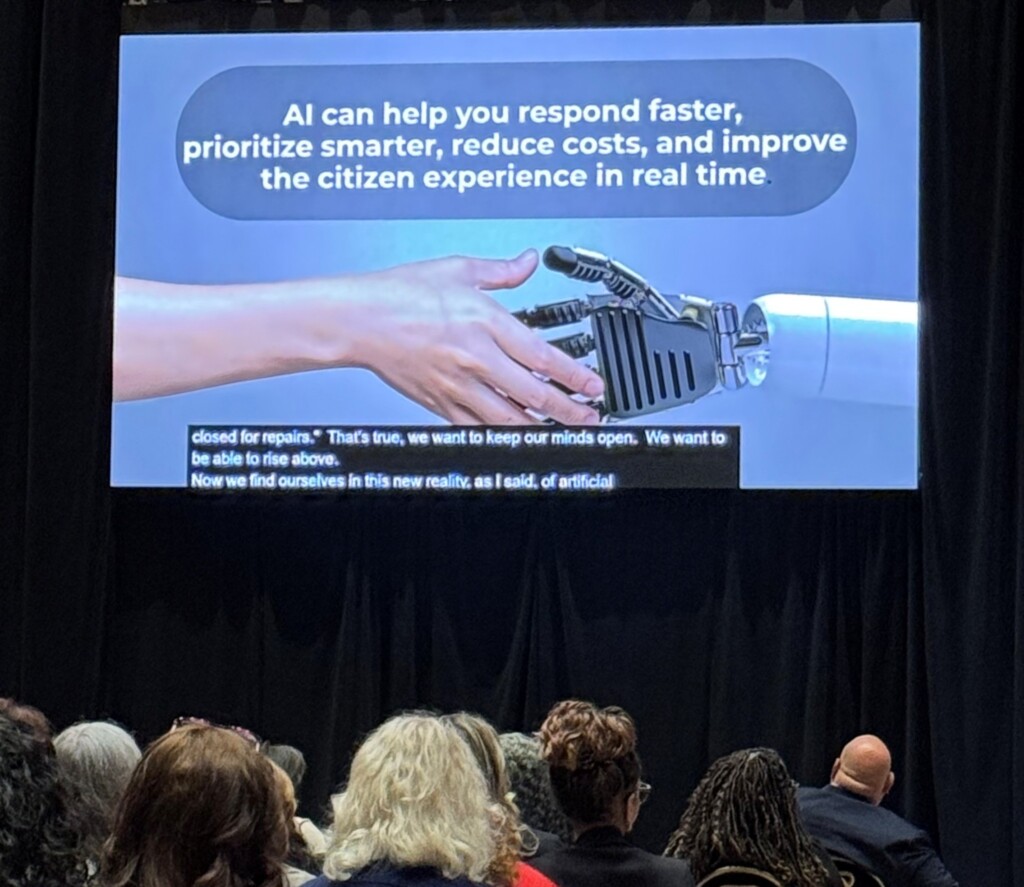
During National Data Privacy Week, Laserfiche attended Public Sector Network’s latest Government Innovation Showcase in Sacramento, California to discuss California’s Digital Future. Californians dedicated to data, AI and IT modernization discussed best practices in implementing technology, ensuring data security and leading IT modernization projects to drive efficient, future-ready infrastructure.
Laserfiche was part of the Technology, Data and AI Integration track discussing AI’s impact on digital transformation and how to leverage AI to transform government operations and public safety. Laserfiche also hosted a roundtable on modernizing government with AI without losing governance. Through the event’s keynotes and panels, attendees gained practical strategies for modernizing infrastructure, improving data-driven decision-making and driving innovation in public agencies, with one clear theme standing out: Innovation in government only succeeds when it is grounded in trust. Trust in data, trust in decision-making, and trust that new technologies are being applied with clear accountability.
California’s Investing in a Future That is Smart, Inclusive and Citizen-Centric
California continues to lead in using AI to advance digital government. The state is home to 32 of Forbes’s top 50 AI companies worldwide. Additionally, “California leads U.S. demand for AI talent,” according to the press office of Governor Gavin Newsom. “In 2024, 15.7% of all U.S. AI job postings were in California — #1 by state, well ahead of Texas (8.8%) and New York (5.8%), per the 2025 Stanford AI Index.”
With billions allocated toward modernizing critical infrastructure and enhancing data-driven programs, the state is committed to delivering faster services to its more than 39+ million residents. The showcase demonstrated the ethos Governor Newsom invoked when he said:
California has proven that we can establish regulations to protect our communities while also ensuring that the growing AI industry continues to thrive. This legislation strikes that balance. AI is the new frontier in innovation, and California is not only here for it — but stands strong as a national leader by enacting the first-in-the-nation frontier AI safety legislation that builds public trust as this emerging technology rapidly evolves.
From reimagining service delivery in health and human services to advancing climate resilience and equitable access, California is setting the pace for what modern governance looks like. AI-powered tools like Laserfiche are helping the state improve citizen outcomes, foster interagency collaboration and meet California’s urgent challenges today and in the future.
AI is the future and California companies are leading.
In Sacramento, several conversations reflected a shared concern for agencies today: the pressure to adopt AI quickly, balanced against the responsibility to ensure transparency, security and public confidence. The answer was not to avoid AI altogether, but to strengthen AI governance. The keynote reiterated this strategic insight.
AI vs. AI: California’s New Frontier in Innovation, Building Trust and Defending the Digital State
Thea Man, chief information security officer, Office of Data and Innovation, presented the keynote of the day centered on California’s innovative future built on trust.
The message?
California is one of the world’s most targeted cyber battlegrounds. AI now operates on both sides of the security equation — accelerating discovery and defense, while enabling new forms of automated cyber-attacks. The result is a digital future where speed, adaptability and foresight define success.
In the era of AI vs. AI, California’s next leadership challenge is clear: to ensure AI not only powers progress, but protects the state from adversaries.
The session, and much of the discussion of the day, was on how California can use AI to outpace AI-driven threats to innovate and protect us in the digital future. Key highlights included how AI can power the next generation of cyber defense across critical sectors and why ethics, transparency and public trust will define the future of AI-enabled governance.
Modernizing Government with AI — Without Losing Governance
During a roundtable I facilitated with department leaders, the conversation moved beyond theory to lived experience with a discussion on the realities of responsible AI in practice. Beyond tools and pilots, AI now impacts day-to-day operations.
AI is already present in government, whether through sanctioned initiatives or informal use by individuals trying to work more efficiently. Participants agreed avoiding AI altogether does not prevent risk — it often increases it by pushing experimentation outside established controls. Participants agreed that a proactive governance approach is essential to maintaining public trust.
Several shared how uncertainty at the executive level unintentionally slowed formal AI efforts, creating space for unsanctioned projects to emerge. In contrast, agencies making progress described taking a measured path — defining clear guardrails around what data could be used, how it would be applied, who could access it, and how outcomes would be evaluated. Governance, in these cases, was not a constraint but a confidence-builder.
Another key insight was that AI adoption does not need to look the same across agencies and departments. Participants emphasized the importance of aligning AI capabilities to mission needs and organizational maturity, rather than pursuing sophistication for its own sake. Governance frameworks helped agencies right-size their approach while preserving consistency and accountability.
Two success factors surfaced repeatedly:
Trusted data: Agencies that had moved forward successfully invested early in establishing confidence in their information through clear policies, records management practices and shared evaluation criteria before introducing AI into workflows.
A people-first approach: One agency shared a lesson learned after realizing that while its data and policies were trusted, its initial AI deployment failed to reflect how staff actually interpreted and used information. By incorporating end users into the development process, the agency was able to course-correct and improve adoption.
The roundtable reinforced that AI in government is not solely a technical challenge. It is a governance and leadership discipline — one that depends equally on trusted data, clear oversight and meaningful human involvement.
The birthplace of AI: Governance and Trust in California
The event united government leaders, technology experts and industry partners across the Golden State to explore how data, AI innovation and secure digital tools can strengthen service delivery while building public trust. Our roundtable had leaders express the importance of involving the people who use data and interpret information daily. This ensures AI systems reflect real operational language and workflows rather than policy assumptions alone.
The takeaway for government leaders was clear: Successful AI adoption is defined by discipline — building governance, trust and human context into systems before scaling them.
New intelligent features automatically organize and classify documents, transforming how organizations manage information at scale.
LONG BEACH, CALIFORNIA, Jan. 28, 2026 – Laserfiche — the leading SaaS provider of intelligent content management — today announced major enhancements to its AI-powered data extraction tool, Smart Fields. The update introduces automated document classification and tagging, allowing organizations to move from unstructured content to informed decisions in seconds.
Using natural language prompts instead of rigid, ruled-based OCR, Smart Fields can now identify document type — such as invoices, taxpayer identification forms, or student transcripts — and automatically apply the correct metadata template using AI. Users can also use Smart Fields to automatically add informational and security tags to files that meet certain criteria, defined using a natural language prompt. Users can capture key details, route documents, and apply the proper metadata tags instantly and at scale.
“Success in today’s AI-driven landscape is defined by speed to insight,” said Michael Allen, chief technology officer at Laserfiche. “By using AI in Laserfiche content management, we are transforming organizations’ digital repositories into active engines for business intelligence. Smart Fields allows users to bypass the friction of manual data entry, saving time for more high-value decision-making.”
Redefining Document Capture for the AI Era
Traditional capture methods often require specialized technical knowledge and complex configuration. Laserfiche Smart Fields, first launched in 2025, eliminates this barrier by allowing users to describe the data they need using natural language. Key updates include:
Automatic classification: Smart Fields recognizes document types and matches them to the appropriate template.
Intelligent auto-tagging: Administrators define tags once, and the Smart Fields applies them during ingestion to help organizations with consistent security and findability.
Smart Fields has helped customers capture metadata from content such as financial documents, vendor forms and legal contracts, cutting document management processes down from months to seconds. These enhancements reduce operational overhead and human error, and support enterprise-wide data consistency while freeing up technical resources.
Key benefits include:
Automated organization: Smart Fields eliminates manual sorting by classifying documents on entry.
Dynamic security controls: Auto-tagging supports both informational and security classifications, enabling organizations to automatically protect sensitive content.
Simplified automation: Classification data can trigger workflows, like approvals or retention schedules, without complex coding.
“The true value of AI in the enterprise is its ability to shed light on dark data, or what Laserfiche calls ‘ghost content,’” said Andrea Malick, principal advisory director at Info-Tech Research Group. “By automating the foundational work of document organization, organizations can finally bridge the gap between content silos and actionable insights, making sure that information is not just stored, but systematically ready for the AI era.”
For More Information
Learn more about Laserfiche’s AI-powered document management capabilities at laserfiche.com/products/ai.
Explore insights into automation, document management and digital transformation in AI era by downloading the Laserfiche report, “The State of Document Management and AI.”
Find out more about ghost content and how it impacts your data strategy in the Laserfiche Blog.
About Laserfiche Laserfiche is the leading enterprise platform that helps organizations digitally transform operations and manage their content with AI-powered solutions. Through scalable workflows, customizable forms, no-code templates and AI-enabled capabilities, the Laserfiche® document management platform accelerates how business gets done. Trusted by organizations of all sizes — from startups to Fortune 500 enterprises — Laserfiche empowers teams to boost productivity, foster collaboration, and deliver a superior customer experience at scale. Headquartered in Long Beach, California, Laserfiche operates globally, with offices across North America, Europe and Asia.
GITEX GLOBAL in 2026 launches into an entirely new dimension. A show already unmatched in scale and influence is being reimagined with new energy, new dates, and an iconic new home.
During our time at Insurtech Insights Asia 2025, Asia’s largest insurance conference, it became clear insurers are stepping into a new era — one where data, content and AI shape how they work and grow. The next step in digital transformation is here: it’s time to move past proof-of-concept projects and implement and adopt AI enterprise-wide.
Gen AI and agentic AI are reshaping the entire value chain — including claims processing, underwriting, policyholder onboarding, policy services, and more. Leaders at the event were clear: to keep up with policyholder expectations and stay competitive, the industry needs connected data, processes and systems.
Debrief: The Top 4 Challenges Facing Insurers
Across keynote sessions and conversations, several challenges stood out. These are no isolated problems — they affect the entire business:
Silosthat hinder data accuracy and accessibility across the value chain.
Manual or unsophisticated workflows that slow productivity, delay processing times and increase operational risk.
Growing compliance and audit pressures with evolving HKIA (Hong Kong Insurance Authority) and regional regulatory changes.
Demands from policyholders for instant, digital experiences.
These challenges showcase the rising expectations from policyholder, regulators and the market.
Laserfiche’s latest survey reflects this wider shift across the industry: • 80% of organizations are focused on automating manual processes • 48% want smoother data flow through system integrations
This growing push toward automation and integration is driving insurers to rethink how they manage data across the enterprise — which brings us to one of the biggest barriers: ghost content.
The True Barrier in Digital Transformation: Ghost Content
As more services than ever are digitized, a major issue — ghost content: the unstructured data hidden inside claims files, medical records, policy documents, scanned forms, handwritten notes, and more.
This creates downstream consequences:
Longer processing times and delayed service
Inconsistent decisions due to lack of complete information
Higher compliance and audit risk
Without solving the ghost content problem, digital transformation becomes much harder — and AI cannot reach its full potential.
The AI Shift: From Paperwork to Enterprise Content Management
What was apparent in all of our conversations at Insurtech Insights, modern companies require modern solutions and are looking how AI can improve the entire flow of information management. Laserfiche was on site to discuss how AI-driven content management is the essential solution to fix these modern challenges:
AI-driven data extraction, using Smart Fields, to turn unstructured data into usable, insightful data with a single click.
AI-powered summarization to get key information for claims adjusters, underwriters and servicing teams with Smart Chat intuitive interface.
Automated end-to-end workflows across first-notice-of-loss (FNOL), claims processing, onboarding and policy services to reduce manual work and increase accuracy.
Real-time data through integrations that consolidates policyholder information.
Compliance-ready data and records governance to support auditability and regulatory alignment.
The Importance of Leveraging AI
The message from Insurtech Insights Asia was clear: modernization is no longer about adopting point solutions — it’s about transforming the enterprise through:
Better policyholder experiences through hyper-personalized, digital services
Strategic alignment, so teams share real-time, accurate data
Operational efficiency through automation and integration
High-quality data to support AI models and decision making
Greater flexibility using low-code tools that allow teams to adjust processes without IT
The Main Takeaway from Insurtech Insights Asia 2025
Insurtech Insights attendees told us what they want – clear insights into their ghost content and strategic action – and looking for efficiency gains, long-term agility and scalable growth. By eliminating ghost content enterprise-wide, you can boost productivity, lower operational risk and open the door to new opportunities for growth.
Diseñada para proveedores de soluciones que comienzan a implementar y dar soporte a Laserfiche. Esta capacitación en vivo, práctica y dirigida por un instructor proporcionará las bases necesarias para diseñar con éxito una solución Laserfiche tanto en Laserfiche Cloud como en sistemas self-hosted. Los temas incluyen trabajo con el repositorio, captura de documentos e información, automatización de procesos y administración, todo mientras se destacan las potentes funciones nuevas de IA de Laserfiche.
Tenga en cuenta que esta capacitación es solamente para proveedores de soluciones.