In the modern enterprise, information is often compared to oil—a raw resource that is valuable only when refined. However, for many organizations, that “oil” has become a “swamp.” We are drowning in Ghost Content: the vast quantities of documents, emails, and data points that are stored daily, tucked away, and promptly forgotten. This hidden hoard isn’t just a storage cost; it’s a locked chest of insights and a potential compliance liability.
In a recent thought leadership webinar, experts from Info-Tech Research Group and Laserfiche sat down to discuss how artificial intelligence is finally providing the key to unlocking your data, moving organizations from digital clutter to operational clarity.
The New Information Landscape: Breaking Down Silos
For decades, IT departments have drawn a thick line between “Data” (structured numbers in databases) and “Content” (unstructured documents like PDFs and emails). According to the Info-Tech experts, those lines are officially dead.
AI doesn’t care about the format of your information. Whether it’s a row in a spreadsheet or a paragraph in a contract, modern AI agents see it all as Knowledge. To be “AI-ready,” organizations must stop managing these assets in silos. Integrating technology, architecture and governance teams is the first step toward a unified information strategy that is cost-effective and compliant.
Nysa Zaran, data and analytics director of research at Info-Tech, emphasizes the importance of this shift, saying, “One of the moves that we need to begin to make as organizations is to think more broadly about our information as a whole, our knowledge, our data and our content, and start thinking about how we can manage that and leverage that together.”
The Four Dimensions of AI
To understand how to leverage this technology, Zaran breaks AI into four core capabilities that are reshaping the workplace:
- Perception: The ability to interpret input, such as digitizing handwriting or transcribing speech.
- Natural Language Processing (NLP): Democratizing access to data by allowing users to interact with systems using human-like speech.
- Knowledge Representation: Providing context in complex environments and mapping how different pieces of information relate to one another.
- Generative AI: The ability to co-create new content based on existing organizational knowledge.
While some of these technologies have existed for years, their accessibility is what has changed. Tools that were once reserved for data scientists are now available at the fingertips of every office worker.
Tackling the “Content Swamp” with Principles
If you turn a powerful AI loose on a “content swamp”—a disorganized SharePoint or a messy file server—you won’t get insights; you’ll get amplified chaos. The experts suggest a principle-based approach to decide what information actually matters. Info-Tech proposes the “I-VALUE” framework. High-value information is:
- Irreplaceable
- Value-driving
- Authoritative
- Legally/Contractually relevant
- Unique
- Enabling to the organization
By establishing these principles, leadership can share the responsibility of data ownership across the company, rather than leaving it solely on the shoulders of the IT department.
Using AI to Prepare for AI
One of the biggest misconceptions in digital transformation is the idea that “we aren’t ready for AI because our data is too messy.” The Info-Tech team flips this script: You can use AI to clean your house.
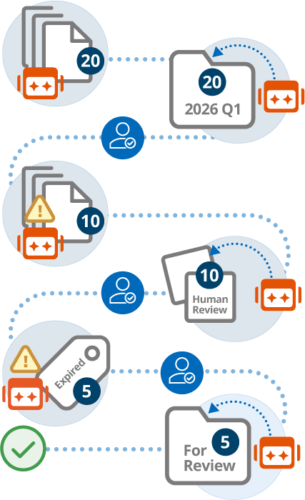
This is where AI-powered information management comes in. Instead of manual audits that take years, organizations are now using AI for auto-classification, metadata prediction, and deduplication. You can use AI to identify personally identifiable information (PII) at scale or to flag expiring vendor contracts that were previously hidden in the depths of your archives. In this way, AI isn’t just the end goal—it’s the janitor that helps you get there.
“Use your technology. It’s powerful,” said Andrea Malick, principal advisory director at Info-Tech. “Use it to its potential, and you’ll now be set up for emerging technology.”
The Path Forward: Strategy Over Hype
So, where should you start? The panel suggests a “strategic but practical” approach. You don’t need an “easy button”; you need a six-month roadmap.
- Identify High-Impact Use Cases: Don’t try to boil the ocean. Find one or two doable projects, like automating a construction foreman’s field notes or linking structured sales data with unstructured client emails to find new patterns.
- Focus on Literacy: Ensure your team understands what these tools are capable of and, more importantly, how to use them safely.
- Leverage Vendor Partners: Use platforms like Laserfiche that have already baked these AI capabilities into their ecosystem. From natural language extraction to AI agents that handle reasoning tasks, the tools to transform your “Ghost Content” into a competitive asset already exist.
Reclaim Control of Your Information Ecosystem
The shift from complex, fragmented data to clear, actionable intelligence isn’t just a technological upgrade; it’s a cultural one. By breaking down the barriers between data and content and using AI-powered information management to streamline governance, your organization can stop searching for information and start using it.
To learn more about how to unlock your organizations unstructured data and hear directly from Research Directors of Info-Tech Research Group, watch the full webinar.