


Joman Kwong, strategic solutions manager: financial services, on how credit unions can build a secure information-governance backbone.
SITUATION
• Capturing, routing and storing member information was manual and lacked consistency
• Operations needed to scale at a pace that aligned with the credit union’s growth trajectory
• The credit union sought a platform for automation that would integrate with existing tech stack
RESULTS
• All staff now use Laserfiche regularly in a variety of key processes
• Saved hundreds of hours each month
• Alleviated the burden of mergers as the credit union grows
“We address people’s needs and solve problems — it’s what credit unions do,” said Matthew Tingey, senior applications specialist at American United Federal Credit Union (FCU).
The philosophy has powered American United FCU since 1952, driving the organization’s growth to serve more than 26,000 people today. And along with that growth has come transformation, to create a single source of truth for records, integrate core technology systems and enable easier self-service for members.
“I was originally asking questions like, ‘Can I automate this? Can I batch process these things? Where can I take the annoying parts out of this process?’” said Tingey. “But it’s never good enough to solve my own problem. I need to solve problems for everyone in the organization. That’s where Laserfiche came in.”

The credit union now uses Laserfiche as its repository for member information, and the main workflow engine for automated processes across the organization, including finance, member relations, money movement and more, saving hundreds of hours each month and alleviating the burden of mergers as the organization continues to grow.
Centralizing and Standardizing Records Management
Like many growing organizations, American United FCU had information — including member documents, HR employee records, financial records and more — incoming from a multitude of channels, being handled in a variety of ways. Tingey, a dedicated credit union professional who has worked in every department across the organization, recognized a need to standardize archival of documents. At the same time, he saw an opportunity to automate information capture.
The credit union began using Laserfiche process automation to automate records management activities, routing documents to where they needed to be stored within the repository, with the needed metadata, no matter the source.
“We’ve processed multiple millions of documents through there,” said Tingey. “Employees just need to click, and it gets to where it needs to go.”
American United FCU, supported by Laserfiche solution provider Millennial Vision (MVi), has built out a Laserfiche program that also supports the organization’s total quality management initiative, which aims to improve processes with an eye toward growth and profitability.
“These tools help us do things more efficiently, bridge the gap between some of our other software tools, and let our teams work in better collaboration. They really solve a lot of problems.”
With the initial solution in place, it was time to connect other systems to eliminate human error and make the repetitive tasks around document capture and storage even easier.
“From there, I wanted Laserfiche to talk back to our core [account system] to verify the information being captured,” Tingey said. “Now, it’s not just member documents that we’re processing through the system but applications, loan documents, and other daily work. The process has expanded and grown. It’s the single source of truth, and really the backbone of our process automation.”
Connecting the Dots: Automating Processes Across the Organization
In addition to having Laserfiche verify information from the organization’s core, CUProdigy, the credit union has a number of integrations that support a more seamless everyday work experience for employees.

“We’ve also built a large database of information that we want to track and report on in Microsoft Power BI, and Laserfiche plays a big role in that,” Tingey said, adding that he keeps track of data issues — caused by activities like an employee leaving the organization, for example — through daily reports. “Laserfiche is a big part of managing the data that is used to create those Power BI reports.”
Similarly, Tingey has transformed the way that the organization validates data, identifying potential issues through Forms processes (started by Laserfiche Workflow) that trigger when an issue occurs. These items were previously actively tracked by an employee on a continual basis; today, no one needs to remember to review the reports since processes are triggered in Forms when issues occur — plus, instructions are integrated into the form so that less training and individual knowledge is required to address them.
“More recently, we’ve added some API integrations with the core to this process,” Tingey explained. “We pull information out of CUProdigy to use in Laserfiche Workflow and Forms via database queries. Notes can be pushed back to accounts with a click of a button in a form. A couple of the items that instructed the user to fix an issue can now be resolved automatically via the API without human intervention. These data validations and the automation around them have allowed our QA to be more efficient, effective and consistent.”
One game-changing integration for the credit union was between Laserfiche and DocuSign, which allowed Tingey to automate a common activity for credit unions: member information changes. The legacy process was manually driven and admittedly not very employee- or member-friendly.
The organization has enhanced the overall experience for employees and members by embedding the entire process into Laserfiche Forms:
- An employee pulls up the member information change form, which auto-populates the member’s information.
- The employee identifies what needs to be changed.
- If the member is in-branch, the member uses the signature pad.
- If the member is not in-branch, Laserfiche interacts with the DocuSign API by sending information from Laserfiche Forms to DocuSign, and then to the member for signature.
- The employee attaches the signed document to the form and submits it in Laserfiche Forms.
- Laserfiche automatically routes the information to the relevant teams for review, approval, and task completion.
Similarly, the credit union’s wire transfer process has benefited from Laserfiche Forms and an integration with DocuSign.
“In terms of solutions, I borrow from myself,” Tingey said, explaining that he’s often able to build on successes by taking a process and repurposing it by making tweaks to forms or steps.
The legacy wire transfer process, which involved many manual activities performed by employees, left members and auditors with little visibility into the required steps. The new Laserfiche process, however, gives the credit union the ability to provide helpful context to the member about what they are signing and the wire disclosure via the DocuSign integration.
“Once complete, employees only need to click a button to attach it to the form, and processing of the wire in our core is done via API, with minimal tasks required by the employee,” Tingey said. The form is automatically routed to the necessary employees for review and processing, and all supporting documentation is archived in the Laserfiche repository with standard naming conventions and metadata.
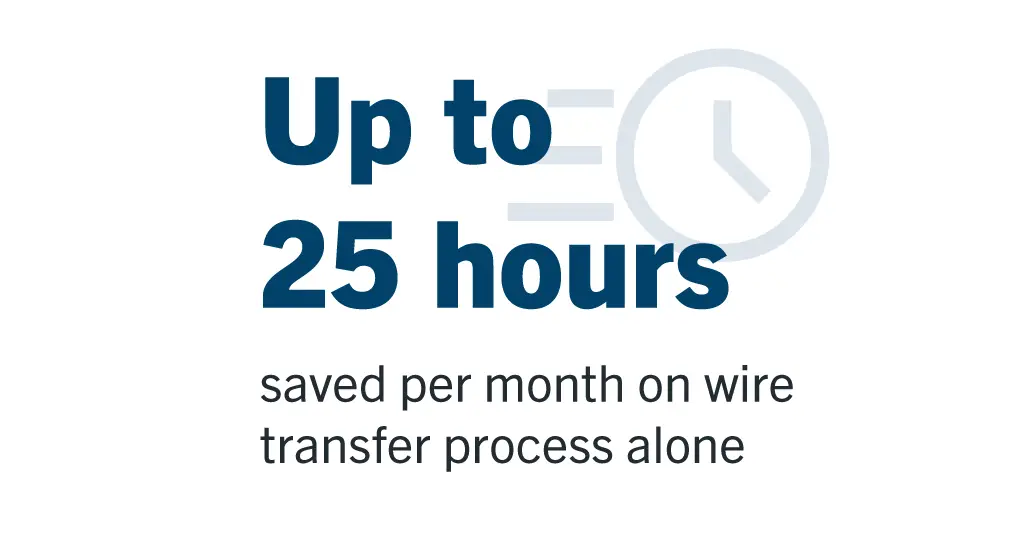
The new wire transfer process saves up to 25 hours of staff processing time per month, while also reducing opportunities for human error and increasing staff satisfaction.
“We’ve taken all the annoying little parts out of the process, like downloading a PDF, uploading it to DocuSign, marking fields on it, manually sending it to the member, downloading it again, etc.” said Tingey. “Another benefit is that when the member is prompted for signature, information will pop up to tell them exactly what they’re doing. It will let them know we’re doing a change of information process and here’s that we’re changing, or a wire transfer and here’s our wire disclosure. So instead of just signing something because they’re being asked to sign something, members feel more informed and taken care of.”
Transforming the Member Experience
Since the initial implementation of Laserfiche for process automation, American United FCU has had a lot of success automating back-office activities as well as some member processes that employees handle. Going beyond the back office to positively impact the member experience has always been the ultimate goal, however.
“These automated processes are all increasing member satisfaction,” Tingey said. “Whether our members are in-branch or doing things remotely, they are saving time and don’t have to wait for a teller to manually find all the documents they need to get things done.”
Today, Tingey is focused on transforming the member experience with the launch of a new website, which will feature enhanced self-service features powered by Laserfiche Forms. One such feature is the rewards claim request, which enables members to claim an end-of-year dividend that the credit union offers as a perk for members based on the products and services they’ve used throughout the year. The claim form lists all of the possible products and services that qualify for a reward amount, and the member enters a few details to verify themselves. The form verifies this information against the database to qualify the submission, and a Laserfiche workflow sends an email confirmation, recording all activities into a database so that rewards can be paid out at the end of the year.
Laserfiche digitization and automation projects have supported increased focus on the member experience, even through significant periods of growth for the credit union. Since 2007, the organization has completed 10 mergers, enabling asset growth from about $39 million to just over $370 million (as of April 27, 2023).
While mergers are always a huge undertaking, the process was made less painful with standardized and automated processes in place. “Mergers are very, very large projects — everything gets dumped into a central location, and there’s cleanup and moving things around,” said Tingey. “If it weren’t for the structure from Laserfiche and the tools like Workflows, they would be nearly impossible.”
Laserfiche has become such a vital part of American United FCU’s infrastructure that many employees aren’t able to imagine life without it today.
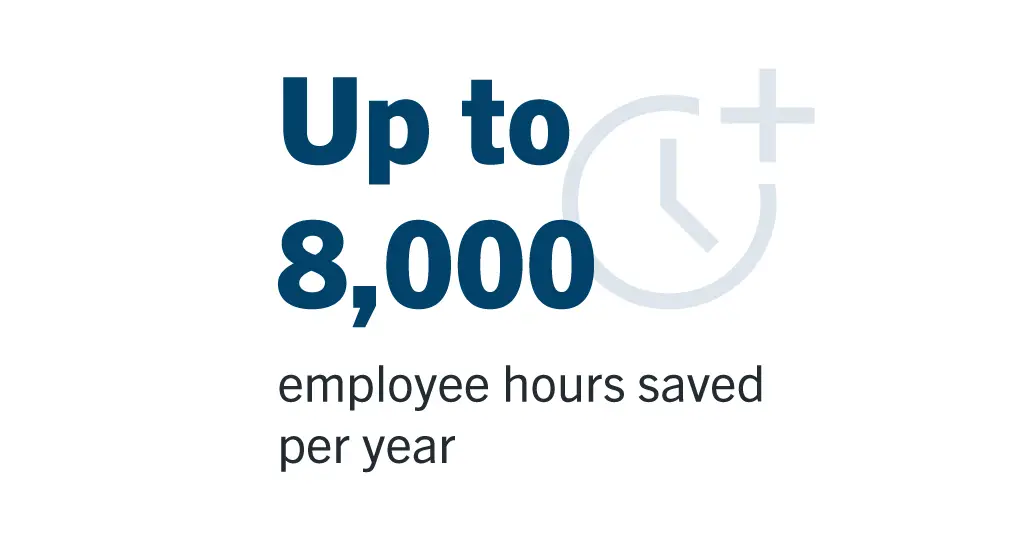
“Laserfiche is a cornerstone of our environment. The automation functionalities alone save us thousands of hours annually, but on top of that it helps us in so many ways to gather, process, and document nearly every piece of information that passes through our organization. There isn’t a single member of our team that doesn’t interact with Laserfiche, and most of them are working with the system throughout the day, every day.”
Insurance Solutions

Claims
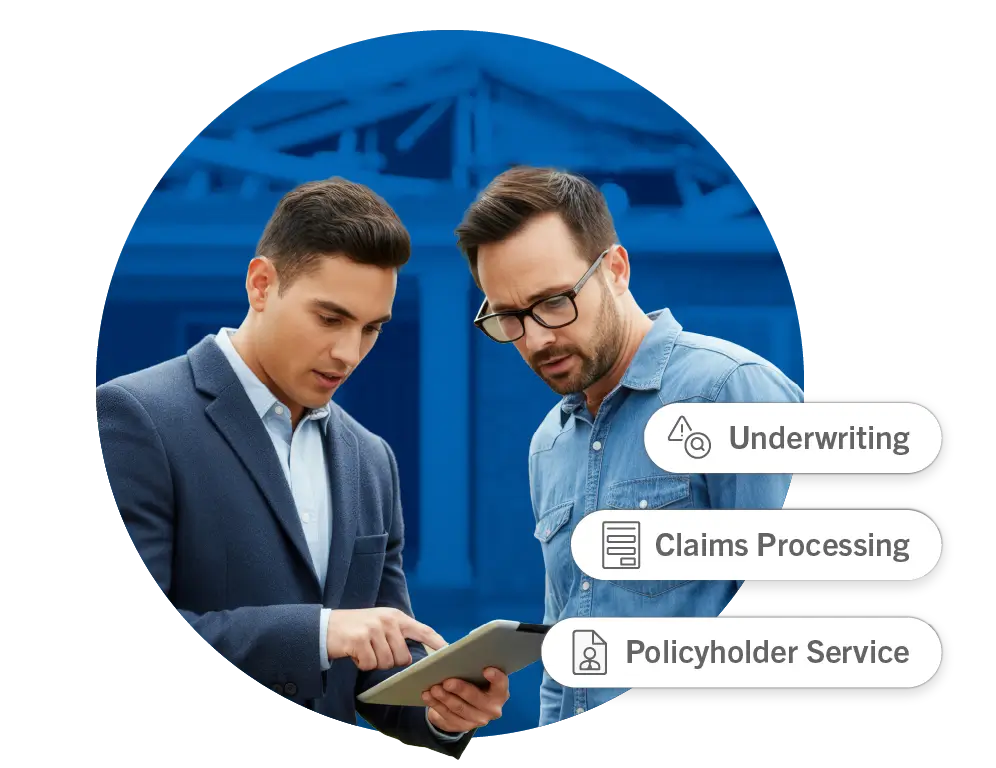
Close more claims, faster, by automating the claims journey. Accelerate claims review and approval with low-code process automation tools.

Underwriting
Drive more accurate risk assessment by giving underwriters centralized access to applications, medical records, financial statements and other content.

Policy Administration
Provide faster, more tailored service by giving policy administrators core policy and customer data at their fingertips.

Policyholder Service
Create a 24/7 self-service portal to give policyholders instant access to service requests, documents and claims history.

Claims Processing
Digitize FNOL submissions to expedite claims. Laserfiche automates the claims journey and provides insights into common claims and adjuster workloads.

Underwriting and Risk Assessment
Expedite underwriting assessments by centralizing information and automating document routing, data extraction and task assignment.

“With Laserfiche processes, we have the ability to increase throughput. We’re able to facilitate growth without having to hire more staff.”
— Chris Cooper, Senior Operations Analyst, CATIC
— Chris Cooper, Senior Operations Analyst, CATIC
Featured Success Story
CATIC Makes Processes Up to 90% More Efficient with Laserfiche
CATIC migrated content from a legacy document management system into Laserfiche, resulting in over $325,000 annual cost savings and creating up to…
Motion Picture Industry Pension & Health Plans (MPI)
MPI was able to continue serving its members through one of the longest writers and actors strikes in entertainment industry history.
Hear from insurance leaders
See more success storiesFrom analysts and customers


Featured Resource
Unlock the power of data
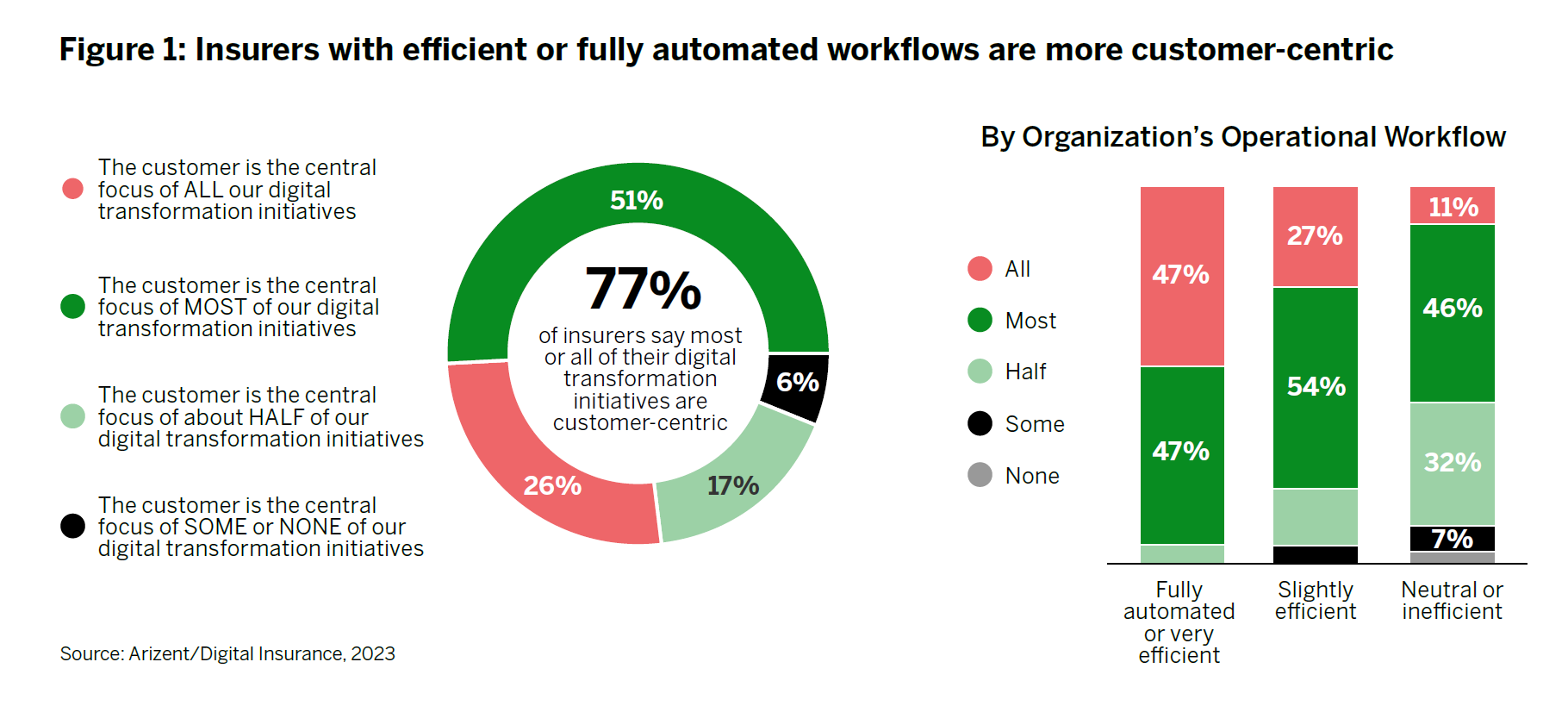
Over 50% of insurers cite data fragmentation as their top operational challenge. Find out how to transform data from an obstacle into your competitive edge.

6 Ways the Right Records Management Solution Can Streamline Financial Services Operations
Blog
Learn More



Contact Us for Your ECM Needs
Whether you have product questions, support needs or want to partner with us, we’re here to help you on your digital transformation journey. Fill out the form and a Laserfiche team member will be in touch as soon as possible.
The City of Santa Monica, California, leverages Laserfiche to provide better services at a lower cost and with lower friction to constituents.
Transcript
Santa Monica is a city of 8.3 square miles. 93,000 residents and about 1800 staff members. We’re a full service city. We have our own utilities, our police, fire traffic, even our federal airport. First, we got a great beach and we have a lot of technology, a very complex environment with probably over 300 applications that we utilize. So I came to the city about five years ago.
Laserfiche was already in our environment. I saw an Opportunity to leverage tools like Laserfiche more extensively to help digitize our environment. And the game changer for us was when Laserfiche came to us and talks about an integration with DocuSign. And so we implemented that. One of the big benefits is that it’s in sustainability.
We no longer use as much paper as it. And in the past three and a half years, we estimated you’d saved over 180000 hours staff time. That integration when the pandemic hit, we had to quickly and become a virtual workplace. We had made the city workforce completely mobile with technology. We had created a user experience that was the same whether you were virtually working or face to face on site.
And we had done all this not because we were anticipating a pandemic We did it because we wanted to enable flexibility and Work-Life Balance for our staff. What we were able to do very quickly was to pivot and have 80% of our staff teleworking with all the tools they needed in 36 hours. Part of that was we had workflows already in place which utilized these Most people don’t think of government as being frictionless.
This matter of fact, most people consider the government a main source of friction But why does it have to be that way? Can we see a way to provide better services at a lower friction, at a lower cost to our constituents? If we can use the same tools that any other organization uses, it’s just thinking about things different.
I see Laserfiche as one of our key platforms that we can leverage and simplify our environment, but also give us greater capability within one system to do more. I’m Joseph Cevetello, and I’m using Laserfiche to empower the people of Santa Monica.
Hudson County Community College automates and accelerates business processes while enabling access for students and staff to information from anywhere.
Transcript
Hudson County Community College is located in Jersey City, New Jersey, right across the water from New York City. Serves about 8000 students a year with about 600 staff and family members. They have an award winning library and a nationally ranked culinary program with amazing kitchens set up for students and the chefs. The school experience with Laserfiche has been a breath of fresh air.
Currently, Hudson’s using it on a few different areas. The biggest area is financially because students submit a lot of documents for financial aid. So the financial aid office, we really focused on getting up and running right away. And then we branch branched out to COVID vaccination tracking for employees and staff. Hudson wanted to track employees and staff that and received the COVID vaccination and reached out to Trisha for ways to be able to track that and attach it to records to make it easier for everyone, not just submitting it, but having to track it.
And Laserfiche was the first response, one for security purposes and confidentiality for those submitting it, and then ease of use So reached out and we had that up and running in a week and a half and we rolled it out to users, adding the participants emailed them and it went into the repository and got access. And so far it’s been a pretty seamless process with them being able to connect it to people’s records.
Enter the information in colleague and information system and then look up if there are any issues. So it’s been a great resource having that ability for them to submit the vaccination forms and see it in college for human resources. The turnaround on this vaccination form was just incredibly fast from its perspective. I want you to be able to access what you need to from anywhere, and that’s totally possible with Laserfiche
So some of the challenges that Hudson has faced was obviously with the pandemic, the shift to remote workforce and the general use of paper and getting people away from that sort of area and being able to get people to understand how easy it is to use a paperless process so that as everyone returns to campus, we maintain that paperless process and keep moving forward.
Laserfiche is making the school more productive and more efficient, which helps in any departments, so we really appreciate that
The Bank of China uses Laserfiche to automate workflows, meet compliance requirements and take a modern approach to banking operations.
Transcript
The Bank of China as a group was founded in 1912 and is the second oldest bank that is still in existence. The bank is the fifth largest bank by capital in the world as of this year. And we are proud to be the most globally oriented. We have over 500 employees and our assets is over $50 billion. The bank started using Laserfiche over 10 years ago and at first, Laserfiche was used as solely a storage for old bank document files as a sort of a hard drive — it’s been over 10 years.
And when I first joined the bank about four years ago, I started looking more into the other services offered by Laserfiche and stumbled into Laserfiche’s offerings that were a lot more than just a repository for documentation management — more process management, workflow management. So that’s where I submitted the idea of paperless to the bank. We got rid of 90% of paper and also helped improve 30% of the manual work and more importantly, Laserfiche also help us meet a lot of regulatory compliance requirements.
My favorite part of Laserfiche I think is the people. Laserfiche helped the bank catch up about 15 years that we were lagging behind, especially when we are talking about paperless, you know, automating manual work. I’m Frank Chen and I’m using Laserfiche to empower Bank of China.
Explore additional insights on the Laserfiche banking solutions page: https://www.laserfiche.com/solutions/financial-services/banks-and-credit-unions/
Glasgow Credit Union is one of the largest credit unions in Europe, serving the greater Glasgow area with a service scope focusing on savings and loans. Experiencing steady growth, the organization used Laserfiche to power a number of digital transformation initiatives aimed at reducing reliance on manual processes and ensuring that the organization could scale while maintaining the high-quality customer experience for which the credit union is known.
The organization initially implemented Laserfiche in 2016 as a document management platform, integrating it with Glasgow’s CRM system to improve access to information for customers and employees. Since then, Laserfiche has helped achieve business process automation to digitize and streamline loan processing. With a completely automated lending platform, clients are offered more competitive lending services, enabling customers to complete loan approvals in under an hour.
“Laserfiche is quite central to all we do,” said Paul McFarlane, chief technology officer at Glasgow Credit Union.
Additionally, Glasgow Credit Union’s digital initiatives have supported business continuity during the COVID-19 pandemic, enabling the organization to rapidly pivot to more digitally focused services. This aligns with expansion and scalability needs: Since implementing Laserfiche, membership has expanded to around 55,000 customers, representing nearly GBP 200 million (US$277 million*) in assets.
A Customer-Focused, Streamlined Lending Process
Founded in 1989, Glasgow Credit Union has grown substantially over the past four decades but its aim has remained the same: helping members and ensuring they have access to friendly, professional financial services that meet their needs. As member expectations have evolved, the credit union has prioritized digital transformation to provide the best possible member experience.
“It’s not just us, but in our sector, we didn’t have a lot of scalability in a lot of our processes,” McFarlane said. “So our application journey, specifically to onboard a member and apply for a loan, was quite a cumbersome process because it was paper-heavy and there was a lot of manual tasks. … There was no automation. Initially there were no web services as well.”
Using Laserfiche, the organization created an automated lending platform which digitized and centralized loan applications, increasing accessibility of information for staff; and ultimately accelerated loan processing for clients. With the understanding that an easy and fast new member onboarding is fundamental to a member’s experience, the credit union also digitized and streamlined the member onboarding process by integrating Laserfiche with its existing financial management application, Curtains, along with DocuSign. New members can now join the credit union and apply for funds within 15 minutes — a process that used to take up to three days.
With an eye toward enhancing the full client experience, Glasgow Credit Union also launched an initiative to streamline the borrowing process. This required as fast a turnaround as possible for customer loans to be issued once their loan applications were accepted. Previously handling around 24,000 loan agreements each year, the company manually processed and archived 120,000 sheets of paper. Customers were manually notified by staff at each stage of the loan journey, resulting in 10,000 resource hours each year.
“The feedback from members was phenomenal — the speed, the efficiency, the fact that we didn’t have to wait for the post to deliver the paper, and how easy it was to do business with us after we had improved those processes,” said McFarlane.
The Glasgow Credit Union team re-engineered and automated the loan agreement process so that loans could be completed in under an hour rather than several days. Approximately 80% of applications were completed digitally prior to the pandemic. COVID-19 increased reliance on digital processes, however, and today, nearly all loan applications are now submitted and processed in a digital manner, benefiting both clients and staff in terms of efficiency and turnaround.
“Our work with Laserfiche wasn’t about preparing for something like COVID — I don’t think anybody was preparing for something like COVID,” McFarlane explained. “Our decision to digitalize was all about efficiency; it was about speed and providing a better, slicker service to our members. But if we hadn’t done that, it would have been a different conversation that we’re having today.”
Improving the Customer Journey
Digitization has also benefited Glasgow Credit Union members by providing the ability to initiate joining and borrowing processes even after office business hours. An automated self-serve channel allows the processes to be kicked off without staff supervision. After initiating an application process, Laserfiche integrations with third party applications — DocuSign, Curtains, and a bespoke front-end platform — seamlessly drive the loan application process through a workflow from the initial application stage to final pay out.
Documents are delivered back to customers for signing, bringing them to the next application stage. The automated process saves more than 150 employee hours each week. Employees have reclaimed this time to focus on other parts of the business, expanding operational capacity.
“We’ve got Laserfiche integrated with our core technologies, so users can view documents through our front-end that are pulled from the Laserfiche platform, without having to open up separate applications,” said McFarlane. “Employees find it quite easy that they’re not having to work across multiple platforms.”
Underlying Glasgow Credit Union’s integration and process automation initiatives, the organization has robust records management practices — a critical element to success in the financial services industry. Laserfiche has supported the organization’s information governance, enabling the credit union to manage the full life cycle of documents and supporting compliance with European data protection regulations.
During the first year after deploying Laserfiche, Glasgow Credit Union experienced an income growth exceeding GBP 1 million (US$1.31 million*), as well as a GBP 40 million (US$52.44 million*) increase in loan volumes from 2017 to 2018. Followed by this business growth, the credit union’s team now feels they have an infinite operational capacity for loan processing. After four years, Glasgow Credit Union has achieved ROI equating to their original investment in the Laserfiche platform. Factoring in resource savings and improved customer journey times, the credit union has a scalable model that has resulted in significant growth in business.
As a central, business-critical software solution, Laserfiche has helped Glasgow Credit Union with existing scalability and project prioritization goals, as well as helped to respond to customer needs during the COVID-19 pandemic. Beyond member onboarding and loan applications, the organization is looking to implement Laserfiche in a similar capacity in mortgage applications and other business units.
“I’m amazed at the simplicity of integrating Laserfiche with our existing processes and other pieces of business-critical technology,” said McFarlane. “Our vision is to be the lender of choice within our marketplace in Glasgow – Laserfiche has helped us achieve that.”
*USD conversion subject to current exchange rate.
Find out more about how Laserfiche helps to transform credit unions here.
Discover the benefits of Laserfiche with a Laserfiche demo today.
The Metropolitan St. Louis Sewer District (MSD) provides comprehensive wastewater and stormwater management services to over 1.3 million people in St. Louis and surrounding areas. In recent years, the organization transformed its document management processes and file sharing, transitioning to Laserfiche Cloud. Using solutions such as Laserfiche Direct Share, MSD modernized the internal and external user experience while increasing efficiency and supporting information governance. As a result of investing in a robust digital infrastructure, MSD also adapted quickly to the challenges of the COVID-19 pandemic, equipping employees with tools to work remotely.
“The ease of adoption has been accelerated because Laserfiche is so easy to use,” said John Daly, information governance manager at MSD. “You don’t have to be a records management information governance expert to succeed with it.”
Testing the Waters for a Digital Future
Since 1954, MSD’s mission has been to protect the public’s health, safety and water environment by responsibly providing wastewater and stormwater management. While its mission hasn’t changed, MSD has identified opportunities for improving operations, empowering its employees and delivering consistent, high-quality customer service.
As local governments, agencies and special districts grow in size and services, the ability to share information and collaborate while also maintaining information governance becomes increasingly important. MSD implemented Laserfiche Cloud to enhance information sharing both internally and externally, while facilitating regulatory compliance, safeguarding electronic records and simplifying records management with Laserfiche’s records management capabilities. Along with automatic updates and easy scalability, Laserfiche Cloud has streamlined document search and retrieval, allowing staff to perform more efficiently and improve the quality of information delivered to stakeholders.
“The biggest impact of MSD’s Laserfiche Cloud initiative has been on employee productivity,” said Daly. “The ability for staff in different departments to access documents organization-wide has saved countless hours previously spent on manually requesting and sharing files.”
As part of this digital transformation initiative, staff are able to preserve critical information dating back decades — in addition to streamlining document management, this increases accessibility of important content while enabling oversight across the organization.
The operational benefits adopting a Laserfiche Cloud system were especially clear during the COVID-19 pandemic, helping staff transition to working remotely and contributing to business resiliency during the major disruption. MSD was able to continue meeting customer needs and keep staff safe at the same time. “With a high level of agility, flexibility and scalability, we couldn’t be happier with Laserfiche Cloud and its role in our organization as a core business application,” added Daly.
Interoperability is also key to MSD’s Laserfiche Cloud system, which includes custom-built integrations with Outlook and DocuSign that facilitate approval processes and improve the user experience. Designed and implemented in partnership with Accelerated Information Systems, MSD’s Laserfiche solution provider, MSD staff can drag-and-drop email directly from Outlook into the Laserfiche repository. All relevant record retention schedules are automatically applied to these uploaded emails, and attachments appear in the file’s metadata just as they would within Outlook.
“It has been extraordinary working with John Daly and the MSD team on their digital transformation,” said Zaheer Master, president at Accelerated Information Systems. “Going from a small, self-hosted Laserfiche implementation to the limitless capabilities of Laserfiche Cloud enabled MSD to better serve their constituents, even while working remotely during COVID-19. As a premier Laserfiche Cloud provider, Accelerated is excited to work with John and MSD to continue to expand their Laserfiche solution.”
“Laserfiche has really opened our eyes to new possibilities we had not even considered before,” said Daly. “We have really noticed an improvement in our overall operations since developing these integrations to automating document management processes.”
A Transparent Pipeline of Content
In addition to addressing the needs of staff members, MSD reimagined the way staff could share documents with people outside of the organization. Rather than rely on traditional methods of information sharing that lacked trackability such as email, USB drives or discs, MSD deployed Laserfiche Direct Share, which allows users to share content from their Laserfiche repository with external customers or community members in an audited and tracked manner.
“Direct Share has been one of the most useful solutions for us at MSD,” said Daly. “For the first time in the history of our organization, we are able to send documents securely and safely, which is a huge game changer.”
MSD has found Direct Share particularly useful for the legal department, which frequently sends and receives large files, and benefits from the visibility and security measures Direct Share provides. MSD attorneys can password-protect links, set the amount of time that recipients can access the document, and manage and track sharing and downloading activities
“I don’t have attorneys calling me anymore, saying, ‘How can I get these case files to someone?’” Daly said. “My phone doesn’t ring as much because now they are using Direct Share to their benefit.”
A Clear Path for Digital Transformation
Using Laserfiche Cloud, MSD continues to modernize processes enterprise-wide to reimagine how employees, vendors and citizens interact with the organization. As part of its commitment to transparency, the district created a Laserfiche-powered public portal on its new website, which gives citizens frictionless access to public documents such as those related to environmental compliance, annual reports, budgets, diversity and more.
Additionally, MSD is working to deploy a number of Laserfiche electronic forms to digitally manage activities such as travel reimbursement, company vehicle requests, badge requests, and business card requests, with more in the works. By digitizing information, forms and processes, MSD is uncovering greater efficiencies while improving the experience for employees and citizens alike.
“For me it’s all about the customer — whether internal or external,” Daly said. “Every day we have the opportunity to make someone’s day better and meeting people’s needs. Every day I’m working, I’m asking what paper-based processes we currently have that could become digital. When customers and employees find information in seconds, rather than minutes, that’s providing us with real organizational value.”